Wednesday, April 05, 2006
Real Post to Follow
Back Monday from a wedding in Philadelphia. Real blog post as soon as I get done with taxes... In the mean time, via Chicagoist... How to have fun on the El.
Tuesday, March 28, 2006
Earth in the 21st Century
At first I was going to title this post "pictures from another world" or something like that. But it struck me that the pictures I was going to link to weren't from another world, really. What's more, they aren't from another time. They're this week's news.
I came across these when I clicked on a misfiled photo and found myself watching the slideshow labelled "Muslims Offended by Danish Cartoons" on Yahoo's news site.
There's a lot of ugly images in that slide show. Lots of pictures of burning flags of various nations, free speech protesters in London with the cartoons on their signs, protestors in Jakarta with banners saying Condoleezza Rice wasn't welcome, a dead Palestinian girl, victims of shootings by "suspected Islamic militants" in Thailand, funerals in Pakistan and India... Grenade wounds. Angry crowds. Blast sites. Tear gas. A picture from Guantanamo Bay.
But there are four that really struck me. They don't really have anything to do with the stories mentioned in their captions. They're just everyday scenes. And they're not from another world, and they're definitely not from another time.
A skyline
A man reading
Kids being lectured
A woman in the city
And then from the Afghanistan slideshow:
A kid with a kite
A cup of tea
The beginning of spring
(Here's another stunning picture of that and one of
women celebrating)
Of course, not all the pictures look like this. Some are ugly, like I said. And some just look like the kind of candid snapshots we all have in our albums. But some of them are magic, a kind of magic our culture doesn't know (though we have our own kinds, of course). Can you blame anyone for wanting to preserve this way of life, or for seeing us as a threat to it?
I came across these when I clicked on a misfiled photo and found myself watching the slideshow labelled "Muslims Offended by Danish Cartoons" on Yahoo's news site.
There's a lot of ugly images in that slide show. Lots of pictures of burning flags of various nations, free speech protesters in London with the cartoons on their signs, protestors in Jakarta with banners saying Condoleezza Rice wasn't welcome, a dead Palestinian girl, victims of shootings by "suspected Islamic militants" in Thailand, funerals in Pakistan and India... Grenade wounds. Angry crowds. Blast sites. Tear gas. A picture from Guantanamo Bay.
But there are four that really struck me. They don't really have anything to do with the stories mentioned in their captions. They're just everyday scenes. And they're not from another world, and they're definitely not from another time.
A skyline

A man reading
Kids being lectured
A woman in the city
And then from the Afghanistan slideshow:
A kid with a kite
A cup of tea
The beginning of spring
(Here's another stunning picture of that and one of
women celebrating)
Of course, not all the pictures look like this. Some are ugly, like I said. And some just look like the kind of candid snapshots we all have in our albums. But some of them are magic, a kind of magic our culture doesn't know (though we have our own kinds, of course). Can you blame anyone for wanting to preserve this way of life, or for seeing us as a threat to it?
Sunday, March 19, 2006
Life in the Lab
I'm really enjoying Chad Orzel's "true lab stories." I linked to his first post in the series, which involved a two-liter soda bottle filled with liquid nitrogen, sealed, and dropped in the bathroom sink. The key words were "earth shattering KABOOM."
He's followed up with a link to a similar story involving a whole tank of liquid nitrogen. This time the key words are "all of the remaining walls of the lab were blown 4-8 inches off their foundations."
Most recently, he's posted a story of his own involving a lab flood. Our lab has had a couple of those, but no really bad ones since I got there. If you don't work in a lab, you probably think the most horrifying words in this story are "the fire department had already been called by the people in the lab downstairs, who came in to find a little waterfall running over the circuit breaker boxes on one wall of their lab"
But our lab has almost exactly the same technology that he describes in this post (only not two but *three* Ti:sapphire laser, each pumped by argon lasers... Or actually, four of each, if you count the ones that don't work. I won't get into the other lasers.) These are fussy, touchy, bad tempered machines that get sick frequently, and have to be painstakingly nursed back to health with days of tweaking. So I know that the most horrifying words are "The external cavity module was literally full of water-- when my supervisor picked it up and turned it on its side, it took a good ten seconds for all the water to drain out. We had to dismantle the whole thing, and clean every single surface."
And the idea of having to remove and clean every single optic (an "optic" is a mirror, a lens, a prism pair, or anything else that the laser beam hits on its way from the laser to the atoms you're aiming it at. There are dozens of things in each beam path, hundreds on a table) makes me shudder. It may give me nightmares.
I doubt that people who aren't optical experimentalists will fully appreciate these stories, but just in case anyone reads the blog in order to get a flavor of what life as a scientist is like... Well, even these stories make it sound more glamorous than it really is. But they're more accurate than any science fiction I've ever seen. A lot of science is trying to fix things that got broken in stupid accidents. When anything works, you don't change it, even if it could theoretically work better. It's almost impossible not to be superstitious, when so many things seem to happen for no better reason than that the universe it out to get you.
I have stories like this from our own lab, of course, but I think I'll wait until I've safely graduated to tell them in public.
Thursday, March 16, 2006
What's the Matter with Kansas Revisited
Fred Clark's posted something I agree with on the reasons why Republicans keep winning elections, in spite of the fact that the nation keeps getting less peaceful and less prosperous under their rule.
Of course, I nearly always agree with Fred Clark, but in this case, he's saying what I wanted to say after I read that book.
It's amazing how many liberals really don't understand. They think these pro-life voters are really anti-sex, or anti-woman, or anti-progress, or that it's a class thing (Tom Frank's argument) or a religious stricture, not having abortions, like keeping kosher if you're Jewish or not cutting your hair if you're Sikh.
But listen, Fred Clark's right. It's not any of those things. Pro-life people really do believe that abortion is murder. It's not a slogan. When they say that, they mean it as a simple statement of fact. How can they support any candidate who sanctions legal murder, whatever their positions on other issues?
Lance Mannion understands too. This is the real debate. Pro-choicers who argue about "not imposing your religion on others" or about women's rights to privacy are fighting straw men, though they don't know it. Knock those religious and misogynistic arguments down if you want. Those aren't the arguments that convince people to vote Republican. The argument that convinces people to vote Republican against their own economic self interest is this one: "Abortion is murder."
Wednesday, March 15, 2006
What's the Point of Having a Blog...
If you're not going to brag?

Those are the pieces I made in the machine shop class. Two sets of bookends, four candle-stick holders, a plumb bob, and a paperweight/pencil holder. The silvery ones are aluminum, and the goldish ones are brass. We used a grinder, a horizontal band saw, a vertical band saw, a milling machine, and an oxyacetalene torch, to solder the tubes on the candlestick holders to their bases. It was not, technically, welding. But I did have to light the torch myself.
One of my bookends has an extra set of holes on the bottom. That's because, in trying to make the holes threaded so that I could put a screw in them, I accidentally broke a tap off in one of them. Also, one of the ring-shaped handles on the candlesticks is loose, because they too are held on by little screws, but I went too deep with the center drill and made my hole a little too big for the tap, so that there are only one or two threads in the hole, and the screw doesn't tighten well.
Still, I did better than I thought I would, considering my general level of clumsiness, and the inability to erase mistakes.
The guy who taught the class, Jim, is retiring this quarter after forty-something years of doing this. He has infinite patience and is good at explaing things without making you feel stupid, even if it's the fourth or fifth time you've asked. I feel lucky to have gotten to take the class with him.
All in all an experience I am grateful to have had. Even if I'm also grateful not to have to get up so early on Tuesday mornings anymore...
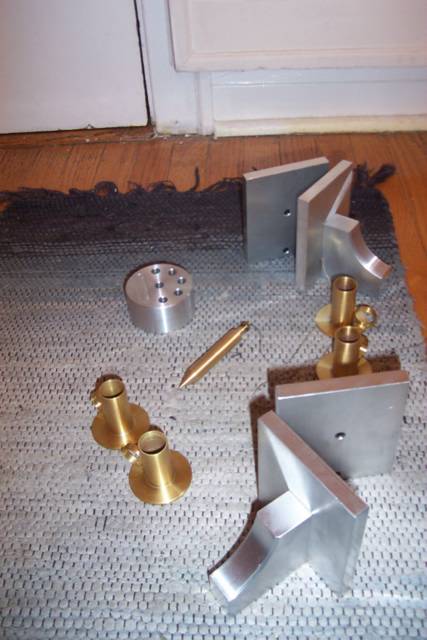
Those are the pieces I made in the machine shop class. Two sets of bookends, four candle-stick holders, a plumb bob, and a paperweight/pencil holder. The silvery ones are aluminum, and the goldish ones are brass. We used a grinder, a horizontal band saw, a vertical band saw, a milling machine, and an oxyacetalene torch, to solder the tubes on the candlestick holders to their bases. It was not, technically, welding. But I did have to light the torch myself.
One of my bookends has an extra set of holes on the bottom. That's because, in trying to make the holes threaded so that I could put a screw in them, I accidentally broke a tap off in one of them. Also, one of the ring-shaped handles on the candlesticks is loose, because they too are held on by little screws, but I went too deep with the center drill and made my hole a little too big for the tap, so that there are only one or two threads in the hole, and the screw doesn't tighten well.
Still, I did better than I thought I would, considering my general level of clumsiness, and the inability to erase mistakes.
The guy who taught the class, Jim, is retiring this quarter after forty-something years of doing this. He has infinite patience and is good at explaing things without making you feel stupid, even if it's the fourth or fifth time you've asked. I feel lucky to have gotten to take the class with him.
All in all an experience I am grateful to have had. Even if I'm also grateful not to have to get up so early on Tuesday mornings anymore...
Monday, March 13, 2006
Neat Toy
Google maps pedometer. Useful for planning running or walking routes. Saturday, which was the nicest day in human history, I apparently went 5.6 miles, passing through three different municipalities as I did so. And one of them, I went all the way across, northern city limits to southern city limits. Yes, I was so impressed with myself that I had to post it on my blog. Pathetic, I know.
Still, that makes six different cities that I've run to or through from where I live, counting the one I start in. Chicago suburbs are so small.
Still, that makes six different cities that I've run to or through from where I live, counting the one I start in. Chicago suburbs are so small.
Monday, March 06, 2006
Long Days
Have I missed the weekend again? It just doens't feel like a weekend, is the problem. We worked yesterday.
Not an unsucessful day at work, actually, but to do anything these days takes longer and longer. First we have to turn on the cooling systems, and turn on, warm up, and tune the lasers. The tuning by itself can take all day, if we're unlucky.
Then align all the beams. This involves turning little screws on the back of the mirror mounts to change the angle. We have little targets set up to help us aim them correctly, irises which open when you're done with them to let the beams pass through. You have to start from the first mirror and go down the line, because if you're off by a small angle at the beginning, you'll miss mirrors entirely, toward the end. Also you have to make sure the beam is passing through all the different lenses and frequency shifters correctly. With so many beams and such long paths this always takes a couple of hours, and is tedious and repetative. If we have to change the beam paths for any reason, that can take an extra hour, or all day.
Parts of the beam are split off and sent through rubidium vapor cells, where, if they are at the right frequency, they are absorbed. We have electronics to adjust the lasers if the beam stops being absorbed (meaning that the laser frequency has drifted). But the electronics are complicated and don't always work. So getting that going can take a while too.
Meanwhile Ken has turned on the heaters that vaporize the rubium for the trap. Once everything is ready, assuming the vacuum pressure is okay, he opens the valve the releases the stream of rubidium vapor into the main vacuum chamber, and looks for a trap. He gets it every day now, reliably. But usually it starts out weak, and more alignment has to be done, and frequencies adjusted, before it will get big and bright.
Now we set up and mount any equipment we will be using for today's trial. Oscilloscopes, high voltage power supplies, light detectors, function generators, etc. Our post-doc does most of the electronic configuration. He's very good. We run lots of cables. More alignment, to make sure the light is getting onto the detectors.
Now, finally, we are ready to begin. We turn off the lights. (These detectors are sensetive. Room light could damage them.) I babysit my laser, changing the frequency when called upon, and making sure it doesn't change when it shouldn't. Ken babysits one of his lasers, and pours liquid nitrogen into the part of the vacuum system from time to time (this helps keep the pressure down.)
Lately his job also includes casting a shadow on the detector, which is picking up light sources we can't control. If he moves, it stops working.
Our post-doc watches the function generators and oscilloscopes and calls out instructions for us, parameters to change. Make this beam stronger. Make this beam weaker. Change the frequency. Scan the frequencies. Block this. Block that. Make the pulse longer. Make the delay shorter. He is looking for certain effects on the light the detector picks up. If he sees them, he saves a trace and calls us over to look.
Not every day is like this. Sometimes we are assigned other projects to work on. But this is the priority, and it always comes back to running this experiment in the trap.
Yesterday we saw an effect we were looking for -- two of our beams prevented one another from being absorbed by the rubidium in the trap. (This is supposed to be useful one day in making the basis elements of a quantum computer. If you don't exactly see how, join the club.)
Today... We get to do it all over again, probably.
Friday, March 03, 2006
The Power of Procrastination
I usually skip the speakers invited to talk by my department. I went a couple of times at first, but didn't find it rewarding. What these speakers are usually trying to do, is impress you. This means they use a lot of jargon and complicated graphs, and try to cram every result they've ever gotten into a one hour presentation. So you, as an audience member, have little to no chance of understanding what they're talking about at all. First, because they don't leave themselves time to explain the basics of their field. Second, because if you understood, you probably wouldn't be as impressed.
But last night I made an exception. Our whole lab attended a talk by Jorge Cham, the creator of Piled Higher and Deeper. You know, that comic strip I keep linking to.
He was great. It was like stand-up comedy with Powerpoint. Why don't more stand-up comedians use Powerpoint?
It was also thereputic. The thing about these comics is, we've all had these experiences. We've all been humiliated. We've all been ignored. We've all panicked. We've all been depressed. We've all been desperate. We've all felt like imposters. We've all considered quitting. According to a study Cham cited, 10% of us have considered suicide, and 1 in 200 actually attempted it. But we never see each other. We all think we're alone. The strip is nice because it tells us we're not. This guy we've never met knows exactly what we're going through. And he has thousands of readers. And he told us to look around the room and see how many people from our own university were laughing at these painful jokes, about being ignored by your advisor. About getting nowhere on your project. About having your ego crushed. About feeling overwhelmed.
At it was really nice to see all these people, to laugh with them. (Our post-doc was laughing so hard he could hardly breathe. That was nice to see.)
The title of the talk was "The Power of Procrastination." The message was -- yes, there are more important things you should be doing right now instead of attending this talk. Or watching TV. Or hanging out with your friends. Or being outside. But there will always be more important things you should be doing. You can't ever be finished with them. So you have no real choice but to put them off, if you ever want to do anything else. Try not to feel so guilty about it.
There were also some words of warning, now that he's graduated -- writing your dissertation will nearly kill you. You will not be happy with your work. And no one will ever read it. But the tenure process makes getting your degree look easy. This is why your professor has no sympathy for you. The academic job market sucks (but you don't have to stay in academia.) Get used to being rejected.
Man, for some reason when I say it, instead of him, this stuff sounds a lot less hilarious...
Interestingly, this morning, I followed a link from Word Munger to a page postulating that the reason there aren't more women in university science departments, is that jobs in university science departments are terrible. Their only attraction is as booby prizes in a sort of pissing contest, and women don't do pissing contests. Those jobs do seem more attractive if you are from China or India, where the standard of living is lower, but immigrant work forces are usually composed mainly of men. (In case you're wondering, Americans are traditionally the minority among physics grad students at major universities.) This sounds pretty cynical, but last night when Cham said the Big Question of grad student life was "Why?!" he got one of his biggest laughs. It's funny 'cause it's true.
Sounds like a depressing talk, but really, it put us in a good mood. It's just so reassuring to be told that it's not us, it's the system. We may feel like failures, but so does everyone else. And there's nothing wrong with a little procrastination. It was exactly what we needed to hear.
Thank you, Jorge Cham.
Monday, February 27, 2006
Lunes Links, Part III
Did you notice how, when I miss the weekend and find myself posting on Mondays, the posts seem to be lazy collections of links instead of deep insights or scientific explanations? Huh. Weird.
Anyway, your theme for this week is old pictures.
I've been meaning to link to this huge collection of World War II posters from Northwestern University Library for so long that I forget where I originally found it.
Then there's this gallery of old newspaper ads which reveal the way of life of previous generations of American capitalists. The host of those images also brings us World War II ephemera (his politics show a little bit there, be warned) and, for a change of scene, bad seventies interior design. The photos he used to have in that gallery had me cracking up helplessly at a library computer one day, but he pulled them down when he published them in book form. These new ones are almost as good.
Let's see, what else... Well, I found myself watching reality TV while I worked out again tonight, so I might as well link to this article about the original unscripted elimination contest: the Miss America pageant. But the theme was supposed to be pictures, so here are the pageant's archive pictures of the winners from the 1920s, with links to the other decades. You can view individual years, too.
And if you'd rather look at men in long socks instead, here is an archive of baseball card images, 1887 - 1914.
Wednesday, February 22, 2006
February Poem
I did a report once in high school about Robert Conquest, so I decided this month, I should find one of his poems. Unfortunately very few are online. I found one I hadn't seen before, but in order to enjoy it I first had to google a few words: "Phlegrean Fields" -- turns out it's the region of ash, cones, and craters "formed about 35,000 years ago with the eruption of 80 cubic km of ash (the Campanian Tuff)" from Mount Vesuvius.) And "mephytic" (the person in that link quotes from a book I really like: "Ex Libris: Confessions of a Common Reader" by Anne Fadiman. The subject of one of her essays was a word quiz she put together. One word was "mephitic. "The English professor said, 'Mephitic! That must mean foul-smelling. I've seen it in 'Paradise Lost,' describing the smell of hell.' My brother, a mountain guide and natural history teacher who lives in Wyoming, said 'Mephitic, hmm, yes. The scientific name for the striped skunk is 'Mephitis mephitis,' which means 'Stinky stinky.'.")
So now that I'm clear on those words, I can feel more confident in presenting the poem:
Campania
The Arts that sensuously address
The raising of the consciousness
Bloom in a spread of themes and tones
—Geology of various zones
Some scale the great volcano—sky,
Flame, precipice, immensity.
While some tread, in the charming vale,
The villages–and–vineyards trail.
The grandeur group (though kindly) tends
To mock at its more modest friends,
While they, in turn, are quick to spot
Pretension in the peak–proud lot.
But both despise one who resigns
The glorious vistas, the green vines
For Phlegrean Fields that gall each sense
With flat glooms round mephytic vents,
A matter of tastes and temperaments.
—Robert Conquest
Friday, February 17, 2006
What is the Value of Algebra?
A column by that title appeared in the Washington Post.
The columnist, Richard Cohen, describes the case of a girl who dropped out of high school in her senior year after flunking algebra six times. Algebra was a graduation requirement.
Richard Cohen himself flunked algebra once, apparently, and barely passed the second time. He says it was a miracle he made it through geometry, and that to this day, although he can do basic arithmetic, he struggles with percentages. And yet he has had a successful career - his own column in the Washington Post! The lesson he draws is that algebra is completely unnecessary. He has never used it, and never regretted not being able to use it.
What's more, he doesn't believe that alegebra teaches reasoning. He says that writing is the highest form of reasoning - you know, rhetoric, debate, the stuff that lawyers do.
Okay, I'm not going to write the blistering critique that this undoubtedly deserves: P.Z. Myers already did. You should read his post, because he's right. But, as usual, he makes good points in a way that makes me want to disagree with him.
See, I struggled with algebra too. I think I got a C, actually. Around the same time, I was getting 50th percentile on standardized math tests. And although those events were around age 14, I also chose more recently, to take the new writing-reasoning section on the Graduate Record Exam instead of the old analytical section: "Amy sits across from Bobby and Carla sits two places down from David. Where were Emily and Frank sitting?"
Not a single math class ever came easily to me, but I learned it, and learned more, and I'm glad I did.
What I've learned is that algebra isn't just for solving homework problems. I took a formal logic class from the philosophy department, and learned that statements, as well as numbers, can be represented symbolically. I used algebra for any chain of reasoning longer than a simple syllogism. I honestly believe that lawyers and Washington Post writers would perpetrate fewer logical fallacies if they all had to take that class.
That's the class where I first learned about truth-tables, a technique I went on to use in my electronics course, where I learned how to build simple digital logic circuits. Richard Cohen may not do a lot of algebra, but I bet he uses a lot of digital logic circuits. I used algebra in computer programming -- I bet he uses a lot of computer programs. He can claim it's not necessary for him to know algebra, but he can't claim algebra isn't useful to him, because it makes a lot of the things that he uses possible.
But those are just utilitarian arguments. He probably thinks that the world worked just fine before all of these things were discovered. Cars are useful too, but we are not all required to learn auto-repair in high school. He probably sees math as a vocational skill. He seems to think that the engineers who built these things were "whizzes at math but did not know a thing about history and could not write a readable English sentence." (He mentions a girl from high school who couldn't locate the Sahara desert on a map. Never mind that according to National Geographic a third of Americans age 18 to 24 can't find the Pacific Ocean on a map.) To Richard, math is like money. Flashy modern electronics may require a lot of it, but it is a shallow subject.
He's rather think deep thoughts about the nature of the world we live in.
But guess what, Richard? At every level, the world we live in obeys mathematical laws. You are worried about injustice? Find me the statistics to tell me who is starving and how much food they need. There is no way you are ever going to solve the problem without quantifying it. You want people to know geography, Richard? Without algebra, sailors would never have been able to navigate beyond their own coasts. Are you at all interested in the fundamental questions about the nature of reality, about time and free will and what those lights in the sky might be? The answers are in physics, Richard. The stars and the planets and we ourselves are all subject to the same immutable algebraic laws. How can you be so incurious that you don't even care to know what they are?
P.Z. Myers is right. Algebra is useful to society if not to Washington Post columnists, and it opens doors to those who learn it. But it is more than just useful. It is the language in which the universe is written. Even if you don't like it for its own sake (I never did), you must learn it to even begin understand the world in which you live.
Sunday, February 12, 2006
Lab Lit
I have been reading more "Piled Higher and Deeper". I already linked to my favorite cartoons, but now I have a few more.
They're all depressing, but number 136 and number 137 particularly so, because hit so close to home... Still, it's nice to know I'm not the only one who feels this way.
Then there's one about what grad school doesn't teach you...
And the answer to a moral dilemma, which is very similar to the one a friend gave me when I first started...
And some practical advice for group meetings...
And how funding problems are resolved.
I was prompted to start re-reading these by the true lab story post over on Uncertain Principles, which explains
He mentions this in the context of lab lit, of which "true lab stories" are a sub-genre. Following his links, I find more examples of lab lit. There's a couple of books I've read on that list. And if the Connie Willis books there are classified as "lab lit," then so is all of "Piled Higher and Deeper." So now I'm trying to write a story of my own, and reading PhD forprocrastination inspiration.
I'll let you know if I ever finish it...
They're all depressing, but number 136 and number 137 particularly so, because hit so close to home... Still, it's nice to know I'm not the only one who feels this way.
Then there's one about what grad school doesn't teach you...
And the answer to a moral dilemma, which is very similar to the one a friend gave me when I first started...
And some practical advice for group meetings...
And how funding problems are resolved.
I was prompted to start re-reading these by the true lab story post over on Uncertain Principles, which explains
'A true lab story is never moral. It does not instruct, nor encourage virtue, nor suggest models of proper scientific practice, nor restrain graduate students from doing the things that graduate students have always done. If a story seems moral, do not believe it. If at the end of a lab story, you feel uplifted, or if you feel that you have learned some useful fact about science, you have been made the victim of an old and terrible lie.
He mentions this in the context of lab lit, of which "true lab stories" are a sub-genre. Following his links, I find more examples of lab lit. There's a couple of books I've read on that list. And if the Connie Willis books there are classified as "lab lit," then so is all of "Piled Higher and Deeper." So now I'm trying to write a story of my own, and reading PhD for
I'll let you know if I ever finish it...
Monday, February 06, 2006
Measure Twice -- Cut Once
Part of me has always been attracted to science because it's not girly. "What's wrong with girly?" you ask. Well, the good feminist in me would rather do non-girly things because she doesn't like the implication that she can't do them. The evil anti-feminist in me likes non-girly things better because girl stuff is boring. It's usually guys who have all the adventures, in books and movies and so on, and when girls do participate (Alien, Alias...) you get the feeling they're not the kind of girls who sew.
So... what could be more manly than machine tools? Drill presses, grinders, band saws, spinning blades of all descriptions, capable of slicing right through steel (and bone! Grr!) Mere "power tools" are for wimps. Oh, and soon we'll be welding!
But what I have learned (and I commented briefly on this before) is that the actual skill sets for these things seriously overlap those of the girlier arts.
For instance -- it is amazing how similar the workings of a vertical band saw are to those of a sewing machine. Sewing machines have a spindle and a bobbin. Vertical band saws have a drive wheel and an idler. The main difference is that the thread keeps unspooling, while the band simply goes round in circles, but the mechanics are the same. On a sewing machine, you can lower the "foot" to hold your material in place and ensure that you stitch a straight line. On a vertical band saw, you can lower a foot to hold your material in place and ensure that you cut a straight line. Except I think they don't call it a "foot." That's just what I've been calling it, in my head. Both are manual drive machines, meaning that the needle (or saw blade) moves up and down and the operator moves the fabric (or metal) across. Stitching a curved line and cutting a curved line are both difficult, but if you can do one, you can do the other. Treat the needle (or blade) as the center of the circle and move the work piece in arc around it as you push it through. Both have adjustable speeds, and you need different needles for different fabrics, just as you need different blades for different metals. And don't kid yourself: a needle through the finger may not be quite as bad as a slice through the tip, but it's nothing you're gonna laugh off, either.
The last step of our first project (a plumb bob) was to put a piece of string through the hole we'd drilled. This was difficult, 'cause the hole was long and the string was floppy. I couldn't resist pointing out that a tool existed for doing this job - the humble needle threader. This is just a fine piece of wire folded into a loop. Stick the loop through the hole in the needle (or screw). Put the thread through the loop. Pull the loop back through the hole. They didn't have any of those in the shop. I have one at home, in the little sewing kit I bought the last time my keys tore through the lining of my coat pocket.
And then there's the whole process of planning, measuring, marking, tracing, leaving extra material around the edges on your first cut, the scrap baskets for small pieces that might come in handy later.... And honestly, is my plumb bob really any more useful than any of the decorative pillows I made in Brownies?
Okay, sewing doesn't involve fire, and machining eventually will. But on the other hand, cooking does, at least if you use a gas stove. (Man, I hope the welding torch lights itself. I hate lighting invisible streams of gas. Stoves, ovens, fireplaces, Bunsen burners... I always panic that either I'm going to somehow light the whole stream of gas, all down the pipe, and explode the building, or fill the room with gas and explode the building.)
I feel like I've made a discovery, here. Like there can't be all that many people who've noticed these similarities, because how many people have actually used both a sewing machine and a vertical band saw? How many people took both shop class and Home Ec in high school? Why are there so few? If you enjoy one of them, you ought to like the other. It's all about working with your hands, making things. If you're good at one, you'll be good at the other. What I think we need, is a class that teaches both.
Subscribe to:
Posts (Atom)