Showing posts with label physics. Show all posts

Tuesday, February 13, 2007

We Have Liftoff


Click on the picture. Watch the animation. Then come back.

It's so hard to explain what this little animation means. Just know that it took years of blood sweat and tears to achieve it, mostly Ken's, but mine too, this last year or so. A lot of the saga I described here.

This is our magneto-optical trap. Being launched upward. The things on the sides are the magnetic coils that help hold it up. They are six centimeters in diameter, which should give you a sense of scale. We just need to be able to launch atoms a little bit higher than the top of the coils, because we can put our cavity right above them. This is the whole reason we designed these smaller coils, so that we wouldn't need to launch so high.

The atom cloud actually expands as it rises, out of the cooling beams. The beam we use to light it up so that we can see it is narrow, so you all you see is a narrow, pencil shaped slice out of the cloud as it expands, like the core of an apple. That's why it looks long and narrow toward the top.

These results don't mean we're done. First of all, we might want to cool the atoms a little more, so that they don't expand so much, so fast (although there is plenty of density up there, even as it is.) We are actually doing a slower launch, so that they slow to a halt just at the top of the coils and then fall back down. The slower launch takes longer, so the atom cloud has expanded more when it gets up there, which is why we might want the additional cooling. Also, we need a way to hold the atoms there, once we get them there. We already know how we're supposed to do that. It's called a "FORT" or "Far Off-Resonance Trap." It's easy in theory -- just shine a really strong, really tightly focused laser beam on the atoms, and that should hold them in place for the few milliseconds we need. Unfortunately we haven't made it work in practice yet, at least, not that we could detect. Finally, we need to actually build the cavity and put it in there. We've already built a couple of cavities for this thing, but for various reasons none of them is suitable for what we're trying to do now.

But still, that little blob in that animation looks a little bit like a light at the end of the tunnel.

Tuesday, January 09, 2007

Physics Classes

I'm finally taking my last two classes this quarter. After that, I will probably never take another, at least not for credit. I can barely imagine never having to do homework again; I've been a student for so long, my whole life. I observed a while ago that I didn't feel ready to be done, didn't feel like I knew as much as I expected to, with only two classes left. A certain older, wiser graduate student with the initial "K" reminded me that I was supposed to be learning something from the research, too.

Surprisingly enough, I seem to have become a little less cynical since I wrote that last post. Just because you can't learn everything in grad school doesn't mean you learn nothing. And I have gotten a lot from independent study and bull-sessions with my co-workers (especially the one I married. I think we figured out what it meant to quantize the electromagnetic field while driving across France on our honeymoon. This was not as quite romantic as it sounds -- we nearly always get frustrated with each other when we talk about physics. But then, we nearly always understand things better afterward.)

Anyway, my last two classes are relativity, which I have been waiting to take, and the second quarter of quantum field theory. I think people might be kind of interested in what classes like that are like. The topics sound so... Deep. Don't they? Is it a profound experience, learning this stuff? Am I gaining access to the secrets of the universe?

Well... No. Physics classes aren't really like that. I mean, take Newton's laws, right? Everyone learned at least a little about Newton's laws at some point, and learned about gravity. Now, if you take a step back, Newton's ideas really are profound. They're universal. With them we can comprehend the motion of the planets, or how far a flea can jump. The same pattern underlies both. They allow us to build devices so powerful they might as well be magic, and, in the limited sense, even to predict the future.

But when you were sitting in your high school physics class, did it feel like a mystical experience?

Everybody who finds out what I do for a living tells me they hated physics in high school, and guess what? So did I. There's so much notation to learn, so many simplistic and unlikely problems to solve. I felt as mindless as a programable calculator, memorizing equations and plugging in numbers and getting out other numbers. It was dry and difficult and mechanical. Worst of all, the more basic questions that I was actually interested in, such as "Why are these equations true? Where do they come from?" were actively discouraged. Newton didn't know why his equations were true. He was just guessing. He figured he saw a pattern underlying a lot of the dynamics of the natural world, and he tried to describe it. It turned out to be a good description. That is all.

Nowadays we have even more sophisticated descriptions, and we can show that if those equations are true, then Newton's follow. So in that sense, we can explain his equations. But then, we can't explain the newer ones. Why do things obey Schroedinger's equation? We don't know. It's just how they seem to behave. Don't ask. Shut up and calculate.

This pragmatic approach continues to the very highest levels of physics education. You can think about "why?" on your own time. In class, we will address questions we can actually answer. Such as "what is the probability that an electron on a collision course with another electron will fly off at a 45 degree angle?"

Just so you know, when you hear physicists pontificating about different interpretations, "many worlds" theories and so on, those are just their own opinions. You don't learn interpretations in class. They aren't speaking for scientists in general.

I'm guilty of it myself. When I write or talk about science, I try to make it sound more interesting by injecting my own private sense of wonder, my own interpretations and opinions. Like I did up there with Newton's laws. But the day-to-day practice and study of science, in the lab and in class, is much more boring.

Wednesday, December 20, 2006

Good MOT, Good MOT!

Okay, so remember the other day when I said we had the brightest trap ever, but couldn't get it to work when we changed the set-up? And how if we didn't change the set-up, we couldn't do the experiment? So we really needed to get it working with the new set-up? Well, we did!

I promised pictures of the super-bright trap, and I took them, just didn't get around to uploading them. But now you can see the super-bright trap, and the new-set-up trap.

But first, for reference, is a picture of what the trap used to always look like (on a good day)


Second is a picture I took of the same monitor, with the same camera (though the camera had been moved slightly, but not significantly closer) on the day after we saw the trap with the naked eye. Believe it or not, the trap was actually even bigger than this at one point, though not much bigger.


The final picture is the trap we got today. It was also slightly bigger than this at one point, but this was a better photo. As you can see, even the weaker new trap is brighter than the kind of trap we used to get.


It always feels like a lot of lot of work to get back to the same place, when we're trying to get the trap going again. This time it took weeks. But the truth is, this represents a major step forward. Because we changed the configuration of the laser beams, and this trap, unlike the old one, can be launched upwards.

The theory behind a trap requires six laser beams: one pointing up, one pointing down, one pointing left, one pointing right, one pointing forward, and one pointing backward. (Actually, our trap is rotated a little so that some beams are diagonal, but lets just ignore that and talk about up and down, forward and back, and left and right.) Up until now, the left pushing beam was simply a reflection of the right pushing beam, and the doward pushing beam was a reflection of the upward pushing beam, and so on. But if you can change the frequencies a little, so that the upward pushing beam is a little higher in frequency than the doward pushing beam, you can arrange for the upward beam to push a little harder than the downward beam... And the atoms are launched upward. It's called an "atomic fountain." This is a necessary part of Ken's experiment. But you can't do it if the downward beam is simply a reflection of the upward beam -- then they're automatically the same frequency.

However, the downward beam is a reflection no more, but a completely independent beam whose frequency can be independently changed. Another hurdle cleared. The impossible experiment is still on.

And we can go on Christmas break without this frustration hanging over our heads.

It feels good.

Tuesday, December 12, 2006

Good News and Bad News

The good news is, yesterday we got the biggest, brightest trap we've ever seen. It took up half the camera's view. Its brightness saturated both cameras and drowned out all other light in the chamber in the pictures. It looked like the sun. It looked like it was going to eat the lab. Our advisor asked us why it was so much bigger, and Ken said "Because we rock?"

Here's the thing -- it was so bright, you could even see it with your naked eye. The reason that is surprising is because it glows in infrared.

"Wait, how can you see infrared with the naked eye?" you ask. Well, the eye's response doesn't cut off sharply at a certain wavelength. It just gets less and less sensitive as you go to longer and longer wavelength. Our light is far enough past the peak sensetivity of the red-receptors in your eye to qualify for the term "infrared," but the eye still has some sensetivity to it. In other words, if it's really bright, you can still see it.

The trap was that bright.

Somehow seeing something like that with your naked eye is much more impressive than merely seeing it on a screen or through a viewer. You know it's not a special effect. It's like -- wow, there's a ghostly glowing red dot just hovering in the center of our vacuum chamber. Okay, I believe in quantum mechanics now.

Nothing else could possibly explain that.

The bad news is, we got this incredible trap by going back to the old set up. See, the way we usually get a trap involves having laser beams that go through the trap (it's partly transparent), hit a mirror, and then go through it again from the other direction. What we need to do now, for reasons I won't get into, is have one beam going through it from one direction, and a separate (but identical) beam going through it from the other direction.

When we reflect one beam back on itself, the trap works, and works spectacularly. When we take off the reflectors and send a supposedly identical beam in from that direction, it doesn't work at all. How can that be?

So that's where we are now, the frustrating mystery we are still trying to solve. But seeing the largest trap ever, and seeing it with our naked eye, makes up for the frustration a little.

For reference this post has a picture of what the trap normally looks like on our TV screen. Yesterday, it took up, literally, about a third of that screen. So, huge. I'll bring a camera in today... And here is a picture of what a trap looks like when you look at it with your naked eye. The difference is, theirs is a sodium trap, and sodium glows with visible yellow light, which makes it much easier to see than our infrared glow. But other than appearing redder and dimmer, that's just what ours looked like.

Tuesday, December 05, 2006

A New Project

So, you all know by now that research is frustrating, right? The project that was supposed to be my thesis... Well, I was spinning my wheels on that for a long time. Couldn't get any traction. When we finally, finally understood the theoretical description of our problem, we discovered that 1: the experimental device we were trying to build wasn't going to work (although not for the reasons I had thought it wouldn't) and 2: the theory behind wasn't new. Other people had already done these calculations.

Ugh, that's very vague. I never know how much I can say about my actual research. I mean, in science, you're supposed to publish in peer reviewed journals, not blogs. But I think it's okay to tell you that I was working on a new kind of optical gyroscope.

Ordinary optical gyroscopes, usually called ring laser gyroscopes, are pretty simple, in principle. Basically, when you rotate a certain type of laser, the frequency of the light coming out of it changes. If you want to know how fast you're rotating, measure the frequency of your laser. This is useful for navigation. Keep track of how fast you're turning and for how long, and you always know what direction you're facing. You can know really accurately, enough to navigate by dead reckoning alone. So all of these airplanes and ships and satellites carry little lasers on board now; optical gyroscopes are pretty standard, apparently.

Anyway, we were supposed to be building a more sensitive optical gyroscope, capable of detecting even very tiny rotations. But it turns out that the effect we thought would simply enhance the sensitivity has a lot of other consequences as well -- like making the frequency measurement much harder to do accurately. And the conditions under which this effect happens turn out to be narrow and hard to realize in practice, and realizing them handicaps the sensitivity in other ways. Which explains why we never managed to demonstrate the increased sensitivity experimentally.

So. End of story, right? So much for my thesis. I've been at loose ends now for a couple of months, wondering if I was ever going to graduate, if I had to start all over, worn out and kind of burned out by the whole saga of the gyroscope. (And meanwhile working on the trap, which is a two person job, with Ken. The trap is always, always frustrating. About two hundred pieces of equipment have to be working all at once in order to trap atoms at all, and optimizing them all takes half a day for two people, even when things are working well, which is not very often. And then when you change anything, it can take days or weeks or months to get the trap back, as you try to track down the problem among all those parts... We've recently changed some things. Ken found a better way of doing what he's trying to do with the trap, in some papers. But it's So. Much. Work.)

To sum up: Arghh! Damnit! Arrrrghh!

But the effect that was supposed to make the gyroscope more sensitive, the effect that other people have already discovered and written about? In trying to understand it, a question occured to us (well, to my advisor) to which we can't seem to find any answer in the literature. Nor is the answer obvious from theory. At first this seemed like bad news -- we still don't totally understand! But now my advisor has given me the assignment of attempting to answer the question experimentally. The fact that no one else seems to know the answer means that the result of such an experiment would potentially be publishable... And more importantly, could go into a thesis.

And that means that all my work so far isn't wasted. The stuff that I learned about this effect, even the stuff I learned about gyroscopes (because depending on the answer to our question, maybe some of those problems I mentioned can be gotten around someday), can still go into my thesis. These things are supposed to be about 200 pages long, but most of that is usually background material. I was worried that all the background I'd been learning was going to turn out to be totally irrelevant, that'd I'd have to start from scratch. So I am incredibly relieved to be given a new problem that is actually related to the work I've already done.

Now actually doing the experiment is going to be hard, don't get me wrong. I don't know where I'm going to find the time, considering that the trap is going to continue to be a two person job, and there are only three of us in the lab. And I've still got classes to take... And I'm already forseeing a million problems with trying to set this new experiment up, and the problems that you forsee aren't ever the bad ones, either.

But those frustrations are for later. Right now, I'm just relieved to have a new project that won't require me to start from scratch.

Tuesday, October 03, 2006

News of the New

Apparently a couple of Americans have won the Nobel Prize in physics. They worked on the COBE satellite, measuring the cosmic microwave background. Microwaves are, of course, just a kind of radio waves. The microwave background is nothing but static, noise. The point is that it doesn't have a source. It seems to come from all directions at once, from all over the sky. It was first discovered by accident by scientists at Bell Labs trying to build a radio reciever, who weren't happy that no matter where they pointed the thing, they couldn't get rid of the noise... But it's not quite the same in every direction, and that's what the COBE satellite measures. The little tiny differences. Since the only possible source for radio waves that come from everywhere is thought to be the Big Bang, studying it can tell us something about the beginning of the universe.

But the Nobel Prize people do more than just give out awards. They also create cheesy flash animation games. Certain members of our lab who shall remain unnamed have no problem playing this at work, since after all, it's educational! It's on the Nobel Prize website, and it's about lasers. We're supposed to be learning about lasers, right? Thanks to Chad Orzel for the link.

In other space news, did you see that Neil Armstrong got his line right after all? The story says

Some historians and critics have dogged Armstrong for not saying the more dramatic and grammatically correct, "One small step for a man ..." in the version he transmitted to NASA's Mission Control. Without the missing "a," Armstrong essentially said, "One small step for mankind, one giant leap for mankind."

The famous astronaut has maintained he intended to say it properly and believes he did. Thanks to some high-tech sound-editing software, computer programmer Peter Shann Ford might have proved Armstrong right.
...
In a graphical representation of the famous phrase, Ford said he found evidence that the missing "a" was spoken and transmitted to NASA.

"I have reviewed the data and Peter Ford's analysis of it, and I find the technology interesting and useful," Armstrong said in a statement. "I also find his conclusion persuasive. Persuasive is the appropriate word."


I, personally, am very glad to hear this. I know some people who would say that there is something to be learned from the original story about an embarrassing human error at the moment of a great human achievement, that it's the difference between real life and myth, and it's important to remember... I say we need mythic achievements these days more than we need reminders of human fallibility. I hope that history books from now on record the line as it was meant to be.

Not all of us get to walk on the moon, of course. But a few teachers got to experience weightlessness recently, in a special airplane like the one astronauts use for training. Sometimes called "the vomit comet," I believe... The idea was to get the teachers excited about science, so they could go back and get their students excited (and incidentally get some publicity for Northrup Gruman, who sponsored it.) But supposedly half of all people get space-sick their first time in zero g. And you only get thirty seconds or so of weightlessness at a time, not enough to acclimate. So you gotta think about half those teachers weren't all that enthusiastic about the experience... But hey, I'd risk it.

Tuesday, August 22, 2006

You Say You Want a Revolution

Maybe the odds are a bit better for Big New Physics being developed in my lifetime than I thought.

It appears "dark matter" is no longer just speculation. Here's some observational evidence that there is something out there that we can't see.

Short explanation for those who've never heard of dark matter before: for a long while, it's appeared that the galaxies and other astronomical objects we can see don't move the way we'd expect them to for the mass they appear to have, if they were just acting under the influence of gravity. So physicists speculated that either they were more massive than they look (by a lot!) or our understanding of gravity was wrong.

But there are apparently reasons to believe that if they are more massive than they look, that mass doesn't come in the form of stuff made of neutrons and protons and electrons. It seems it has to come from something that doesn't interact with normal matter by almost any means except through gravity, otherwise we'd be able to detect it. So ghostly "dark matter" was invoked. Such convenient substances have been hypothesized before, though, and eventually disproved, as in the case of luminiferous aether

Only all of the sudden it's no longer so mysterious, so speculative. It seems that some astronomers have found a couple of galactic clusters which collided, and the collision knocked the matter in them away from the gravitational center of mass. Now normally the center of mass is, you know surrounded by mass. That is to say, surrounded by matter. But here all the matter's been pushed away, and the gravity is still pulling things toward where it used it be. It's as if the Sun got knocked out of the solar system but the earth kept orbiting the point where it once was. You'd have to assume there was something else there, right?

The revolution will come when and if we ever figure out what dark matter actually is, besides all around us.

(Actually dark matter still isn't enough to completely explain the dynamics of the stars. Something else, called "dark energy" or sometimes "the cosmological constant," is invoked to explain some aspects. But that remains in the realm of speculation and controversy for now. Anyway, I'm looking forward to finally taking that general relativity class this winter, and I'm sort of glad I'll be taking it after this dark matter discovery.)

Wednesday, July 26, 2006

Career Paths

I don't want to say anything here that I will regret. I don't want to stand up and declare "I am done with academia! No more!" and then be embarrassed by that someday, when I'm feeling less disillusioned and less scared, and am after all applying for professorial jobs. And, of course, I don't want any potential employer to find out I've written anything like that.

But I don't think professorial jobs are the ones I will be applying for when I finish grad school. I'll try to summarize the reasons why not. What's a blog for if not working through your angst? And maybe there are some insights to be had from my experience, who knows?

I didn't start my college career dreaming of being a professor. That was an ambition I picked up as an undergraduate, which is probably when most people who become professors decide that's what they want to be... As an undergrad, you're being exposed to all of these new ideas. It's a thrill. If you're lucky enough to go to a small teaching institution like I did (The University of Puget Sound), you're talking about all of these ideas with your professors. You want to keep talking about exciting, important ideas, to keep making discoveries, to contribute something to humanity. And the way to do that seems to be, become a professor. Because they're right there with you, having these conversations, only getting paid for it. Only it's even better for them, because they're experts, with the respect and attention of everyone else in the conversation...

And then, if you're lucky enough to go to a small teaching school, you sometimes get invited over to their houses (beautiful! Hardwood floors, views of the Sound and the mountains, basement workshops, cute families) and even out on their boat (thanks, Professor Thorndike!). And they travel. Take sabbaticals! Who wouldn't want that? It looks like a dream job. And to get it, you think, all you have to do is stay in school. Undergraduate you doesn't mind that idea at all. You're good at school. And it's a lot less scary than the idea of getting a "real job". You wouldn't even know where to begin to find one of those. And besides, you now realize college hasn't really trained you for a real job (unless you majored in business). Maybe you thought vaguely that you would be a "scholar" or a "philosopher" or a "scientist," but now it starts to sink in that all of those words are just synonyms for "professor." The idea of wasting all that education on an office job, coming home every night to your own empty apartment (assuming you're not married or engaged by the end of college) and no guarentee that there will ever be more... Well, it's depressing. And besides all of that, if you're a scientist, they offer to pay you to go to school! Not a lot by your parents' standards, but more money than you've ever made, more than you've had to live on for the last four years. So you start applying for grad school, and on all your grad school application essays, you say that you want to be a professor, and have a view of the mountains, and make important, meaningful discoveries and contribute to humanity. And you do want that.

So what could possibly have changed in three years that this no longer sounds like a dream come true?

Well, I guess it does still sound like a dream come true, in the same way that winning the lottery does. But I have come to realize that saying "I want to be a professor like the ones I had at Puget Sound" is only a little more realistic than saying "I want to win the lottery when I grow up." As an undergraduate at a place like that, you have a skewed sample set. Every person you meet who went to grad school, also has a faculty position. But as a graduate student, you meet all of the people who didn't get that golden ticket. You meet some people pushing forty who are still grad students (and some who have dropped out after spending ten years of their life in grad school, with nothing to show for it.) You meet post docs, who have earned their PhDs and make a little more money than you do, but who are basically still doing what grad students do: low status lab work, taking orders and sometimes abuse from their faculty advisors, often living in dorms. They are on temporary five or three or one year contracts. After that they are on their own again. You eventually find that you know some unemployed post docs. You meet "adjunct professors," "visiting professors," and "research faculty." These people are older than the post docs, in their forties and fifties and even sixties, but they too are on temporary contracts, which you think must make it hard to have kids or buy a house or even a car. How can they know what they'll be able to afford in five years, after their current employment has ended? You realize that many of them don't have those things, houses or cars or families. You meet tenure track professors who are then denied tenure, which is to say, fired, and the houses and cars and families in which they recklessly invested are now in jeopardy. You come to realize that even the professors who get tenure still have little real job security. Part of their salary comes from research grants which they are expected to get (mostly from the government.) These grants are highly competitive, and are awarded for one or three or five years...

You realize that in all this cut-throat competition for jobs and grants, the ones who succeed aren't necessarily the ones who deserve to succeed. The people who make the hiring decisions and give the grants aren't usually experts in the fields the research is in. So they have two things to rely on, when making these decisions: the applicants' own claims about themselves and their research, and the applicants' record of publications in various journals. So the people who are the most arrogant, the most self-promoting, the most prone to exaggeration and incomprehensible jargon... They win. Assuming they have also published a lot of papers, at least. Hence the phrase "publish or perish". So it's the stressed out, frantic, intensely career oriented, arrogant self-promoters who actually win. Do you really want to be like them?

Worse, you see the incentives to exaggerate the importance of one's research, to make bigger claims for its potential applications than it really warrents. To make it sound more impressive and more successful than it is. And you begin working on research of your own, which you realize cannot possibly live up to the claims made for it in the funding applications. If you are a scientist, you learn that science is hard. That most ambitious projects aren't going to succeed, at least in the short term, because that's what "hard" means. The better you understand your field, and other people's research in it, the more skeptical you get. You don't feel like you are contributing anything signficant to humanity after all. You feel like a fraud. And you suspect that some of the other people in your field, making even bigger claims, are frauds too.

The transition from coddled undergraduate at a teaching institution (a paying customer) to cheap labor at a research institution is a rude awakening generally, for ambitious and academically talented students. Your education is no longer about taking classes, certainly not after the first year. It is more like an apprenticeship. But there are few protections in place for you. If your advisor wants you to work nights and weekends, and you really think they might punish you for refusal in any of the hundreds of ways available to them -- assigning you to meaningless and tedious tasks, grading you harshly in their classes, declining to put your name on papers summarizing your groups' research, even failing you on your qualifying exams or thesis proposal (or simply failing to schedule them), or refusing to graduate you, or refusing to give references and recommendations if you do graduate -- then you'd better work nights and weekends. No overtime pay. (Not that my advisor has punished anyone in any of these ways. But the fact that the potential exists is oppressive enough to make it hard to object to anything he asks us to do.) In grad school, you are not made to feel special. You are not made to feel like a smart person with a lot of potential. You are now (especially when you first start your research) the stupidest person in the room, the lowest person on the totem poll. The things you are asked to do seem impossible. You get used to failure. The ambitions that motivated you as an undergraduate now seem unachievable.

Finally, if you have met someone, if you are no longer facing the prospect of a lonely studio apartment after graduation, you start to wonder how you're going to make it work. You are twenty-five or twenty-eight or thirty years old. Your parents had a kid or three by this age. If your significant other is also in academia (and if you met them in grad school, the odds are good that they are) then you faced the two body problem. Getting any kind of permanent position seems impossible, but getting two in the same state, much less the same city? If you take temporary positions, what are you going to do when one of them ends and the other does not? It seems you will have prioritize. How important is this academic career to you after all, after everything you've seen? Now that you've lost your illusions?

Paints a pretty depressing picture, doesn't it?

Well, that picture is an illusion too, to some extent. Things have been getting better, this past year or so. I am not so new, anymore, and I no longer feel like stupidest person in the room, for starters. I feel more confident about the work that I'm doing, confident of my own abilities. I have gotten over some of my disappointment with the gap between the claims people make and what research can actually achieve. Anyway, not everything fails. some useful stuff does come out of this kind of research. A lot of people do find ways to make families work. The job market is tough, but not necessarily any tougher than the one my mom faced with her law degree, for instance. Making two careers and a family work is difficult for anyone, in any job, and you do have to make sacrifices, but you don't have to sacrifice either one completely.

Finally, and this is an important one for me to remember, because I often lose sight of it in my worry about the future... My life right now does not suck. I have a great apartment near the lake in one of the best cities in the world. My job, while stressful and hard on the ego and low paying and distressingly temporary, is also mentally challenging, with flexible hours, and not what you would call a dead end. I expect to make quite a bit more, not too far in the future, regardless of whether I stay in academia or not. Even post docs make twice what we're paid now, and more than the national average wage. And, of course, I'm married to an amazing guy. I already have a family. Just because we'd like to make it bigger some day doesn't mean it's not happy now. And furthermore, I have wonderful parents and siblings. And great in-laws. And I've been to Hawaii and Europe in the past two years. So really, I need to quit whining and start enjoying it, right?

But taking all of that into account, trying to keep everything in perspective... I think I'd rather go into industry than academia after this. The prospects for job security are better. There is (I hope!) less direct competition with your colleagues, less "publish or perish" pressure, less risk of perishing, in general. And I have been humbled by this experience so that I no longer look at abstract "contributions to mankind" as the only worthwhile thing to do with one's life. I think I would now like to do something a little less grandiose and a little more useful. Like designing products that people actually want. If the justification for doing science is that its discoveries allows us to develop new technologies which then make people's lives better... Well, I wouldn't mind being involved in the developing new technologies part, instead of the discoveries part. There just aren't enough significant "discoveries" out there to really support all of the people who want to make them, anyway.

Of course, that's only part of the justification for doing science. The other part has to do with the value of understanding for its own sake. But I feel like, in a weird way, I now know enough about the universe. I know calculus and quantum mechanics and a bit of particle physics (quantum field theory) and once I've learned a bit more relativity (this winter, hopefully) I will have satisfied the curiosity that led me to major in physics in the first place. As much as I'm likely to really satisfy it, anyway. Unless significant new insights, on par with relativity or quantum mechanics, are found in my lifetime. Odds are they won't be. They're pretty rare, in human history. Odds are I wouldn't be the one of the find them, if they were found. And even if I were likely to find such insights, other people would be equally capable. Things like this are usually discovered independently a couple of times. I'll let them have the fun... Generous, of me, right? If such a revolution happens, there will be nothing to stop me from reading a few papers on it even if I'm not in academia at the time. And nothing to guarentee I'd understand them, even if I were.

And who knows, maybe one day when I'm sitting at the computer designing lenses or lasers or whatever, inspiration will strike. Einstein was a patent clerk, wasn't he?

Wednesday, June 21, 2006

Candidate Ken

No, he's not running for anything. Ken gave his thesis proposal today, and it was accepted by his commitee, which raises him to the status of "PhD Candidate" (at least, as soon as the paperwork is done.)

And I've got to say -- as a colleague -- he kicked butt. Hardly any "ums" and "uhs" even when unexpected questions forced him to try to explain complicated concepts not covered in his prepared talk. Didn't have to rush, never got boring or bogged down, covered all the material, transitioned smoothly, kept the audience engaged, and clearly knew more than anybody in the room about the project, and knew he knew it. Made a couple of jokes, and got into a couple of interesting side discussions. In short: professional.

But what does this "candidacy" mean? Well, Wikipedia says that at some universities it's an actual degree:


All But Dissertation or All But Degree, abbreviated ABD, or Candidatus Philosophiae or Candidate in Philosophy, abbreviated C.Phil. is a formal academic degree awarded to a student, or an informal status that says a Doctor of Philosophy (PhD) student has completed all graduate study leading up to the final dissertation. This typically includes graduate coursework, preliminary/cumulative/qualifying examinations, and defense of the dissertation prospectus, advanced to candidacy.

Sometimes "C.Phil." or "Ph.D. (ABD)" is used as a title. In the U.S., ABD is an unofficial status, and C.Phil. is an official degree at very few universities.

In some schools a student can write an additional thesis at this point and receive a Master of Philosophy (MPhil) degree; in others, the MA, MS or MPhil (sometimes Candidate in Philosophy, CPhil) is conferred on an ABD student who has been advanced to candidacy for the Ph.D. Additionally, some American universities award the Master of Philosophy to students who have completed the coursework necessary for a Ph.D. but who have not completed the dissertation.


What it means at our university is 1: He can't take classes anymore for credit. He's done being a student, officially. His job now is research. And 2: his tuition (which is paid for mostly out of our advisor's grant money) is now therefor much cheaper. This makes our advisor happy. And of course 3: the last formal requirement left for him for graduation is actually defending his thesis.

My turn will come after I've completed all my required classes, which I'm not planning to do until next winter (which is when the classes I want to take are next offered.) I hope I do as well.

Sunday, June 04, 2006

"Optics man is busy preparing to wrap the coils."

Searching the internet to see if I could find out what the boiling point of Rubidium at pressures of ~10^(-6) Torr is (anyone know? Or know where to look it up?), I came across a site made by some students who seem to be trying to build a rubidium atom trap, but on a much smaller scale than our setup -- I guess they don't have to fit a cavity in their trap. Compare their pictures with ours -- there's no way we're building an oven around our system. We just wrap the heater coils around it and cover the whole thing with tinfoil, when we need to bake.

I am of course fascinated by this. It's weird to see someone else suffer through the same things, and weird to see their different approach to some of the problems.

They don't say whether they ever succeeded or not. The story ends with the coils still nonexistant. But I love "optics man." I'm totally going to build his brother, for our lab.

Also on the topic of seeing other people suffer in familiar ways: "Colst" explains the ways in which graduate student life is completely and utterly different than undergraduate life, which most people, including undergraduates who are considering grad school, completely fail to grasp.

Thursday, May 25, 2006

Trap Day!

Wait, didn't I already have a post called "Trap Day"?

Well, yes, and we saw the trap pretty much every day after that for a while, but this is an even better trap day than that.

That trap used a set of magnetic coils which had been handed down to us from grad student generation to grad student generation. Unfortunately, those coils were too large for our purposes. To make any progress, we were going to have to replace them. Last September, we did that... And the trap stopped working, for reasons we never exactly figured out. I thought it was never going to work again, until that day in January, when it finally did... With the old, too large coils.

Last week, right before we left for Hawaii, we opened the vacuum system and put in a different set of smaller coils. (Then we sealed it up and gave it the week it needs to bake out and pump down.) I was morally sure they would never work, and ready to quit if they didn't. It would have meant eight months worth of work down the drain, and no way forward.

But we got a trap! We got a trap! We got a trap! And on the first try. That never happens. Ken, at least, has been through this process many times, with a couple of different post-docs, and it just isn't supposed to work that fast. And this despite the fact that the chirp laser was seriously messed up this morning (Ken is now killer at fixing diode lasers) and the argon laser is dying (Pati made it work, eventually) and the Ti:Sapph laser control box kept messing with the lock (Ken and Pati together) and we ran out of liquid nitrogen (it takes an hour to fill) and the vacuum is still fluctuating and the trap cameras all got moved, and the new coils blocked their angles of view... In spite of almost everything going wrong that could go wrong, we got got a trap on our first try.

And now we have coils that will work, in there, and a mock-up of our cavity, and our impossible project is still on, and Ken can say in his thesis proposal (coming soon) that a major hurdle has already been overcome.

But I don't want to press our luck. Maybe we should quit while we're ahead, take a break to savor the success... Maybe we need to go back to Hawaii, now.

Saturday, May 06, 2006

Serendipity

So, two Fridays ago, we were in the lab doing the kind of horrible stuff I described in the "Happy Monday" post. I was trying to shine light onto one end of an especially skinny fiber optic fiber and get it to come out the other end, and not having much success, when I noticed a funny smell. Usually in our lab, when you smell something funny, it means something is burning, probably the insulation on some high current wires... I asked Ken and our post doc if they smelled it. Our post-doc said "that's gas." And we were all confused, because what in our lab uses gas?

Still, we assumed the problem was coming from our lab, and went to tell our advisor. He could smell it in his office, too. And the hallway. Could it be coming from our other lab? Should we see if it smelled so strong in other hallways? He called facilities management to report it. They had no advice for us. As we stood around trying to decide what to investigate, we all began to feel a bit woozy, and went outside.

Other people were pouring out. From all of the hallways. We decided it probably wasn't us. There was some construction on the north side of the building, maybe they hit a pipe. Beautiful, sunny day. We stood around talking with a friend for a while, and then decided to go for lunch. The Fire Department had been called. We could see emergency lighting. We figured the building would be closed for a while.

But when we got to the student union building, on the other side of campus, the power was out. So then we started worrying -- if there's a power outage and our pumps go off, and then later the power goes on but the pressure is high, that can kill the pumps. About $10,000, right there. And if the power wasn't out... Should we tell people the lasers were on? We hadn't wanted to turn them off in case that caused sparks..

So, anyway, we went to our post-doc's place, spent some time on the phone with some very confused people who contradicted each other but finally said the power was on in our building (which seemed very strange, as that's where the gas leak was) and that our equipment was fine, decided we'd done all we could. We enjoyed a delicious lunch, and then a walk by the lake. We eventually went back to check on everything, after the all-clear, but it was basically a really nice day off, outside, out of our darkened lab with its tedious little knobs... We decided there should be a gas leak every Friday.

But what we didn't know, was that the fates were conspiring to give us our nice day off...


From: Eugene S. Sunshine, Vice President for Business and Finance, and C. Bradley Moore, Vice President for Research

On Friday April 21, 2006 at approximately 11:02 AM University Police (UP) began to receive numerous phone calls of a strong odor of natural gas in campus buildings. The Fire Department was immediately notified and responded along with UP officers and Facilities Management personnel.

As building evacuations were proceeding, a member of the Office for Research Safety responded to the incident command post and reported a small spill of the reagent Thiol in the Center for Nanofabrication and Molecular Self-Assembly. This chemical is not harmful but emits a strong odor similar to the smell of natural gas. This chemical spill was later identified as the cause of the natural gas smell in multiple buildings.

At approximately 11:30 AM a power outage occurred affecting a portion of the campus. The outage was caused by tree removal work that damaged a power transformer. The outage affected approximately 16 campus buildings including some of those reporting the smell of natural gas.

At 12:34 PM, after the affected buildings were reopened, a fire was reported in a laboratory hood in the Center for Catalysis and Surface Science. The Fire Department responded and learned that a subject in the lab had utilized a fire extinguisher to extinguish the fire. The subject then left the room and activated the fire alarm system in the building. The Fire Department inspected the affected hood and determined that damage was confined to the inside of the hood. The fire alarm was reset and the building was declared safe.

No injuries were reported in these incidents. No significant damage to facilities occurred. A post-event action report to analyze the response of participating agencies and departments is being developed to identify strengths and areas for improvement.


I have only two further comments to make on these amazing revelations: First, Eugene S. Sunshine? And second, a "subject" in the lab? Because grad students are subjects of his royal highness, their advisor, I guess...

But for a single day, all us subjects threw off the chains of our oppressors, and enjoyed the sunshine.

Sunday, March 19, 2006

Life in the Lab

I'm really enjoying Chad Orzel's "true lab stories." I linked to his first post in the series, which involved a two-liter soda bottle filled with liquid nitrogen, sealed, and dropped in the bathroom sink. The key words were "earth shattering KABOOM."

He's followed up with a link to a similar story involving a whole tank of liquid nitrogen. This time the key words are "all of the remaining walls of the lab were blown 4-8 inches off their foundations."

Most recently, he's posted a story of his own involving a lab flood. Our lab has had a couple of those, but no really bad ones since I got there. If you don't work in a lab, you probably think the most horrifying words in this story are "the fire department had already been called by the people in the lab downstairs, who came in to find a little waterfall running over the circuit breaker boxes on one wall of their lab"

But our lab has almost exactly the same technology that he describes in this post (only not two but *three* Ti:sapphire laser, each pumped by argon lasers... Or actually, four of each, if you count the ones that don't work. I won't get into the other lasers.) These are fussy, touchy, bad tempered machines that get sick frequently, and have to be painstakingly nursed back to health with days of tweaking. So I know that the most horrifying words are "The external cavity module was literally full of water-- when my supervisor picked it up and turned it on its side, it took a good ten seconds for all the water to drain out. We had to dismantle the whole thing, and clean every single surface."

And the idea of having to remove and clean every single optic (an "optic" is a mirror, a lens, a prism pair, or anything else that the laser beam hits on its way from the laser to the atoms you're aiming it at. There are dozens of things in each beam path, hundreds on a table) makes me shudder. It may give me nightmares.

I doubt that people who aren't optical experimentalists will fully appreciate these stories, but just in case anyone reads the blog in order to get a flavor of what life as a scientist is like... Well, even these stories make it sound more glamorous than it really is. But they're more accurate than any science fiction I've ever seen. A lot of science is trying to fix things that got broken in stupid accidents. When anything works, you don't change it, even if it could theoretically work better. It's almost impossible not to be superstitious, when so many things seem to happen for no better reason than that the universe it out to get you.

I have stories like this from our own lab, of course, but I think I'll wait until I've safely graduated to tell them in public.

Wednesday, March 15, 2006

What's the Point of Having a Blog...

If you're not going to brag?


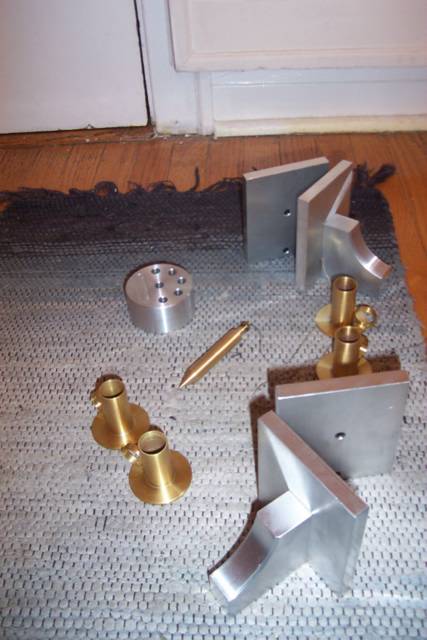
Those are the pieces I made in the machine shop class. Two sets of bookends, four candle-stick holders, a plumb bob, and a paperweight/pencil holder. The silvery ones are aluminum, and the goldish ones are brass. We used a grinder, a horizontal band saw, a vertical band saw, a milling machine, and an oxyacetalene torch, to solder the tubes on the candlestick holders to their bases. It was not, technically, welding. But I did have to light the torch myself.

One of my bookends has an extra set of holes on the bottom. That's because, in trying to make the holes threaded so that I could put a screw in them, I accidentally broke a tap off in one of them. Also, one of the ring-shaped handles on the candlesticks is loose, because they too are held on by little screws, but I went too deep with the center drill and made my hole a little too big for the tap, so that there are only one or two threads in the hole, and the screw doesn't tighten well.

Still, I did better than I thought I would, considering my general level of clumsiness, and the inability to erase mistakes.

The guy who taught the class, Jim, is retiring this quarter after forty-something years of doing this. He has infinite patience and is good at explaing things without making you feel stupid, even if it's the fourth or fifth time you've asked. I feel lucky to have gotten to take the class with him.

All in all an experience I am grateful to have had. Even if I'm also grateful not to have to get up so early on Tuesday mornings anymore...

Monday, March 06, 2006

Long Days

Have I missed the weekend again? It just doens't feel like a weekend, is the problem. We worked yesterday.

Not an unsucessful day at work, actually, but to do anything these days takes longer and longer. First we have to turn on the cooling systems, and turn on, warm up, and tune the lasers. The tuning by itself can take all day, if we're unlucky.

Then align all the beams. This involves turning little screws on the back of the mirror mounts to change the angle. We have little targets set up to help us aim them correctly, irises which open when you're done with them to let the beams pass through. You have to start from the first mirror and go down the line, because if you're off by a small angle at the beginning, you'll miss mirrors entirely, toward the end. Also you have to make sure the beam is passing through all the different lenses and frequency shifters correctly. With so many beams and such long paths this always takes a couple of hours, and is tedious and repetative. If we have to change the beam paths for any reason, that can take an extra hour, or all day.

Parts of the beam are split off and sent through rubidium vapor cells, where, if they are at the right frequency, they are absorbed. We have electronics to adjust the lasers if the beam stops being absorbed (meaning that the laser frequency has drifted). But the electronics are complicated and don't always work. So getting that going can take a while too.

Meanwhile Ken has turned on the heaters that vaporize the rubium for the trap. Once everything is ready, assuming the vacuum pressure is okay, he opens the valve the releases the stream of rubidium vapor into the main vacuum chamber, and looks for a trap. He gets it every day now, reliably. But usually it starts out weak, and more alignment has to be done, and frequencies adjusted, before it will get big and bright.

Now we set up and mount any equipment we will be using for today's trial. Oscilloscopes, high voltage power supplies, light detectors, function generators, etc. Our post-doc does most of the electronic configuration. He's very good. We run lots of cables. More alignment, to make sure the light is getting onto the detectors.

Now, finally, we are ready to begin. We turn off the lights. (These detectors are sensetive. Room light could damage them.) I babysit my laser, changing the frequency when called upon, and making sure it doesn't change when it shouldn't. Ken babysits one of his lasers, and pours liquid nitrogen into the part of the vacuum system from time to time (this helps keep the pressure down.)

Lately his job also includes casting a shadow on the detector, which is picking up light sources we can't control. If he moves, it stops working.

Our post-doc watches the function generators and oscilloscopes and calls out instructions for us, parameters to change. Make this beam stronger. Make this beam weaker. Change the frequency. Scan the frequencies. Block this. Block that. Make the pulse longer. Make the delay shorter. He is looking for certain effects on the light the detector picks up. If he sees them, he saves a trace and calls us over to look.

Not every day is like this. Sometimes we are assigned other projects to work on. But this is the priority, and it always comes back to running this experiment in the trap.

Yesterday we saw an effect we were looking for -- two of our beams prevented one another from being absorbed by the rubidium in the trap. (This is supposed to be useful one day in making the basis elements of a quantum computer. If you don't exactly see how, join the club.)

Today... We get to do it all over again, probably.

Friday, March 03, 2006

The Power of Procrastination

I usually skip the speakers invited to talk by my department. I went a couple of times at first, but didn't find it rewarding. What these speakers are usually trying to do, is impress you. This means they use a lot of jargon and complicated graphs, and try to cram every result they've ever gotten into a one hour presentation. So you, as an audience member, have little to no chance of understanding what they're talking about at all. First, because they don't leave themselves time to explain the basics of their field. Second, because if you understood, you probably wouldn't be as impressed.

But last night I made an exception. Our whole lab attended a talk by Jorge Cham, the creator of Piled Higher and Deeper. You know, that comic strip I keep linking to.

He was great. It was like stand-up comedy with Powerpoint. Why don't more stand-up comedians use Powerpoint?

It was also thereputic. The thing about these comics is, we've all had these experiences. We've all been humiliated. We've all been ignored. We've all panicked. We've all been depressed. We've all been desperate. We've all felt like imposters. We've all considered quitting. According to a study Cham cited, 10% of us have considered suicide, and 1 in 200 actually attempted it. But we never see each other. We all think we're alone. The strip is nice because it tells us we're not. This guy we've never met knows exactly what we're going through. And he has thousands of readers. And he told us to look around the room and see how many people from our own university were laughing at these painful jokes, about being ignored by your advisor. About getting nowhere on your project. About having your ego crushed. About feeling overwhelmed.

At it was really nice to see all these people, to laugh with them. (Our post-doc was laughing so hard he could hardly breathe. That was nice to see.)

The title of the talk was "The Power of Procrastination." The message was -- yes, there are more important things you should be doing right now instead of attending this talk. Or watching TV. Or hanging out with your friends. Or being outside. But there will always be more important things you should be doing. You can't ever be finished with them. So you have no real choice but to put them off, if you ever want to do anything else. Try not to feel so guilty about it.

There were also some words of warning, now that he's graduated -- writing your dissertation will nearly kill you. You will not be happy with your work. And no one will ever read it. But the tenure process makes getting your degree look easy. This is why your professor has no sympathy for you. The academic job market sucks (but you don't have to stay in academia.) Get used to being rejected.

Man, for some reason when I say it, instead of him, this stuff sounds a lot less hilarious...

Interestingly, this morning, I followed a link from Word Munger to a page postulating that the reason there aren't more women in university science departments, is that jobs in university science departments are terrible. Their only attraction is as booby prizes in a sort of pissing contest, and women don't do pissing contests. Those jobs do seem more attractive if you are from China or India, where the standard of living is lower, but immigrant work forces are usually composed mainly of men. (In case you're wondering, Americans are traditionally the minority among physics grad students at major universities.) This sounds pretty cynical, but last night when Cham said the Big Question of grad student life was "Why?!" he got one of his biggest laughs. It's funny 'cause it's true.

Sounds like a depressing talk, but really, it put us in a good mood. It's just so reassuring to be told that it's not us, it's the system. We may feel like failures, but so does everyone else. And there's nothing wrong with a little procrastination. It was exactly what we needed to hear.

Thank you, Jorge Cham.

Sunday, February 12, 2006

Lab Lit

I have been reading more "Piled Higher and Deeper". I already linked to my favorite cartoons, but now I have a few more.

They're all depressing, but number 136 and number 137 particularly so, because hit so close to home... Still, it's nice to know I'm not the only one who feels this way.

Then there's one about what grad school doesn't teach you...

And the answer to a moral dilemma, which is very similar to the one a friend gave me when I first started...

And some practical advice for group meetings...

And how funding problems are resolved.

I was prompted to start re-reading these by the true lab story post over on Uncertain Principles, which explains
'A true lab story is never moral. It does not instruct, nor encourage virtue, nor suggest models of proper scientific practice, nor restrain graduate students from doing the things that graduate students have always done. If a story seems moral, do not believe it. If at the end of a lab story, you feel uplifted, or if you feel that you have learned some useful fact about science, you have been made the victim of an old and terrible lie.


He mentions this in the context of lab lit, of which "true lab stories" are a sub-genre. Following his links, I find more examples of lab lit. There's a couple of books I've read on that list. And if the Connie Willis books there are classified as "lab lit," then so is all of "Piled Higher and Deeper." So now I'm trying to write a story of my own, and reading PhD for procrastination inspiration.

I'll let you know if I ever finish it...

Monday, February 06, 2006

Measure Twice -- Cut Once

Part of me has always been attracted to science because it's not girly. "What's wrong with girly?" you ask. Well, the good feminist in me would rather do non-girly things because she doesn't like the implication that she can't do them. The evil anti-feminist in me likes non-girly things better because girl stuff is boring. It's usually guys who have all the adventures, in books and movies and so on, and when girls do participate (Alien, Alias...) you get the feeling they're not the kind of girls who sew.

So... what could be more manly than machine tools? Drill presses, grinders, band saws, spinning blades of all descriptions, capable of slicing right through steel (and bone! Grr!) Mere "power tools" are for wimps. Oh, and soon we'll be welding!

But what I have learned (and I commented briefly on this before) is that the actual skill sets for these things seriously overlap those of the girlier arts.

For instance -- it is amazing how similar the workings of a vertical band saw are to those of a sewing machine. Sewing machines have a spindle and a bobbin. Vertical band saws have a drive wheel and an idler. The main difference is that the thread keeps unspooling, while the band simply goes round in circles, but the mechanics are the same. On a sewing machine, you can lower the "foot" to hold your material in place and ensure that you stitch a straight line. On a vertical band saw, you can lower a foot to hold your material in place and ensure that you cut a straight line. Except I think they don't call it a "foot." That's just what I've been calling it, in my head. Both are manual drive machines, meaning that the needle (or saw blade) moves up and down and the operator moves the fabric (or metal) across. Stitching a curved line and cutting a curved line are both difficult, but if you can do one, you can do the other. Treat the needle (or blade) as the center of the circle and move the work piece in arc around it as you push it through. Both have adjustable speeds, and you need different needles for different fabrics, just as you need different blades for different metals. And don't kid yourself: a needle through the finger may not be quite as bad as a slice through the tip, but it's nothing you're gonna laugh off, either.

The last step of our first project (a plumb bob) was to put a piece of string through the hole we'd drilled. This was difficult, 'cause the hole was long and the string was floppy. I couldn't resist pointing out that a tool existed for doing this job - the humble needle threader. This is just a fine piece of wire folded into a loop. Stick the loop through the hole in the needle (or screw). Put the thread through the loop. Pull the loop back through the hole. They didn't have any of those in the shop. I have one at home, in the little sewing kit I bought the last time my keys tore through the lining of my coat pocket.

And then there's the whole process of planning, measuring, marking, tracing, leaving extra material around the edges on your first cut, the scrap baskets for small pieces that might come in handy later.... And honestly, is my plumb bob really any more useful than any of the decorative pillows I made in Brownies?

Okay, sewing doesn't involve fire, and machining eventually will. But on the other hand, cooking does, at least if you use a gas stove. (Man, I hope the welding torch lights itself. I hate lighting invisible streams of gas. Stoves, ovens, fireplaces, Bunsen burners... I always panic that either I'm going to somehow light the whole stream of gas, all down the pipe, and explode the building, or fill the room with gas and explode the building.)

I feel like I've made a discovery, here. Like there can't be all that many people who've noticed these similarities, because how many people have actually used both a sewing machine and a vertical band saw? How many people took both shop class and Home Ec in high school? Why are there so few? If you enjoy one of them, you ought to like the other. It's all about working with your hands, making things. If you're good at one, you'll be good at the other. What I think we need, is a class that teaches both.

Friday, January 27, 2006

Trap Day

Day before yesterday, Ken got a trap.

Yesterday he got it again, only bigger and brighter.

Yay! Hooray! You're cheering, right?

No, you're asking "What's a trap, and why does it matter?" That's the problem with achievements in a field like this -- any specialized field, I guess.

A "trap" is a small collection of atoms held suspended in mid-air -- except actually there can't be any air in the system or it won't work. A small collection of atoms held suspended in mid-vacuum. They aren't touching anything at all. They are surrounded by almost perfect nothingness. What holds them up? Laser beams, and a magnetic field.

The technical name for it is a "magneto-optical trap." You can actually see the atoms hovering there, a small glowing spot a few millimeters to a centimeter in diameter. You can see them because the lasers make them glow. In our case, they glow in the infrared, so you have to use a viewer to see the light, but here is a picture of someone's sodium MOT, that looks just like ours, only glowing with yellow light.

How does it work? Light actually does exert a force when it interacts with atoms. It can slow them as they come out of a nozzle. If you have light beams pushing up, down, left, right, forward, and back, it can keep atoms from escaping in any direction - it can trap them. Now the problem is to make sure that it exerts the right amount of force, and more, that the left-pushing beam only operates on atoms that are moving to the right, and not on those already moving leftward, and likewise for the other beams. This is where the magnetic field comes in. It changes the properties of the atoms, so that atoms in one part of the field interact with a different kind of light then atoms in the other part, and atoms further from the center are pushed harder than those near it. How do you calculate these forces and interaction energies? Um... Ask Ken. But give him time to go through his notes first.

The best explanation of laser cooling and trapping for the non-scientist (OK, and for the scientist as well. I personally need help turning the math into a conceptual picture) is at the University of Colorado's Bose-Einstein Condensate page. It's got little java videogames (hit "next" at the bottom of the page to see more), to let you try your hand at some laser cooling of your own. In our lab, we stop short of the "evaporative cooling" stage, and we don't get BECs. But we do get cold atoms.

What's nice about cold atoms is that they don't bump into each other so much, and they all have about the same velocity (close to zero). Any time you want to do an experiment that involves putting atoms into certain quantum states (you do this with lasers) -- you really want to do it in a trap, because if the atom collides with anything, your state is ruined. Also, you have to use different laser frequencies depending on the velocity of your atom, so if you can arrange for all the atoms to have the same velocity, you get better results.

So, Ken's project involves putting atoms into a certain quantum state, called the "dark state". You can control whether atoms in this state absorb light or not, and if they don't absorb it, what kind of "phase shift" they give it. (A phase shift just makes the peaks and troughs of the wave occur in different places.) This is supposed to be analogous to what some parts of a computer do to electronic signals and would supposedly be useful for some hypothetical quantum-computer, someday. Possibly. Maybe. Whatever. It means Ken is one step closer to graduating.

It's been a long, gruelling, frustrating process. The lab used to have a trap, and Ken worked on it, but with the departure of one of our post-docs, the whole shebang became Ken's responsibility. There are so many working parts to this, what with three lasers, at least nine different beams to align, electronics and optics to lock the lasers, frequency modulators, waveplates, beam expanders, magnetic coils, cooling water, and, oh yes, the vacuum. The pressure has to be on the order of 10^(-10) torr. Atmospheric pressure is 760 torr. Three different pumps, each with their own plumbing, their own gaskets, their own impossible-to-reach nuts and bolts. So many things have to work, all at once...

Only three people ever understood this system. The other two are now gone. Our former post-doc was able to consult a little, and I could help do the two-person jobs if he told me what to do (turn a knob at this end of the table to adjust a beam at that end. Turn the gas on and off to blow sealant through the coils, etc.) but Ken ran the operation, knew what had to be done, and succeeded.

So now you have enough information to understand what these pictures mean, scientifically and emotionally.


This is the vacuum chamber, in which the atoms are trapped. You can see a camera on the right-hand side.


This is what the camera saw. That bright dot at the center is the trap.


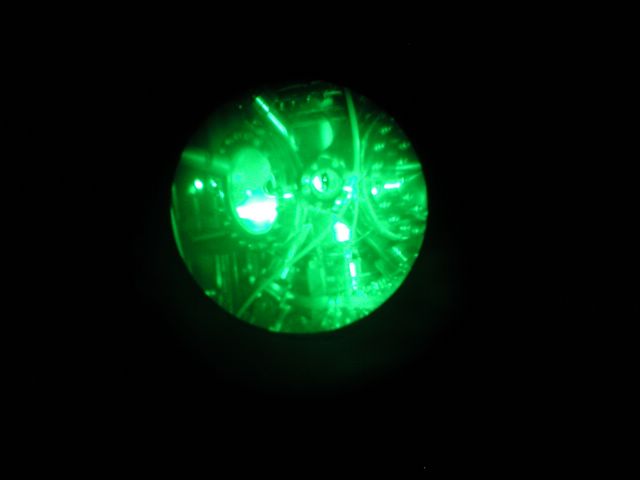
This is my attempt to take a picture through the viewer. The trap is very clear and bright, if you just look through, but it's hard to take pictures through an eye-piece. Anyway, click on the picture to enlarge it, and you can see it, a bright dot at the center of the small window.


This is what the vacuum gauge reads: 7.1*10^(-10). That's .00000000071 torr. Thank you, vacuum gods!

Monday, November 14, 2005

More Lab Pictures


This is a seventies era argon ion laser. You can just about see the orange case at the bottom, even though the cover is off. We were told to figure out if it would still work. The first time it was tested (Ken and I were safely in Europe, fortunately) it blew a fuse.


The fuses are those white cylinders sitting horizontally in the middle. They're bigger than a roll of quarters, maybe the size of a roll of half-dollars. The blue cylinders at the top are capacitors as big around as my forearm. I can't remember how many thousands of volts I was told this thing needed for initial discharge, unfortunately. It was a really impressive number.


Looks like it works. But those are some weird error messages... Turn it off!


Liquid nitrogen is less dangerous. The thing it's spraying from is an ion pump, for the vaccuum system. Liquid nitrogen cools parts of this thing, and then the rubidium vapor condenses on them, like water condensing on the inside of your car windows when they're cold. This gives a higher vacuum. Or so I'm told.


This was sent with one of our orders from Thorlabs. They are now my favorite optics company.