Sunday, October 22, 2006

Things That Look Cool

* Close Up Pictures of Snow Crystals via Girl Hacker

* A photographer who made his famous subjects pose in midair via MetaFilter

* This is what the end of the world looks like Links to missile test pictures at MetaFilter

* Manhole covers of Japan via Making Light

* The Biomedical Image Awards We know lots of people in biomedical imaging these days... Also via Making Light.

* Photos of Mars they need your help cataloguing all the craters. Computers aren't good at it. Via User Friendly I think.

* The Sidewalk Art of Julian Beever via Making Light and User Friendly.

* Mars in 3-D I'm sorry, I forget the source.

* The Nieman Marcus Catalog featuring a cruise in a space ship.

* Light and line Great shots by Chicago Tribune photographers. Registration probably required.

* Our pumpkin. Ken suggested I try to carve this Bears logo, and it turned out great.

Tuesday, October 17, 2006

Bears Win

Did you see that Bears game last night? The Chicago Tribune called it a Monday Night Miracle. On national television, the Bears came back from the 20 point deficit they were looking at in the third quarter. The offense looked like amateurs and never managed more than three points in the whole game, while turning over the ball six times. But the defense and special teams proved they could win the game all by themselves. By one point. That one point lead wouldn't have been enough, of course, if the Arizona kicker hadn't missed his easy shot in the last minute of the game. Man, two and a half hours of painful, boring futility, followed by half an our of shouting ourselves hoarse, and a final minute of jumping and dancing and arm pumping. I guess American football can be as exciting as Ken says it is... And the Bears are still unbeaten.

But how does their defense do it? The Onion reveals their secret.

Monday, October 09, 2006

October Poem

October

By T.A. Daly

Come, forsake your city streets!
Come to God’s own fields and meet
October.
Not the lean, unkempt and brown
Counterfeit that haunts the town,
Pointing like a thing of gloom,
At dead summer in her tomb;
Reading in each fallen leaf
Nothing but regret and grief.
Come out, where, beneath the blue,
You may frolic with the true
October.

Call his name and mark the sound,
Opulent and full and round:
“October.”
Come, and gather from his hand
Lavish largess of the land;
Read in his prophetic eyes
Clear as skies of paradise,
Not of summer days that died,
But of summer fructified!
Here, O soul, his message sweet.
Come to God’s own fields and meet
October.

Tuesday, October 03, 2006

News of the New

Apparently a couple of Americans have won the Nobel Prize in physics. They worked on the COBE satellite, measuring the cosmic microwave background. Microwaves are, of course, just a kind of radio waves. The microwave background is nothing but static, noise. The point is that it doesn't have a source. It seems to come from all directions at once, from all over the sky. It was first discovered by accident by scientists at Bell Labs trying to build a radio reciever, who weren't happy that no matter where they pointed the thing, they couldn't get rid of the noise... But it's not quite the same in every direction, and that's what the COBE satellite measures. The little tiny differences. Since the only possible source for radio waves that come from everywhere is thought to be the Big Bang, studying it can tell us something about the beginning of the universe.

But the Nobel Prize people do more than just give out awards. They also create cheesy flash animation games. Certain members of our lab who shall remain unnamed have no problem playing this at work, since after all, it's educational! It's on the Nobel Prize website, and it's about lasers. We're supposed to be learning about lasers, right? Thanks to Chad Orzel for the link.

In other space news, did you see that Neil Armstrong got his line right after all? The story says

Some historians and critics have dogged Armstrong for not saying the more dramatic and grammatically correct, "One small step for a man ..." in the version he transmitted to NASA's Mission Control. Without the missing "a," Armstrong essentially said, "One small step for mankind, one giant leap for mankind."

The famous astronaut has maintained he intended to say it properly and believes he did. Thanks to some high-tech sound-editing software, computer programmer Peter Shann Ford might have proved Armstrong right.
...
In a graphical representation of the famous phrase, Ford said he found evidence that the missing "a" was spoken and transmitted to NASA.

"I have reviewed the data and Peter Ford's analysis of it, and I find the technology interesting and useful," Armstrong said in a statement. "I also find his conclusion persuasive. Persuasive is the appropriate word."


I, personally, am very glad to hear this. I know some people who would say that there is something to be learned from the original story about an embarrassing human error at the moment of a great human achievement, that it's the difference between real life and myth, and it's important to remember... I say we need mythic achievements these days more than we need reminders of human fallibility. I hope that history books from now on record the line as it was meant to be.

Not all of us get to walk on the moon, of course. But a few teachers got to experience weightlessness recently, in a special airplane like the one astronauts use for training. Sometimes called "the vomit comet," I believe... The idea was to get the teachers excited about science, so they could go back and get their students excited (and incidentally get some publicity for Northrup Gruman, who sponsored it.) But supposedly half of all people get space-sick their first time in zero g. And you only get thirty seconds or so of weightlessness at a time, not enough to acclimate. So you gotta think about half those teachers weren't all that enthusiastic about the experience... But hey, I'd risk it.

Sunday, September 24, 2006

Some Links, Some Thoughts

On science related topics:

Peter Woit writes about "open access" journals.. You probably know that scientific theories and experimental results are supposed to be published in "peer reviewed" journals. You may not know that the only subscribers to the physical copies of these journals are university libraries. That's because those subscriptions are expensive. Or that no one these days ever really looks at the physical copies. The university library usually has a subscription to the electronic edition too, you see, much easier to access. (But also expensive.)

Also these days many papers are available on the so-called "arXiv". (The X is a greek Chi. Get it?) Papers on the arXiv have not been peer reviewed yet, may not ever actually be published. But since results appear there months earlier than in the journals, and since papers which will end up in all different journals are available there in a single place, it's very popular.

So to me, the question is, does it make sense to write papers to fit the limitations of print? The shortage of space in print journals means that there is usually no room for a whole derivation, so equations are presented without justification. Results taken from huge data sets are summarized in single graphs. Basically, everything has to be compressed until it's so cryptic that even "peer" reviewers (who are not always specialists in the precise sub-fields of the papers they're sent) have little chance of working out whether the equations make sense or whether the results are reasonable.

And, of course, lots of papers are rejected by the more prestigious journals, not because they're wrong, but because you can only fit so much in an issue. This makes the ego-driven, status-seeking aspects of "publication" even worse.

But the "Open Access" movement apparently doesn't want to move to electronic journals, but to pay-to-publish print journals!

Speaking of the ego-driven, status seeking aspects of publishing: Piled Higher and Deeper has a simple diagram of how it works.

Okay, but before I get too cynical, I'll go on to "Cocktail Party Physics," a non-academic, un-mathematical blog by science writer and Buffy fan Jennifer Ouellette. Her enthusiasm for the subject usually restores my own a little, (so does Pyracantha's.) Inspired by the internet holiday called "Talk Like a Pirate Day," she proposes Talk like physicist day. I think we should combine them. Argh, matey, that plank is a simple harmonic oscillator and you're about to find out its natural frequency!

And Chad Orzel, a working researcher in (more or less) my own field, reminds me that as frustrating as the impossible experiments we try to do on our cold atoms may be, the basic idea of laser cooling is still pretty awesome. He describes the first time he heard of it, as an undergraduate "Right about there, I was hooked, just because it's such a wonderfully counter-intuitive idea. When you think about hitting something with a laser, you don't imagine that it'll get cold.". He then describes the basic concepts involved, continued in the following post. This is the theory behind a lot of the stuff our lab does, if you're at all curious. Ken is the university's laser cooling and trapping expert, these days, as the operator of the only working atom trap. Even when the research is stalled, that's still a pretty cool position to hold.

Finally, Mark Chu-Carroll has a post about working in a academia versus working in industry from the point of view of someone who works in industry. Of course, his field is computer science, but a lot of what he says seems to be true in general. He says, "When I started working on my PhD, I had no intention of going to work at an industry research lab. I went to get my PhD specifically because I wanted to teach." The story of how he wound up where he is, especially the parts about not having as many publications as he'd've liked, and research politics, and the constraints of being married to someone with her own career, and the fun he had working at his current lab as an intern compared with the pressure to get grants and get papers published in academia, are all really interesting to me. And the fact that he's so happy with how it worked out is very encouraging.

It's also really encouraging that some post-doc friends of mine recently got permanent jobs of their own, outside the academic track (and in very diverse places.) We'll probably see one of them, at least, at a conference we're attending next month (my first one! I'm nervous about it.)

In the end, the best advice is probably Timothy Burke's. Accept that your first job out of college or grad school is not going to be great. Accept that you're going to be paying some dues. Just because you don't get the cool job right away, doesn't mean you never will... So I should relax.

I'll try.

Wednesday, September 20, 2006

September Poem

Dunno what this one means, but it suits my mood.

W.H. Auden

For what as easy
For what thought small,
For what is well
Because between,
To you simply
From me I mean.

Who goes with who
The bedclothes say,
As I and you
Go kissed away,
The data given,
The senses even.

Fate is not late,
Nor the speech rewritten,
Nor one word forgotten,
Said at the start
About heart,
By heart, for heart.

Monday, September 11, 2006

The Final Frontier

I'm a fan of the space program. Not a hardcore fan, maybe, not a self-made expert like some I've known. But, y'know, I watched Apollo 13 four or five times in theaters and the HBO series "From the Earth to the Moon" and "The Right Stuff" and then I read some of the books that those are based on. And yesterday I picked up We Seven, purporting to be an account of the "most magnificent adventure of modern times, told by the heroes who achieved it" -- the Mercury astronauts.

And then there's all the science fiction dating back to the early days of the space program that I still love. When I bought the Mercury book, I also picked up Stowaway to Mars by John Wyndham. "An international prize of over a million dollars was being offered to the first man to complete an interplanetary journey. Target -- Mars. [...] Dale Curtance of England didn't need the fortune. He was a millionaire. He was an eccentric. But most of all he was an adventurer and he was determined to win. [...] There were going to be many surprises. And they all began with the stowaway aboard Curtance's ship. A stowaway to Mars. A woman."

Who could resist that?

The great part about space travel is that it blurs the line between science fiction and reality. For instance, there is the X Prize Cup, which has already awarded a ten million dollar prize to a spacecraft developed by a billionaire. Now they plan to offer more prizes. And a British billionaire has joined forces with the American one to try to put the prize-winning craft to use.

And NASA really is planning to go to Mars, and back to the moon. The Constellation program borrows ideas from Apollo (and so resembles the science fiction of that era too) for the design of a vehicle versatile enough to handle both, supposedly, and dock with a space station too. Lockheed Martin got the contract. They're hiring in Colorado. My mom sent me an e-mail alert. But I don't really want to build it, so much as fly in it... Maybe I'll stow away.

Realistically, private space tourism is probably is the only way I'm ever going to get any kind of taste of space. Right now it's a little out of my price range, around $20 million to go up aboard a Russian Soyuz and an extra $15 million if you actually want to do a spacewalk. I'm saving up.

There is one other option. You can move to a small country and talk them into buying fighter planes from Russia, and hope the Russians throw a trip in to "sweeten the deal". That's how Malaysia's getting its first astronaut to space. Whoever it is will attempt to make Teh Tarik (pulled tea) in space. This will be a challenge because, normally, it involves pouring "boiling-hot milky tea swiftly and repeatedly from one vessel held high in one hand into another held low, producing a distinctive layer of froth."

If I ever go into space, I'm going to drink my national beverage: Diet Coke. I can think of all kinds of experiments to do with that. Shaking the can, ditching the can altogether, maybe even bringing along some Mentos.

Sunday, September 03, 2006

Happy Birthday to Me

Actually I did have a happy birthday yesterday. I love that my birthday falls 1) on or near a three day weekend, every year 2) at the beginning of my favorite season. And now that it's not "back to school time" for me anymore (I never left), my only worry is allergies. What the heck is it that blooms in September and makes my nose go nuts?

But the season is worth the sneezing. In Chicagoland, fall is by far the nicest time of year. Seventy degree days with golden sunshine and cool lake breezes. And yesterday was the most beautiful day in the history of the Earth. I went for a long run, interrupted in the middle by a little while laying on a bench and watching the sailboats pass in front of the skyline and letting myself be hypnotized by the sunlight flashing on the water.

I got a bracelet, money, flowers and (yet to come) running shoes from my parents. I asked for the running shoes. From my husband, I got, not the new watch I had asked for, but my beloved old one, repaired. He snuck out and got this done while I was making copies the other day, never even knew he'd left. I also got a new wallet (the one I had was in shreds, but I hadn't been able to find one like it) and and candy and glow in the dark solar system and Star Wars stickers. I will be taking general relativity soon, after all. A girl's got to decorate her binder.

He also took me out to dinner -- capellini pomodoro, red wine, and chocolate cheese cake, with a candle. Mmmm.

Then we went for a walk, back out in that beautiful sunshine. And I got phone calls from family, and fell asleep watching the Saturday night B-movie on Svengoolie. I tell ya -- this is the life.

Sunday, August 27, 2006

Real and Imaginary

I've got a few blog entries marked "keep new" in my Bloglines feed, because I keep meaning to get around to writing about them. The problem is that they're on intimidating subjects, which deserve long, thoughtful posts, and it's hard to muster that much mental energy. But they nag at me, and so perhaps I'll just try to say something about them, and link to them, and get it over with.

One is a sort of rambling post by Lance Mannion called The Purpose of Religion.

In it, he says


Faith, that is the belief in things unseen, is willful stupidity. Faith is believing that what your eyes and ears tell you is secondary to what your imagination allows you to wish were true instead. Faith is a belief in nonsense. To have even a little faith is to believe in nonsense and to open your mind up to all kinds of other nonsense.


That sounds harsh, and later he backs off it a little -- he seems to be trying to say that he can see the appeal, unlike some atheists. But seeing the appeal is not the same as approving.

By contrast, Pyracantha posted a nice series of short essays beginning with Science Religion Imagination Realities, part I (and continuing with part II, III, IV, and V) wherein she summarizes the conflict between those who believe in the supernatural and those who do not, and places herself somewhere outside of that, as someone who believes that the supernatural exists in our minds, and that this kind of existence, while unphysical, is still real.

She thinks that scientists will scorn this unempirical, irrational view of the world. But I think that if they do, they're hypocrites. The thing is, scientists believe in math. Math is unphysical. And yet you'll have a hard time finding a scientist who doesn't believe the person who discovered the value of pi (or rather, the means to calculate it to as many digits as you please) didn't discover something real about the universe.

I had this argument with a philosophy professor in college. I said, "Pi doesn't exist." He said, "Yes, of course it does." I said, "Show me where." He said, "It's implicit in every circle." I said, "Show me a perfect circle."

I don't remember how he answered that. It seems to me unanswerable. There are no perfect circles. Pi is an idealization, and abstraction, an idea.

The same goes for every theorem ever "discovered" by mathematicians. They are really invented. They rest explicitly on unprovable assumptions. Some of those assumptions are even acknowledged to be inconsistent with what we see about the universe around is, and yet scientists believe theorems about hypothetical spaces where triangles have more than 180 degrees to be, nevertheless, "discovered," to be in some sense, facts.

But it doesn't stop at math. If pressed, most scientists will admit that they believe in such abstractions as justice, friendship, and personal identity. All the fictions that human beings live by. You can't kick justice, you can't measure friendship, and no one is really the same person from moment to moment; nobody is consistent or predictable enough in their behavior to qualify as a real scientific phenomenon.

The metaphor that I like, I got from Buckminster Fuller. It's something like this: these abstract things are like knots tied in a rope. You can't have the knot without the rope, of course. The knot, by itself, isn't a physical thing. It's just a pattern. The physical thing is the rope. But the knot is really there, nevertheless. Another metaphor for the same thing: a mosaic. Let's say a mosaic depicting an elephant. The stones are physically there. The elephant is not, has no existence beyond the stones. It's true, there is no elephant. And yet everyone who sees it knows exactly what it is.

Buckminster Fuller said that energy was the rope, and even matter was just a knot in it. Because matter is created and destroyed (in nuclear reactions, usually) but energy, on average, is not.

You can extend these metaphors. What if I make a pattern out of knots, two and then one, two and then one? Is the pattern really there? But it only exists in the knots, which only exist in the rope. You could even imagine using the knots to make morse code, or the mosaic tiles to make letters, and spelling out the word "apple." In what sense is the apple "really there"? (It must be a little bit really there, because if I show it to people and tell them to go fetch one, they'll consistently -- repeatably! -- come back with real, physical apples.)

So that's my take. The difference between a real person and a fictional character is a level of abstraction, the difference between a knot and a pattern made out of knots.

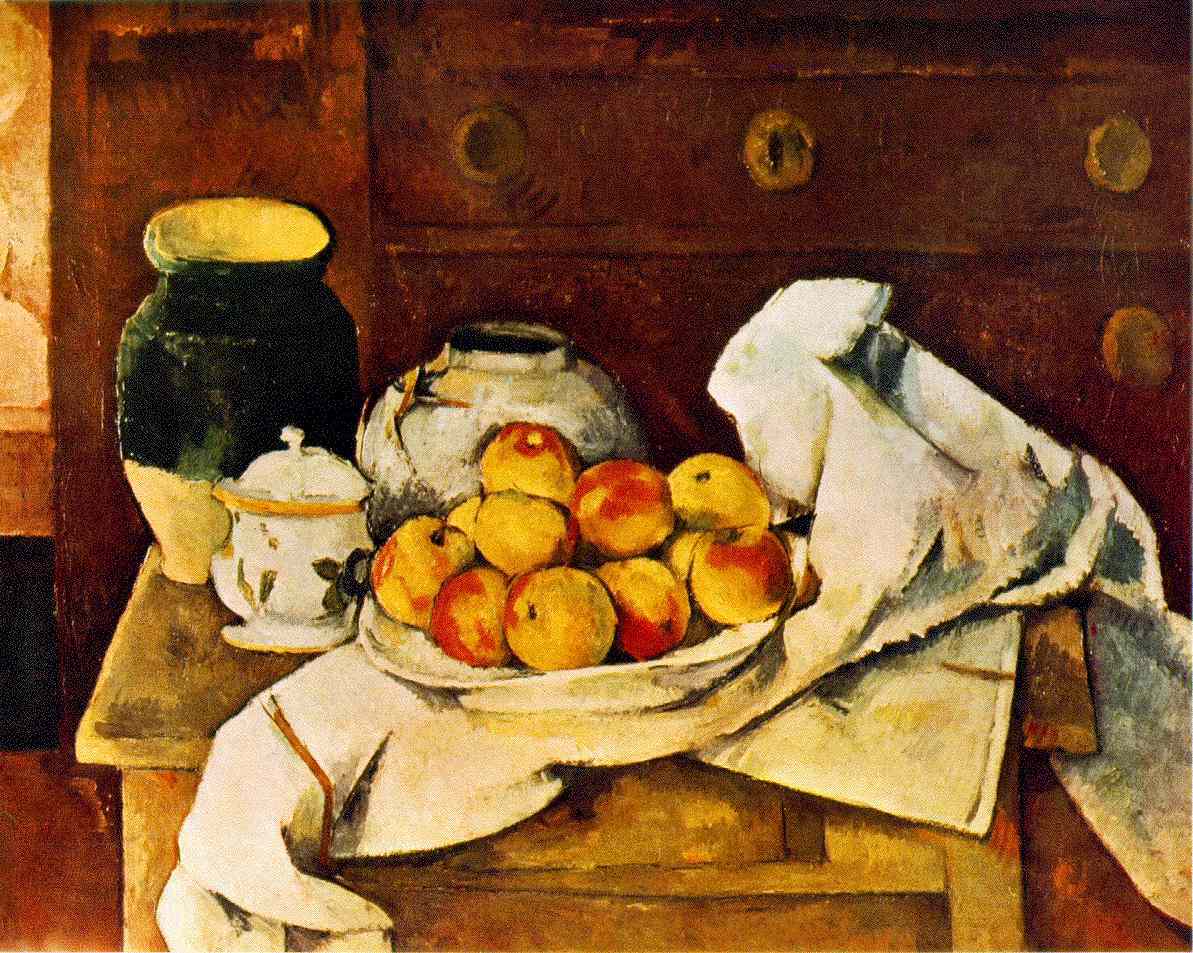
Now believing that a God exists at some level of abstraction is not likely to satisfy a genuinely religious person, since Sherlock Holmes also exists, at some level of abstraction. The question is, is God a pattern in the universe, or a pattern in our minds? What level of abstraction? This ambiguity is sort of like a Rorschach test or an optical illusion -- is the image on the page or in your head? But maybe either way, it hardly matters. The mind is so many levels of abstraction away from matter and energy anyway, what's one more, give or take? If it exists in the mind, it's only a little further from the physical than we ourselves are. And it can still have consequences in the world, can still make people fetch apples. Of course, the only difference between a right theory and a wrong theory in science is also the level of abstraction (wrong theories exist only in your head), but if God is not a scientific theory, is more like a work of art? Does it really matter if a this still life was painted from a model or simply created in the artists' imagination? Does it matter if he got the details "wrong"?

Statements like Lance Mannion's seem to me like someone looking at a mosaic and insisting that there is no elephant, only a bunch of stones.

Tuesday, August 22, 2006

You Say You Want a Revolution

Maybe the odds are a bit better for Big New Physics being developed in my lifetime than I thought.

It appears "dark matter" is no longer just speculation. Here's some observational evidence that there is something out there that we can't see.

Short explanation for those who've never heard of dark matter before: for a long while, it's appeared that the galaxies and other astronomical objects we can see don't move the way we'd expect them to for the mass they appear to have, if they were just acting under the influence of gravity. So physicists speculated that either they were more massive than they look (by a lot!) or our understanding of gravity was wrong.

But there are apparently reasons to believe that if they are more massive than they look, that mass doesn't come in the form of stuff made of neutrons and protons and electrons. It seems it has to come from something that doesn't interact with normal matter by almost any means except through gravity, otherwise we'd be able to detect it. So ghostly "dark matter" was invoked. Such convenient substances have been hypothesized before, though, and eventually disproved, as in the case of luminiferous aether

Only all of the sudden it's no longer so mysterious, so speculative. It seems that some astronomers have found a couple of galactic clusters which collided, and the collision knocked the matter in them away from the gravitational center of mass. Now normally the center of mass is, you know surrounded by mass. That is to say, surrounded by matter. But here all the matter's been pushed away, and the gravity is still pulling things toward where it used it be. It's as if the Sun got knocked out of the solar system but the earth kept orbiting the point where it once was. You'd have to assume there was something else there, right?

The revolution will come when and if we ever figure out what dark matter actually is, besides all around us.

(Actually dark matter still isn't enough to completely explain the dynamics of the stars. Something else, called "dark energy" or sometimes "the cosmological constant," is invoked to explain some aspects. But that remains in the realm of speculation and controversy for now. Anyway, I'm looking forward to finally taking that general relativity class this winter, and I'm sort of glad I'll be taking it after this dark matter discovery.)

Sunday, August 20, 2006

Low Sodium Soup

This is an advertisement. Why? Because I want this product to do well so that there is a market for similar products.

No salt added minestrone: low sodium soup from Health Valley.

Do you know how hard it is to find low sodium products?! Much harder than low fat or low calorie or even "low carb."

If anyone has tips or recommendations, leave a comment.

Friday, August 18, 2006

August Poem

I have been away, attending the funeral of my great aunt Mary, and then visiting my family for my mother's birthday and my sister's sixteenth birthday. It's been a strange trip, a funny mixture of sad and happy. My parents had to work during our visit, but my grandfather was there during the day. He was fun to hang out with, in spite of some medical problems of his own. My mom took us out to fancy dinners and then took me shopping on her birthday. Ken drove us, more than 2500 miles in all. That was stressful. And while we were there he drove my sister around to see some friends, get a haircut. He's a good brother-in-law. She passed her driving test yesterday and will soon be driving herself around.

I'm tired, after sixteen hours in the car yesterday, so it seems like a good opportunity to post the August poem:


On The Meaning Of Things
by Ana Castillo

(In memory of Dieter Herms)

He took me to my first opera.
I was 38 and he was dying.
He looked elegantly gaunt rather than infirmed
in an off-white double breasted jacket
suitable for summer.
It was 'Don Giovanni', in Italian with
German subtitles projected onto a screen.
"The plot is rather stupid," he said and already knew,
but enjoyed hearing Mozart again, the high point for him
being when he recognized an aria and could fit it
into the story.
He listened throughout near-faint
with the thinness of air, the crowded theatre,
and the constant drilling pain.
At intermission, he reserved a table
and we had champagne.
"This will be the last time we see each other,"
he said. "What is hardest for me to give up is memory."
I moved my seat closer to his, "Perhaps, memory too,
will be transformed," I said.
"Will I remember you?" he asked.
"In another way," I speculated,
as is all we can do
with the meaning of greetings and partings, and love
that resists death.

--Originally printed in Poesía, Ollantay Press, 1995


My aunt Mary never took me to see an opera, but she did own opera glasses, and used them for watching TV, or watching the pastor in church. She was going blind, her last years, and resented it, but the opera glasses helped. Aunt Mary worked as the admissions director for a fancy girls school in Dallas for 37 years (I went there for preschool and kindergarten) and moved in a set of rich and famous people who did go to operas. She did take me to breakfast and then to school, when I was about five years old, and we lived in Dallas. She did give me old books signed by famous authors she'd met, for my birthdays. It's funny how as soon as someone dies, they stop being old. They're every age at once. She's as much the person I remember from my childhood, now, as the person who was sick in the nursing home these last few years. She's the person I've heard stories about, who went to college and then began a career in Chicago before World War II, and then moved to Wichita to work for Boeing as a part of the war effort. The happier, younger Mary is as real now as the older, sadder one, who had already given up a lot of her memories... That's a comforting thought for me.

Wednesday, August 09, 2006

Mini Blog

I wrote a short story this weekend, so my writing muscles were too tired for blogging. Before I wanted to be a physics major, I wanted to be a science fiction writer. I figured a PhD was a good fallback... Turns out, it takes up a lot of your time. Who knew? But I recently joined a writer's group, as a way of having a social life, and it's motivated me a bit. People have weirder hobbies, right?

Only I still can't think of anything to blog about. So you get a little lazy blogging, which means, "repeating something I read in the Tribune." You heard it here second (or more likely, twenty-second. This must've gotten some publicity that I missed):

One Laptop Per Child.

That's the name of an organization that's developing cheap laptops for kids in developing countries. They give the village a wireless router and the kids computers, and presto, internet for everyone.

Apparently, Microsoft has problems with this idea. From the Tribune story:


At long last, MIT-associated computer experts gave a demonstration of a seriously working model of the final machine to be distributed to worldwide poverty pockets, to the dismay of some industry stalwarts, notably the folks running Microsoft Corp.

...

Craig Mundie, top new technology planner at Microsoft, has been quoted saying that a better solution would be to build such a computer around a cell phone--preferably one running Windows Mobile PC.

By picking the open-source and free Linux instead of Microsoft's products, if successful, the project could affect Microsoft's overseas sales to one degree or another.

Additionally, by picking small-fry chip fabricators instead of Intel for the 500 megahertz central microprocessor, the project has shunned the American industrial establishment since it was introduced by Nicholas Negroponte at the World Economic Summit in Davos, Switzerland, on Jan. 28, 2005.


Annoying Microsoft isn't the actual point, of course. The point is raising a generation of literate kids with technological tools and expanded horizons.

There's a view of the prototype here.

There seem to be lots of practical features built in, like a low-power black and white mode, and a hand crank for temporarily recharging it. But I wonder...

Are parents going to really let their kids use these? I mean, it looks like something for kids, but you'd think it would be such a precious possession. And these will get broken. I can imagine hundreds and hundreds of ways for kids to break these things. Their parents will be so furious... If your computer were irreplacable, would you trust your kid with it?

Then again, will the parents be able to use them at all? Or does it take a kid to figure it out? Technology, like language, seems to be a skill learned best when learned young. That seems to be the idea behind the project. Maybe parents will let their kids play with them, because the parents won't actually understand their value.