Google maps pedometer. Useful for planning running or walking routes. Saturday, which was the nicest day in human history, I apparently went 5.6 miles, passing through three different municipalities as I did so. And one of them, I went all the way across, northern city limits to southern city limits. Yes, I was so impressed with myself that I had to post it on my blog. Pathetic, I know.
Still, that makes six different cities that I've run to or through from where I live, counting the one I start in. Chicago suburbs are so small.
Monday, March 13, 2006
Monday, March 06, 2006
Long Days
Have I missed the weekend again? It just doens't feel like a weekend, is the problem. We worked yesterday.
Not an unsucessful day at work, actually, but to do anything these days takes longer and longer. First we have to turn on the cooling systems, and turn on, warm up, and tune the lasers. The tuning by itself can take all day, if we're unlucky.
Then align all the beams. This involves turning little screws on the back of the mirror mounts to change the angle. We have little targets set up to help us aim them correctly, irises which open when you're done with them to let the beams pass through. You have to start from the first mirror and go down the line, because if you're off by a small angle at the beginning, you'll miss mirrors entirely, toward the end. Also you have to make sure the beam is passing through all the different lenses and frequency shifters correctly. With so many beams and such long paths this always takes a couple of hours, and is tedious and repetative. If we have to change the beam paths for any reason, that can take an extra hour, or all day.
Parts of the beam are split off and sent through rubidium vapor cells, where, if they are at the right frequency, they are absorbed. We have electronics to adjust the lasers if the beam stops being absorbed (meaning that the laser frequency has drifted). But the electronics are complicated and don't always work. So getting that going can take a while too.
Meanwhile Ken has turned on the heaters that vaporize the rubium for the trap. Once everything is ready, assuming the vacuum pressure is okay, he opens the valve the releases the stream of rubidium vapor into the main vacuum chamber, and looks for a trap. He gets it every day now, reliably. But usually it starts out weak, and more alignment has to be done, and frequencies adjusted, before it will get big and bright.
Now we set up and mount any equipment we will be using for today's trial. Oscilloscopes, high voltage power supplies, light detectors, function generators, etc. Our post-doc does most of the electronic configuration. He's very good. We run lots of cables. More alignment, to make sure the light is getting onto the detectors.
Now, finally, we are ready to begin. We turn off the lights. (These detectors are sensetive. Room light could damage them.) I babysit my laser, changing the frequency when called upon, and making sure it doesn't change when it shouldn't. Ken babysits one of his lasers, and pours liquid nitrogen into the part of the vacuum system from time to time (this helps keep the pressure down.)
Lately his job also includes casting a shadow on the detector, which is picking up light sources we can't control. If he moves, it stops working.
Our post-doc watches the function generators and oscilloscopes and calls out instructions for us, parameters to change. Make this beam stronger. Make this beam weaker. Change the frequency. Scan the frequencies. Block this. Block that. Make the pulse longer. Make the delay shorter. He is looking for certain effects on the light the detector picks up. If he sees them, he saves a trace and calls us over to look.
Not every day is like this. Sometimes we are assigned other projects to work on. But this is the priority, and it always comes back to running this experiment in the trap.
Yesterday we saw an effect we were looking for -- two of our beams prevented one another from being absorbed by the rubidium in the trap. (This is supposed to be useful one day in making the basis elements of a quantum computer. If you don't exactly see how, join the club.)
Today... We get to do it all over again, probably.
Not an unsucessful day at work, actually, but to do anything these days takes longer and longer. First we have to turn on the cooling systems, and turn on, warm up, and tune the lasers. The tuning by itself can take all day, if we're unlucky.
Then align all the beams. This involves turning little screws on the back of the mirror mounts to change the angle. We have little targets set up to help us aim them correctly, irises which open when you're done with them to let the beams pass through. You have to start from the first mirror and go down the line, because if you're off by a small angle at the beginning, you'll miss mirrors entirely, toward the end. Also you have to make sure the beam is passing through all the different lenses and frequency shifters correctly. With so many beams and such long paths this always takes a couple of hours, and is tedious and repetative. If we have to change the beam paths for any reason, that can take an extra hour, or all day.
Parts of the beam are split off and sent through rubidium vapor cells, where, if they are at the right frequency, they are absorbed. We have electronics to adjust the lasers if the beam stops being absorbed (meaning that the laser frequency has drifted). But the electronics are complicated and don't always work. So getting that going can take a while too.
Meanwhile Ken has turned on the heaters that vaporize the rubium for the trap. Once everything is ready, assuming the vacuum pressure is okay, he opens the valve the releases the stream of rubidium vapor into the main vacuum chamber, and looks for a trap. He gets it every day now, reliably. But usually it starts out weak, and more alignment has to be done, and frequencies adjusted, before it will get big and bright.
Now we set up and mount any equipment we will be using for today's trial. Oscilloscopes, high voltage power supplies, light detectors, function generators, etc. Our post-doc does most of the electronic configuration. He's very good. We run lots of cables. More alignment, to make sure the light is getting onto the detectors.
Now, finally, we are ready to begin. We turn off the lights. (These detectors are sensetive. Room light could damage them.) I babysit my laser, changing the frequency when called upon, and making sure it doesn't change when it shouldn't. Ken babysits one of his lasers, and pours liquid nitrogen into the part of the vacuum system from time to time (this helps keep the pressure down.)
Lately his job also includes casting a shadow on the detector, which is picking up light sources we can't control. If he moves, it stops working.
Our post-doc watches the function generators and oscilloscopes and calls out instructions for us, parameters to change. Make this beam stronger. Make this beam weaker. Change the frequency. Scan the frequencies. Block this. Block that. Make the pulse longer. Make the delay shorter. He is looking for certain effects on the light the detector picks up. If he sees them, he saves a trace and calls us over to look.
Not every day is like this. Sometimes we are assigned other projects to work on. But this is the priority, and it always comes back to running this experiment in the trap.
Yesterday we saw an effect we were looking for -- two of our beams prevented one another from being absorbed by the rubidium in the trap. (This is supposed to be useful one day in making the basis elements of a quantum computer. If you don't exactly see how, join the club.)
Today... We get to do it all over again, probably.
Friday, March 03, 2006
The Power of Procrastination
I usually skip the speakers invited to talk by my department. I went a couple of times at first, but didn't find it rewarding. What these speakers are usually trying to do, is impress you. This means they use a lot of jargon and complicated graphs, and try to cram every result they've ever gotten into a one hour presentation. So you, as an audience member, have little to no chance of understanding what they're talking about at all. First, because they don't leave themselves time to explain the basics of their field. Second, because if you understood, you probably wouldn't be as impressed.
But last night I made an exception. Our whole lab attended a talk by Jorge Cham, the creator of Piled Higher and Deeper. You know, that comic strip I keep linking to.
He was great. It was like stand-up comedy with Powerpoint. Why don't more stand-up comedians use Powerpoint?
It was also thereputic. The thing about these comics is, we've all had these experiences. We've all been humiliated. We've all been ignored. We've all panicked. We've all been depressed. We've all been desperate. We've all felt like imposters. We've all considered quitting. According to a study Cham cited, 10% of us have considered suicide, and 1 in 200 actually attempted it. But we never see each other. We all think we're alone. The strip is nice because it tells us we're not. This guy we've never met knows exactly what we're going through. And he has thousands of readers. And he told us to look around the room and see how many people from our own university were laughing at these painful jokes, about being ignored by your advisor. About getting nowhere on your project. About having your ego crushed. About feeling overwhelmed.
At it was really nice to see all these people, to laugh with them. (Our post-doc was laughing so hard he could hardly breathe. That was nice to see.)
The title of the talk was "The Power of Procrastination." The message was -- yes, there are more important things you should be doing right now instead of attending this talk. Or watching TV. Or hanging out with your friends. Or being outside. But there will always be more important things you should be doing. You can't ever be finished with them. So you have no real choice but to put them off, if you ever want to do anything else. Try not to feel so guilty about it.
There were also some words of warning, now that he's graduated -- writing your dissertation will nearly kill you. You will not be happy with your work. And no one will ever read it. But the tenure process makes getting your degree look easy. This is why your professor has no sympathy for you. The academic job market sucks (but you don't have to stay in academia.) Get used to being rejected.
Man, for some reason when I say it, instead of him, this stuff sounds a lot less hilarious...
Interestingly, this morning, I followed a link from Word Munger to a page postulating that the reason there aren't more women in university science departments, is that jobs in university science departments are terrible. Their only attraction is as booby prizes in a sort of pissing contest, and women don't do pissing contests. Those jobs do seem more attractive if you are from China or India, where the standard of living is lower, but immigrant work forces are usually composed mainly of men. (In case you're wondering, Americans are traditionally the minority among physics grad students at major universities.) This sounds pretty cynical, but last night when Cham said the Big Question of grad student life was "Why?!" he got one of his biggest laughs. It's funny 'cause it's true.
Sounds like a depressing talk, but really, it put us in a good mood. It's just so reassuring to be told that it's not us, it's the system. We may feel like failures, but so does everyone else. And there's nothing wrong with a little procrastination. It was exactly what we needed to hear.
Thank you, Jorge Cham.
But last night I made an exception. Our whole lab attended a talk by Jorge Cham, the creator of Piled Higher and Deeper. You know, that comic strip I keep linking to.
He was great. It was like stand-up comedy with Powerpoint. Why don't more stand-up comedians use Powerpoint?
It was also thereputic. The thing about these comics is, we've all had these experiences. We've all been humiliated. We've all been ignored. We've all panicked. We've all been depressed. We've all been desperate. We've all felt like imposters. We've all considered quitting. According to a study Cham cited, 10% of us have considered suicide, and 1 in 200 actually attempted it. But we never see each other. We all think we're alone. The strip is nice because it tells us we're not. This guy we've never met knows exactly what we're going through. And he has thousands of readers. And he told us to look around the room and see how many people from our own university were laughing at these painful jokes, about being ignored by your advisor. About getting nowhere on your project. About having your ego crushed. About feeling overwhelmed.
At it was really nice to see all these people, to laugh with them. (Our post-doc was laughing so hard he could hardly breathe. That was nice to see.)
The title of the talk was "The Power of Procrastination." The message was -- yes, there are more important things you should be doing right now instead of attending this talk. Or watching TV. Or hanging out with your friends. Or being outside. But there will always be more important things you should be doing. You can't ever be finished with them. So you have no real choice but to put them off, if you ever want to do anything else. Try not to feel so guilty about it.
There were also some words of warning, now that he's graduated -- writing your dissertation will nearly kill you. You will not be happy with your work. And no one will ever read it. But the tenure process makes getting your degree look easy. This is why your professor has no sympathy for you. The academic job market sucks (but you don't have to stay in academia.) Get used to being rejected.
Man, for some reason when I say it, instead of him, this stuff sounds a lot less hilarious...
Interestingly, this morning, I followed a link from Word Munger to a page postulating that the reason there aren't more women in university science departments, is that jobs in university science departments are terrible. Their only attraction is as booby prizes in a sort of pissing contest, and women don't do pissing contests. Those jobs do seem more attractive if you are from China or India, where the standard of living is lower, but immigrant work forces are usually composed mainly of men. (In case you're wondering, Americans are traditionally the minority among physics grad students at major universities.) This sounds pretty cynical, but last night when Cham said the Big Question of grad student life was "Why?!" he got one of his biggest laughs. It's funny 'cause it's true.
Sounds like a depressing talk, but really, it put us in a good mood. It's just so reassuring to be told that it's not us, it's the system. We may feel like failures, but so does everyone else. And there's nothing wrong with a little procrastination. It was exactly what we needed to hear.
Thank you, Jorge Cham.
Monday, February 27, 2006
Lunes Links, Part III
Did you notice how, when I miss the weekend and find myself posting on Mondays, the posts seem to be lazy collections of links instead of deep insights or scientific explanations? Huh. Weird.
Anyway, your theme for this week is old pictures.
I've been meaning to link to this huge collection of World War II posters from Northwestern University Library for so long that I forget where I originally found it.
Then there's this gallery of old newspaper ads which reveal the way of life of previous generations of American capitalists. The host of those images also brings us World War II ephemera (his politics show a little bit there, be warned) and, for a change of scene, bad seventies interior design. The photos he used to have in that gallery had me cracking up helplessly at a library computer one day, but he pulled them down when he published them in book form. These new ones are almost as good.
Let's see, what else... Well, I found myself watching reality TV while I worked out again tonight, so I might as well link to this article about the original unscripted elimination contest: the Miss America pageant. But the theme was supposed to be pictures, so here are the pageant's archive pictures of the winners from the 1920s, with links to the other decades. You can view individual years, too.
And if you'd rather look at men in long socks instead, here is an archive of baseball card images, 1887 - 1914.
Anyway, your theme for this week is old pictures.
I've been meaning to link to this huge collection of World War II posters from Northwestern University Library for so long that I forget where I originally found it.
Then there's this gallery of old newspaper ads which reveal the way of life of previous generations of American capitalists. The host of those images also brings us World War II ephemera (his politics show a little bit there, be warned) and, for a change of scene, bad seventies interior design. The photos he used to have in that gallery had me cracking up helplessly at a library computer one day, but he pulled them down when he published them in book form. These new ones are almost as good.
Let's see, what else... Well, I found myself watching reality TV while I worked out again tonight, so I might as well link to this article about the original unscripted elimination contest: the Miss America pageant. But the theme was supposed to be pictures, so here are the pageant's archive pictures of the winners from the 1920s, with links to the other decades. You can view individual years, too.
And if you'd rather look at men in long socks instead, here is an archive of baseball card images, 1887 - 1914.
Wednesday, February 22, 2006
February Poem
I did a report once in high school about Robert Conquest, so I decided this month, I should find one of his poems. Unfortunately very few are online. I found one I hadn't seen before, but in order to enjoy it I first had to google a few words: "Phlegrean Fields" -- turns out it's the region of ash, cones, and craters "formed about 35,000 years ago with the eruption of 80 cubic km of ash (the Campanian Tuff)" from Mount Vesuvius.) And "mephytic" (the person in that link quotes from a book I really like: "Ex Libris: Confessions of a Common Reader" by Anne Fadiman. The subject of one of her essays was a word quiz she put together. One word was "mephitic. "The English professor said, 'Mephitic! That must mean foul-smelling. I've seen it in 'Paradise Lost,' describing the smell of hell.' My brother, a mountain guide and natural history teacher who lives in Wyoming, said 'Mephitic, hmm, yes. The scientific name for the striped skunk is 'Mephitis mephitis,' which means 'Stinky stinky.'.")
So now that I'm clear on those words, I can feel more confident in presenting the poem:
Campania
The Arts that sensuously address
The raising of the consciousness
Bloom in a spread of themes and tones
—Geology of various zones
Some scale the great volcano—sky,
Flame, precipice, immensity.
While some tread, in the charming vale,
The villages–and–vineyards trail.
The grandeur group (though kindly) tends
To mock at its more modest friends,
While they, in turn, are quick to spot
Pretension in the peak–proud lot.
But both despise one who resigns
The glorious vistas, the green vines
For Phlegrean Fields that gall each sense
With flat glooms round mephytic vents,
A matter of tastes and temperaments.
—Robert Conquest
So now that I'm clear on those words, I can feel more confident in presenting the poem:
Campania
The Arts that sensuously address
The raising of the consciousness
Bloom in a spread of themes and tones
—Geology of various zones
Some scale the great volcano—sky,
Flame, precipice, immensity.
While some tread, in the charming vale,
The villages–and–vineyards trail.
The grandeur group (though kindly) tends
To mock at its more modest friends,
While they, in turn, are quick to spot
Pretension in the peak–proud lot.
But both despise one who resigns
The glorious vistas, the green vines
For Phlegrean Fields that gall each sense
With flat glooms round mephytic vents,
A matter of tastes and temperaments.
—Robert Conquest
Friday, February 17, 2006
What is the Value of Algebra?
A column by that title appeared in the Washington Post.
The columnist, Richard Cohen, describes the case of a girl who dropped out of high school in her senior year after flunking algebra six times. Algebra was a graduation requirement.
Richard Cohen himself flunked algebra once, apparently, and barely passed the second time. He says it was a miracle he made it through geometry, and that to this day, although he can do basic arithmetic, he struggles with percentages. And yet he has had a successful career - his own column in the Washington Post! The lesson he draws is that algebra is completely unnecessary. He has never used it, and never regretted not being able to use it.
What's more, he doesn't believe that alegebra teaches reasoning. He says that writing is the highest form of reasoning - you know, rhetoric, debate, the stuff that lawyers do.
Okay, I'm not going to write the blistering critique that this undoubtedly deserves: P.Z. Myers already did. You should read his post, because he's right. But, as usual, he makes good points in a way that makes me want to disagree with him.
See, I struggled with algebra too. I think I got a C, actually. Around the same time, I was getting 50th percentile on standardized math tests. And although those events were around age 14, I also chose more recently, to take the new writing-reasoning section on the Graduate Record Exam instead of the old analytical section: "Amy sits across from Bobby and Carla sits two places down from David. Where were Emily and Frank sitting?"
Not a single math class ever came easily to me, but I learned it, and learned more, and I'm glad I did.
What I've learned is that algebra isn't just for solving homework problems. I took a formal logic class from the philosophy department, and learned that statements, as well as numbers, can be represented symbolically. I used algebra for any chain of reasoning longer than a simple syllogism. I honestly believe that lawyers and Washington Post writers would perpetrate fewer logical fallacies if they all had to take that class.
That's the class where I first learned about truth-tables, a technique I went on to use in my electronics course, where I learned how to build simple digital logic circuits. Richard Cohen may not do a lot of algebra, but I bet he uses a lot of digital logic circuits. I used algebra in computer programming -- I bet he uses a lot of computer programs. He can claim it's not necessary for him to know algebra, but he can't claim algebra isn't useful to him, because it makes a lot of the things that he uses possible.
But those are just utilitarian arguments. He probably thinks that the world worked just fine before all of these things were discovered. Cars are useful too, but we are not all required to learn auto-repair in high school. He probably sees math as a vocational skill. He seems to think that the engineers who built these things were "whizzes at math but did not know a thing about history and could not write a readable English sentence." (He mentions a girl from high school who couldn't locate the Sahara desert on a map. Never mind that according to National Geographic a third of Americans age 18 to 24 can't find the Pacific Ocean on a map.) To Richard, math is like money. Flashy modern electronics may require a lot of it, but it is a shallow subject.
He's rather think deep thoughts about the nature of the world we live in.
But guess what, Richard? At every level, the world we live in obeys mathematical laws. You are worried about injustice? Find me the statistics to tell me who is starving and how much food they need. There is no way you are ever going to solve the problem without quantifying it. You want people to know geography, Richard? Without algebra, sailors would never have been able to navigate beyond their own coasts. Are you at all interested in the fundamental questions about the nature of reality, about time and free will and what those lights in the sky might be? The answers are in physics, Richard. The stars and the planets and we ourselves are all subject to the same immutable algebraic laws. How can you be so incurious that you don't even care to know what they are?
P.Z. Myers is right. Algebra is useful to society if not to Washington Post columnists, and it opens doors to those who learn it. But it is more than just useful. It is the language in which the universe is written. Even if you don't like it for its own sake (I never did), you must learn it to even begin understand the world in which you live.
The columnist, Richard Cohen, describes the case of a girl who dropped out of high school in her senior year after flunking algebra six times. Algebra was a graduation requirement.
Richard Cohen himself flunked algebra once, apparently, and barely passed the second time. He says it was a miracle he made it through geometry, and that to this day, although he can do basic arithmetic, he struggles with percentages. And yet he has had a successful career - his own column in the Washington Post! The lesson he draws is that algebra is completely unnecessary. He has never used it, and never regretted not being able to use it.
What's more, he doesn't believe that alegebra teaches reasoning. He says that writing is the highest form of reasoning - you know, rhetoric, debate, the stuff that lawyers do.
Okay, I'm not going to write the blistering critique that this undoubtedly deserves: P.Z. Myers already did. You should read his post, because he's right. But, as usual, he makes good points in a way that makes me want to disagree with him.
See, I struggled with algebra too. I think I got a C, actually. Around the same time, I was getting 50th percentile on standardized math tests. And although those events were around age 14, I also chose more recently, to take the new writing-reasoning section on the Graduate Record Exam instead of the old analytical section: "Amy sits across from Bobby and Carla sits two places down from David. Where were Emily and Frank sitting?"
Not a single math class ever came easily to me, but I learned it, and learned more, and I'm glad I did.
What I've learned is that algebra isn't just for solving homework problems. I took a formal logic class from the philosophy department, and learned that statements, as well as numbers, can be represented symbolically. I used algebra for any chain of reasoning longer than a simple syllogism. I honestly believe that lawyers and Washington Post writers would perpetrate fewer logical fallacies if they all had to take that class.
That's the class where I first learned about truth-tables, a technique I went on to use in my electronics course, where I learned how to build simple digital logic circuits. Richard Cohen may not do a lot of algebra, but I bet he uses a lot of digital logic circuits. I used algebra in computer programming -- I bet he uses a lot of computer programs. He can claim it's not necessary for him to know algebra, but he can't claim algebra isn't useful to him, because it makes a lot of the things that he uses possible.
But those are just utilitarian arguments. He probably thinks that the world worked just fine before all of these things were discovered. Cars are useful too, but we are not all required to learn auto-repair in high school. He probably sees math as a vocational skill. He seems to think that the engineers who built these things were "whizzes at math but did not know a thing about history and could not write a readable English sentence." (He mentions a girl from high school who couldn't locate the Sahara desert on a map. Never mind that according to National Geographic a third of Americans age 18 to 24 can't find the Pacific Ocean on a map.) To Richard, math is like money. Flashy modern electronics may require a lot of it, but it is a shallow subject.
He's rather think deep thoughts about the nature of the world we live in.
But guess what, Richard? At every level, the world we live in obeys mathematical laws. You are worried about injustice? Find me the statistics to tell me who is starving and how much food they need. There is no way you are ever going to solve the problem without quantifying it. You want people to know geography, Richard? Without algebra, sailors would never have been able to navigate beyond their own coasts. Are you at all interested in the fundamental questions about the nature of reality, about time and free will and what those lights in the sky might be? The answers are in physics, Richard. The stars and the planets and we ourselves are all subject to the same immutable algebraic laws. How can you be so incurious that you don't even care to know what they are?
P.Z. Myers is right. Algebra is useful to society if not to Washington Post columnists, and it opens doors to those who learn it. But it is more than just useful. It is the language in which the universe is written. Even if you don't like it for its own sake (I never did), you must learn it to even begin understand the world in which you live.
Sunday, February 12, 2006
Lab Lit
I have been reading more "Piled Higher and Deeper". I already linked to my favorite cartoons, but now I have a few more.
They're all depressing, but number 136 and number 137 particularly so, because hit so close to home... Still, it's nice to know I'm not the only one who feels this way.
Then there's one about what grad school doesn't teach you...
And the answer to a moral dilemma, which is very similar to the one a friend gave me when I first started...
And some practical advice for group meetings...
And how funding problems are resolved.
I was prompted to start re-reading these by the true lab story post over on Uncertain Principles, which explains
He mentions this in the context of lab lit, of which "true lab stories" are a sub-genre. Following his links, I find more examples of lab lit. There's a couple of books I've read on that list. And if the Connie Willis books there are classified as "lab lit," then so is all of "Piled Higher and Deeper." So now I'm trying to write a story of my own, and reading PhD forprocrastination inspiration.
I'll let you know if I ever finish it...
They're all depressing, but number 136 and number 137 particularly so, because hit so close to home... Still, it's nice to know I'm not the only one who feels this way.
Then there's one about what grad school doesn't teach you...
And the answer to a moral dilemma, which is very similar to the one a friend gave me when I first started...
And some practical advice for group meetings...
And how funding problems are resolved.
I was prompted to start re-reading these by the true lab story post over on Uncertain Principles, which explains
'A true lab story is never moral. It does not instruct, nor encourage virtue, nor suggest models of proper scientific practice, nor restrain graduate students from doing the things that graduate students have always done. If a story seems moral, do not believe it. If at the end of a lab story, you feel uplifted, or if you feel that you have learned some useful fact about science, you have been made the victim of an old and terrible lie.
He mentions this in the context of lab lit, of which "true lab stories" are a sub-genre. Following his links, I find more examples of lab lit. There's a couple of books I've read on that list. And if the Connie Willis books there are classified as "lab lit," then so is all of "Piled Higher and Deeper." So now I'm trying to write a story of my own, and reading PhD for
I'll let you know if I ever finish it...
Monday, February 06, 2006
Measure Twice -- Cut Once
Part of me has always been attracted to science because it's not girly. "What's wrong with girly?" you ask. Well, the good feminist in me would rather do non-girly things because she doesn't like the implication that she can't do them. The evil anti-feminist in me likes non-girly things better because girl stuff is boring. It's usually guys who have all the adventures, in books and movies and so on, and when girls do participate (Alien, Alias...) you get the feeling they're not the kind of girls who sew.
So... what could be more manly than machine tools? Drill presses, grinders, band saws, spinning blades of all descriptions, capable of slicing right through steel (and bone! Grr!) Mere "power tools" are for wimps. Oh, and soon we'll be welding!
But what I have learned (and I commented briefly on this before) is that the actual skill sets for these things seriously overlap those of the girlier arts.
For instance -- it is amazing how similar the workings of a vertical band saw are to those of a sewing machine. Sewing machines have a spindle and a bobbin. Vertical band saws have a drive wheel and an idler. The main difference is that the thread keeps unspooling, while the band simply goes round in circles, but the mechanics are the same. On a sewing machine, you can lower the "foot" to hold your material in place and ensure that you stitch a straight line. On a vertical band saw, you can lower a foot to hold your material in place and ensure that you cut a straight line. Except I think they don't call it a "foot." That's just what I've been calling it, in my head. Both are manual drive machines, meaning that the needle (or saw blade) moves up and down and the operator moves the fabric (or metal) across. Stitching a curved line and cutting a curved line are both difficult, but if you can do one, you can do the other. Treat the needle (or blade) as the center of the circle and move the work piece in arc around it as you push it through. Both have adjustable speeds, and you need different needles for different fabrics, just as you need different blades for different metals. And don't kid yourself: a needle through the finger may not be quite as bad as a slice through the tip, but it's nothing you're gonna laugh off, either.
The last step of our first project (a plumb bob) was to put a piece of string through the hole we'd drilled. This was difficult, 'cause the hole was long and the string was floppy. I couldn't resist pointing out that a tool existed for doing this job - the humble needle threader. This is just a fine piece of wire folded into a loop. Stick the loop through the hole in the needle (or screw). Put the thread through the loop. Pull the loop back through the hole. They didn't have any of those in the shop. I have one at home, in the little sewing kit I bought the last time my keys tore through the lining of my coat pocket.
And then there's the whole process of planning, measuring, marking, tracing, leaving extra material around the edges on your first cut, the scrap baskets for small pieces that might come in handy later.... And honestly, is my plumb bob really any more useful than any of the decorative pillows I made in Brownies?
Okay, sewing doesn't involve fire, and machining eventually will. But on the other hand, cooking does, at least if you use a gas stove. (Man, I hope the welding torch lights itself. I hate lighting invisible streams of gas. Stoves, ovens, fireplaces, Bunsen burners... I always panic that either I'm going to somehow light the whole stream of gas, all down the pipe, and explode the building, or fill the room with gas and explode the building.)
I feel like I've made a discovery, here. Like there can't be all that many people who've noticed these similarities, because how many people have actually used both a sewing machine and a vertical band saw? How many people took both shop class and Home Ec in high school? Why are there so few? If you enjoy one of them, you ought to like the other. It's all about working with your hands, making things. If you're good at one, you'll be good at the other. What I think we need, is a class that teaches both.
So... what could be more manly than machine tools? Drill presses, grinders, band saws, spinning blades of all descriptions, capable of slicing right through steel (and bone! Grr!) Mere "power tools" are for wimps. Oh, and soon we'll be welding!
But what I have learned (and I commented briefly on this before) is that the actual skill sets for these things seriously overlap those of the girlier arts.
For instance -- it is amazing how similar the workings of a vertical band saw are to those of a sewing machine. Sewing machines have a spindle and a bobbin. Vertical band saws have a drive wheel and an idler. The main difference is that the thread keeps unspooling, while the band simply goes round in circles, but the mechanics are the same. On a sewing machine, you can lower the "foot" to hold your material in place and ensure that you stitch a straight line. On a vertical band saw, you can lower a foot to hold your material in place and ensure that you cut a straight line. Except I think they don't call it a "foot." That's just what I've been calling it, in my head. Both are manual drive machines, meaning that the needle (or saw blade) moves up and down and the operator moves the fabric (or metal) across. Stitching a curved line and cutting a curved line are both difficult, but if you can do one, you can do the other. Treat the needle (or blade) as the center of the circle and move the work piece in arc around it as you push it through. Both have adjustable speeds, and you need different needles for different fabrics, just as you need different blades for different metals. And don't kid yourself: a needle through the finger may not be quite as bad as a slice through the tip, but it's nothing you're gonna laugh off, either.
The last step of our first project (a plumb bob) was to put a piece of string through the hole we'd drilled. This was difficult, 'cause the hole was long and the string was floppy. I couldn't resist pointing out that a tool existed for doing this job - the humble needle threader. This is just a fine piece of wire folded into a loop. Stick the loop through the hole in the needle (or screw). Put the thread through the loop. Pull the loop back through the hole. They didn't have any of those in the shop. I have one at home, in the little sewing kit I bought the last time my keys tore through the lining of my coat pocket.
And then there's the whole process of planning, measuring, marking, tracing, leaving extra material around the edges on your first cut, the scrap baskets for small pieces that might come in handy later.... And honestly, is my plumb bob really any more useful than any of the decorative pillows I made in Brownies?
Okay, sewing doesn't involve fire, and machining eventually will. But on the other hand, cooking does, at least if you use a gas stove. (Man, I hope the welding torch lights itself. I hate lighting invisible streams of gas. Stoves, ovens, fireplaces, Bunsen burners... I always panic that either I'm going to somehow light the whole stream of gas, all down the pipe, and explode the building, or fill the room with gas and explode the building.)
I feel like I've made a discovery, here. Like there can't be all that many people who've noticed these similarities, because how many people have actually used both a sewing machine and a vertical band saw? How many people took both shop class and Home Ec in high school? Why are there so few? If you enjoy one of them, you ought to like the other. It's all about working with your hands, making things. If you're good at one, you'll be good at the other. What I think we need, is a class that teaches both.
Friday, January 27, 2006
Trap Day
Day before yesterday, Ken got a trap.
Yesterday he got it again, only bigger and brighter.
Yay! Hooray! You're cheering, right?
No, you're asking "What's a trap, and why does it matter?" That's the problem with achievements in a field like this -- any specialized field, I guess.
A "trap" is a small collection of atoms held suspended in mid-air -- except actually there can't be any air in the system or it won't work. A small collection of atoms held suspended in mid-vacuum. They aren't touching anything at all. They are surrounded by almost perfect nothingness. What holds them up? Laser beams, and a magnetic field.
The technical name for it is a "magneto-optical trap." You can actually see the atoms hovering there, a small glowing spot a few millimeters to a centimeter in diameter. You can see them because the lasers make them glow. In our case, they glow in the infrared, so you have to use a viewer to see the light, but here is a picture of someone's sodium MOT, that looks just like ours, only glowing with yellow light.
How does it work? Light actually does exert a force when it interacts with atoms. It can slow them as they come out of a nozzle. If you have light beams pushing up, down, left, right, forward, and back, it can keep atoms from escaping in any direction - it can trap them. Now the problem is to make sure that it exerts the right amount of force, and more, that the left-pushing beam only operates on atoms that are moving to the right, and not on those already moving leftward, and likewise for the other beams. This is where the magnetic field comes in. It changes the properties of the atoms, so that atoms in one part of the field interact with a different kind of light then atoms in the other part, and atoms further from the center are pushed harder than those near it. How do you calculate these forces and interaction energies? Um... Ask Ken. But give him time to go through his notes first.
The best explanation of laser cooling and trapping for the non-scientist (OK, and for the scientist as well. I personally need help turning the math into a conceptual picture) is at the University of Colorado's Bose-Einstein Condensate page. It's got little java videogames (hit "next" at the bottom of the page to see more), to let you try your hand at some laser cooling of your own. In our lab, we stop short of the "evaporative cooling" stage, and we don't get BECs. But we do get cold atoms.
What's nice about cold atoms is that they don't bump into each other so much, and they all have about the same velocity (close to zero). Any time you want to do an experiment that involves putting atoms into certain quantum states (you do this with lasers) -- you really want to do it in a trap, because if the atom collides with anything, your state is ruined. Also, you have to use different laser frequencies depending on the velocity of your atom, so if you can arrange for all the atoms to have the same velocity, you get better results.
So, Ken's project involves putting atoms into a certain quantum state, called the "dark state". You can control whether atoms in this state absorb light or not, and if they don't absorb it, what kind of "phase shift" they give it. (A phase shift just makes the peaks and troughs of the wave occur in different places.) This is supposed to be analogous to what some parts of a computer do to electronic signals and would supposedly be useful for some hypothetical quantum-computer, someday. Possibly. Maybe. Whatever. It means Ken is one step closer to graduating.
It's been a long, gruelling, frustrating process. The lab used to have a trap, and Ken worked on it, but with the departure of one of our post-docs, the whole shebang became Ken's responsibility. There are so many working parts to this, what with three lasers, at least nine different beams to align, electronics and optics to lock the lasers, frequency modulators, waveplates, beam expanders, magnetic coils, cooling water, and, oh yes, the vacuum. The pressure has to be on the order of 10^(-10) torr. Atmospheric pressure is 760 torr. Three different pumps, each with their own plumbing, their own gaskets, their own impossible-to-reach nuts and bolts. So many things have to work, all at once...
Only three people ever understood this system. The other two are now gone. Our former post-doc was able to consult a little, and I could help do the two-person jobs if he told me what to do (turn a knob at this end of the table to adjust a beam at that end. Turn the gas on and off to blow sealant through the coils, etc.) but Ken ran the operation, knew what had to be done, and succeeded.
So now you have enough information to understand what these pictures mean, scientifically and emotionally.
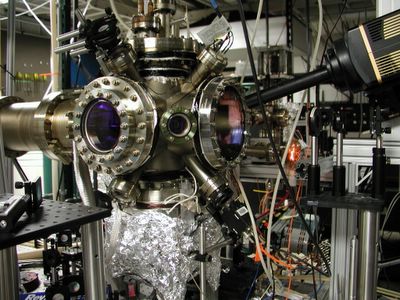
This is the vacuum chamber, in which the atoms are trapped. You can see a camera on the right-hand side.

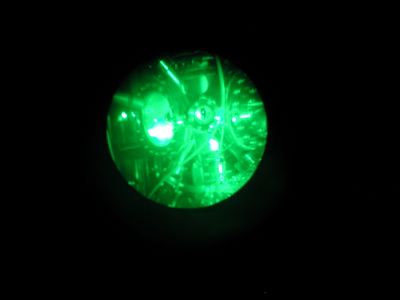
This is what the camera saw. That bright dot at the center is the trap.
This is my attempt to take a picture through the viewer. The trap is very clear and bright, if you just look through, but it's hard to take pictures through an eye-piece. Anyway, click on the picture to enlarge it, and you can see it, a bright dot at the center of the small window.
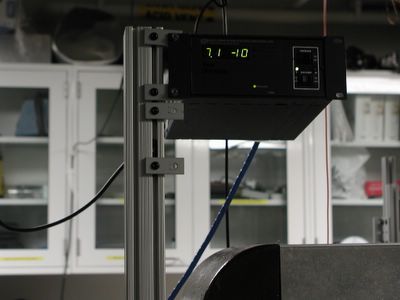
This is what the vacuum gauge reads: 7.1*10^(-10). That's .00000000071 torr. Thank you, vacuum gods!
Yesterday he got it again, only bigger and brighter.
Yay! Hooray! You're cheering, right?
No, you're asking "What's a trap, and why does it matter?" That's the problem with achievements in a field like this -- any specialized field, I guess.
A "trap" is a small collection of atoms held suspended in mid-air -- except actually there can't be any air in the system or it won't work. A small collection of atoms held suspended in mid-vacuum. They aren't touching anything at all. They are surrounded by almost perfect nothingness. What holds them up? Laser beams, and a magnetic field.
The technical name for it is a "magneto-optical trap." You can actually see the atoms hovering there, a small glowing spot a few millimeters to a centimeter in diameter. You can see them because the lasers make them glow. In our case, they glow in the infrared, so you have to use a viewer to see the light, but here is a picture of someone's sodium MOT, that looks just like ours, only glowing with yellow light.
How does it work? Light actually does exert a force when it interacts with atoms. It can slow them as they come out of a nozzle. If you have light beams pushing up, down, left, right, forward, and back, it can keep atoms from escaping in any direction - it can trap them. Now the problem is to make sure that it exerts the right amount of force, and more, that the left-pushing beam only operates on atoms that are moving to the right, and not on those already moving leftward, and likewise for the other beams. This is where the magnetic field comes in. It changes the properties of the atoms, so that atoms in one part of the field interact with a different kind of light then atoms in the other part, and atoms further from the center are pushed harder than those near it. How do you calculate these forces and interaction energies? Um... Ask Ken. But give him time to go through his notes first.
The best explanation of laser cooling and trapping for the non-scientist (OK, and for the scientist as well. I personally need help turning the math into a conceptual picture) is at the University of Colorado's Bose-Einstein Condensate page. It's got little java videogames (hit "next" at the bottom of the page to see more), to let you try your hand at some laser cooling of your own. In our lab, we stop short of the "evaporative cooling" stage, and we don't get BECs. But we do get cold atoms.
What's nice about cold atoms is that they don't bump into each other so much, and they all have about the same velocity (close to zero). Any time you want to do an experiment that involves putting atoms into certain quantum states (you do this with lasers) -- you really want to do it in a trap, because if the atom collides with anything, your state is ruined. Also, you have to use different laser frequencies depending on the velocity of your atom, so if you can arrange for all the atoms to have the same velocity, you get better results.
So, Ken's project involves putting atoms into a certain quantum state, called the "dark state". You can control whether atoms in this state absorb light or not, and if they don't absorb it, what kind of "phase shift" they give it. (A phase shift just makes the peaks and troughs of the wave occur in different places.) This is supposed to be analogous to what some parts of a computer do to electronic signals and would supposedly be useful for some hypothetical quantum-computer, someday. Possibly. Maybe. Whatever. It means Ken is one step closer to graduating.
It's been a long, gruelling, frustrating process. The lab used to have a trap, and Ken worked on it, but with the departure of one of our post-docs, the whole shebang became Ken's responsibility. There are so many working parts to this, what with three lasers, at least nine different beams to align, electronics and optics to lock the lasers, frequency modulators, waveplates, beam expanders, magnetic coils, cooling water, and, oh yes, the vacuum. The pressure has to be on the order of 10^(-10) torr. Atmospheric pressure is 760 torr. Three different pumps, each with their own plumbing, their own gaskets, their own impossible-to-reach nuts and bolts. So many things have to work, all at once...
Only three people ever understood this system. The other two are now gone. Our former post-doc was able to consult a little, and I could help do the two-person jobs if he told me what to do (turn a knob at this end of the table to adjust a beam at that end. Turn the gas on and off to blow sealant through the coils, etc.) but Ken ran the operation, knew what had to be done, and succeeded.
So now you have enough information to understand what these pictures mean, scientifically and emotionally.

This is the vacuum chamber, in which the atoms are trapped. You can see a camera on the right-hand side.

This is what the camera saw. That bright dot at the center is the trap.
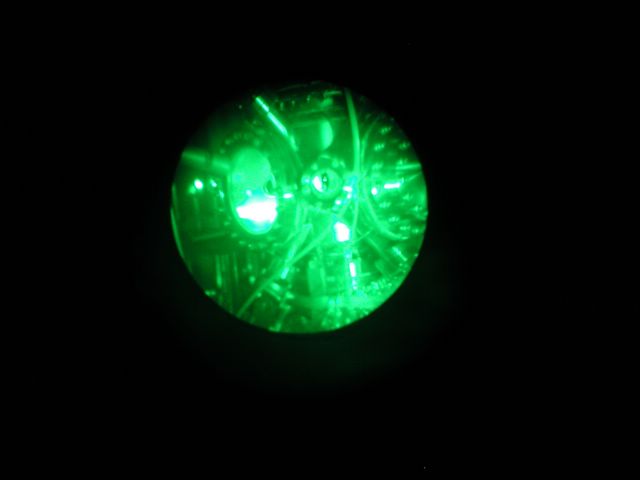
This is my attempt to take a picture through the viewer. The trap is very clear and bright, if you just look through, but it's hard to take pictures through an eye-piece. Anyway, click on the picture to enlarge it, and you can see it, a bright dot at the center of the small window.

This is what the vacuum gauge reads: 7.1*10^(-10). That's .00000000071 torr. Thank you, vacuum gods!
Monday, January 23, 2006
Son of Lunes Links
The funniest art story ever. I have to say this "performance art" cracks me up, which means I enjoy it, which means it's really art? Does the fact that it makes me think about whether it's really art, mean it's really art?
In memoriam for the Bears 2005 season: Shave Kyle Orton's neck beard. Via Ken.
A site that's been linked a couple of times by Jaquandor: Eyesore of the month. The month I link to is funny to me because it doesn't turn out to be the cemetary-strip-mall on Parker Road that I know.
Stop me if I've linked to this before: uglydress.com.
Which reminds me: these recipes probably really will help you lose weight, if only by destroying your appetite.
That's all.
In memoriam for the Bears 2005 season: Shave Kyle Orton's neck beard. Via Ken.
A site that's been linked a couple of times by Jaquandor: Eyesore of the month. The month I link to is funny to me because it doesn't turn out to be the cemetary-strip-mall on Parker Road that I know.
Stop me if I've linked to this before: uglydress.com.
Which reminds me: these recipes probably really will help you lose weight, if only by destroying your appetite.
That's all.
Saturday, January 14, 2006
The Toolmaker
I just read a book by Jill Patton Walsh, who is one of my favorite authors...
I first heard of her when she finished Dorothy Sayers’ unfinished novel Thrones, Dominions. I liked this enough to pick up her book about an atheist in a fantasy Inquisition-era Spain, called Knowledge of Angels. That one really got under my skin, with its portrayal of the suffering of a man of the sort I described in my last entry, a bishop whose faith is built on logic alone, when that faith is undermined by logical counter-arguments. So I read more. A book about aristocratic refugees in an imaginary Eastern European country, during and after their communist revolution (A Desert in Bohemia). A book about survivor guilt, years later, after a lifeboat accident (The Serpentine Cave). And then I discovered that she was primarily known for her children’s books. My university library had one. A story about a family who escapes Earth just before it is destroyed (The Green Book). A (true) story about a light-house keeper’s daughter who goes from isolation to celebrity after she rescues boaters. (Grace). A story about the fall of Byzantium (The Emporer’s Winding Sheet.) A story about the plague ( A Parcel of Patterns.) She is one of the least known of my favorite authors -- probably because she is still alive and writing. And she answered my e-mails a couple of times.
I wrote to her because some of the things she’d written were about women and academia (the Imogen Quy mysteries) and because she was clearly a Dorothy Sayers fan, and Dorothy Sayers was all about the kind of questions I was facing... After a year in grad school, I was starting to feel like I was wasting my time. I was starting to wonder if an academic career was really enough to give my life meaning. This was before I knew Ken (although I’d already seen him in our quantum mechanics class – okay, stared at him in quantum mechanics class – I figured he was way out of my league). The future I pictured for myself, if I stayed in grad school and kept on as I was going, was as bookish spinster. I didn’t really want that future. It didn’t seem like enough. I couldn’t imagine that I would ever do important enough work to justify my life by work alone. I certainly wasn’t doing it as a first year grad student. On the other hand, I didn’t really want to believe that I needed a husband and a family to make my life meaningful. Did I want to say Donna Reed’s life was more meaningful than Emily Noether’s? Did men need families to make their lives meaningful? Now, facing a much different future, I’m embarrassed by the memory of asking these questions of practically every woman I admired, or who was still single. Professors and authors. I put them in an uncomfortable position, and must have sounded hopelessly young. But Jill Patton Walsh was very gentle with me. I think she told me, more or less, that I was going to be disappointed if I was hoping for someone else to give my life meaning. But I couldn’t count on my work doing that for me either.
Okay, so the book of hers I just finished was called Toolmaker. It’s about a man in a prehistoric hunter-gatherer tribe who is better than his fellow tribesmen at making flint axes and arrow heads and so on. So they ask him to do it for them, leaving him no time to hunt. They bring him food. But he becomes too specialized, losing the ability to hunt for himself, and when times are lean, they are no longer interested in his toolmaking ability. He loses his status in his tribe. I won’t tell you how it ends. It’s a sort of parable, but you can take lots of different lessons from it... One of the most obvious being that it’s a bad idea to look down on your toolmakers, just because they don’t hunt. (Another being that it’s dangerous to become too specialized...)
Now, when you hear this story, who do you think of as the modern "toolmakers"? Are you thinking "intellectuals," scientists, professors, etc? ‘Cause I’m not. I’m thinking of the guys in the machine shop, who make the tools. The longer I stay in this field, the more natural the analogy of research scientist as hunter seems to me. (Their elusive prey? Grants.) And too often they do look down at the people who do the real, dangerous, and difficult work of shaping precision instruments capable of probing the smallest scales under the worst extremes of temperature, pressure, and in the presence of dangerous chemicals.
I finally started the machine shop class. The instructor has told us we should not hope to become machinists after only eight weeks (their apprenticeships last for years) but I am hoping to at least gain a better appreciation of what it takes. We spent the first day grinding a cutting tool that we will later use with the milling machine (I don’t know how or why, yet.) And we cut the our raw materials for our other products into rough outlines of the shapes we needed – and I do mean rough.
I still want meaningful work. In some ways the stuff I do in the machine shop seems more meaningful than the stuff I do in the lab. Ken says he felt the same, when he took the class. He misses that. But I also don’t want to rely on work alone to give my life meaning. The toolmaker in the book spends a lot of his time lonely, outcast, at one point, almost suicidal.
It’s so funny. I used to worry about this stuff, and think that what I needed was either to do something more important than homework, real research, or find a man, and I agonized over which was more important... Now I’m in a lab and I’m married, and I see that the problem never really had anything to do with either one.
I first heard of her when she finished Dorothy Sayers’ unfinished novel Thrones, Dominions. I liked this enough to pick up her book about an atheist in a fantasy Inquisition-era Spain, called Knowledge of Angels. That one really got under my skin, with its portrayal of the suffering of a man of the sort I described in my last entry, a bishop whose faith is built on logic alone, when that faith is undermined by logical counter-arguments. So I read more. A book about aristocratic refugees in an imaginary Eastern European country, during and after their communist revolution (A Desert in Bohemia). A book about survivor guilt, years later, after a lifeboat accident (The Serpentine Cave). And then I discovered that she was primarily known for her children’s books. My university library had one. A story about a family who escapes Earth just before it is destroyed (The Green Book). A (true) story about a light-house keeper’s daughter who goes from isolation to celebrity after she rescues boaters. (Grace). A story about the fall of Byzantium (The Emporer’s Winding Sheet.) A story about the plague ( A Parcel of Patterns.) She is one of the least known of my favorite authors -- probably because she is still alive and writing. And she answered my e-mails a couple of times.
I wrote to her because some of the things she’d written were about women and academia (the Imogen Quy mysteries) and because she was clearly a Dorothy Sayers fan, and Dorothy Sayers was all about the kind of questions I was facing... After a year in grad school, I was starting to feel like I was wasting my time. I was starting to wonder if an academic career was really enough to give my life meaning. This was before I knew Ken (although I’d already seen him in our quantum mechanics class – okay, stared at him in quantum mechanics class – I figured he was way out of my league). The future I pictured for myself, if I stayed in grad school and kept on as I was going, was as bookish spinster. I didn’t really want that future. It didn’t seem like enough. I couldn’t imagine that I would ever do important enough work to justify my life by work alone. I certainly wasn’t doing it as a first year grad student. On the other hand, I didn’t really want to believe that I needed a husband and a family to make my life meaningful. Did I want to say Donna Reed’s life was more meaningful than Emily Noether’s? Did men need families to make their lives meaningful? Now, facing a much different future, I’m embarrassed by the memory of asking these questions of practically every woman I admired, or who was still single. Professors and authors. I put them in an uncomfortable position, and must have sounded hopelessly young. But Jill Patton Walsh was very gentle with me. I think she told me, more or less, that I was going to be disappointed if I was hoping for someone else to give my life meaning. But I couldn’t count on my work doing that for me either.
Okay, so the book of hers I just finished was called Toolmaker. It’s about a man in a prehistoric hunter-gatherer tribe who is better than his fellow tribesmen at making flint axes and arrow heads and so on. So they ask him to do it for them, leaving him no time to hunt. They bring him food. But he becomes too specialized, losing the ability to hunt for himself, and when times are lean, they are no longer interested in his toolmaking ability. He loses his status in his tribe. I won’t tell you how it ends. It’s a sort of parable, but you can take lots of different lessons from it... One of the most obvious being that it’s a bad idea to look down on your toolmakers, just because they don’t hunt. (Another being that it’s dangerous to become too specialized...)
Now, when you hear this story, who do you think of as the modern "toolmakers"? Are you thinking "intellectuals," scientists, professors, etc? ‘Cause I’m not. I’m thinking of the guys in the machine shop, who make the tools. The longer I stay in this field, the more natural the analogy of research scientist as hunter seems to me. (Their elusive prey? Grants.) And too often they do look down at the people who do the real, dangerous, and difficult work of shaping precision instruments capable of probing the smallest scales under the worst extremes of temperature, pressure, and in the presence of dangerous chemicals.
I finally started the machine shop class. The instructor has told us we should not hope to become machinists after only eight weeks (their apprenticeships last for years) but I am hoping to at least gain a better appreciation of what it takes. We spent the first day grinding a cutting tool that we will later use with the milling machine (I don’t know how or why, yet.) And we cut the our raw materials for our other products into rough outlines of the shapes we needed – and I do mean rough.
I still want meaningful work. In some ways the stuff I do in the machine shop seems more meaningful than the stuff I do in the lab. Ken says he felt the same, when he took the class. He misses that. But I also don’t want to rely on work alone to give my life meaning. The toolmaker in the book spends a lot of his time lonely, outcast, at one point, almost suicidal.
It’s so funny. I used to worry about this stuff, and think that what I needed was either to do something more important than homework, real research, or find a man, and I agonized over which was more important... Now I’m in a lab and I’m married, and I see that the problem never really had anything to do with either one.
Saturday, January 07, 2006
Logic and Faith
This discussion about evolution and religion on AFP (which I’m not posting to, because I’ve had this discussion enough times) got me thinking again about the appeal of religion for rational thinkers. The thing about science is, it forbids certainty. If you’re a good scientist, you have to be agnostic, not just about the existence of any gods, but about everything, including scientific theories, personal experiences, the evidence of your senses and the evidence of other people’s senses. You can’t be sure that you’re not just dreaming the rest of us. The refusal to take anything on faith leads to what one religious poster calls a “complete fog of unknowing” and a nonreligious poster admits is at least “fairly misty.”
This isn’t a fun position for rational thinkers, who presumably like to think rationally because it leads to conclusions which they can trust more than they can trust their wild guesses. In other words, they like to think rationally because they’re looking for some degree of certainty. But if you aren’t willing to accept the premises on faith, then you can’t accept the conclusions that follow rationally from them either. So people who are looking for answers ultimately have to rely on a combination of faith and reason.
The difference is in what kind of axioms you feel you can accept. What combination of direct personal experience, second hand reports, and consistency with your other experiences does it take to convince you that something is a fact? Scientists look for repeatable, recordable data. Religious people have to rely on subjective experience of God. (Since crazy people have subjective experience of their dogs talking to them, this is rarely convincing to anyone else. Scientists rely on subjective experience too, though, just not for reaching scientific conclusions.) And how willing are you to re-evaluate your position later? Scientists are supposed to only ever accept anything provisionally, always reserving the right to change their minds if contradictory data comes along. They'd like more certainty, but they have to leave room for new theories.
Some people aren’t satisfied with such wishy-washiness. They’re looking for truth without error bars and disclaimers. They want rock-solid foundations, none of this fog or mist, on which to build with iron logic, and religion provides that for them. There are more of these people than most atheists and agnostics think. There was a time when theology, not math or physics, was considered “queen of the sciences.”
It so happens that some of these people claim to have discovered, among other things, that those who reach the wrong conclusions about the way the universe works will meet terrible fates. (This is a testable prediction. Unfortunately, we can’t test it until we’re dead.)
The problem is, not all of these people agree with each other. They are not all of the same religion. So some of them must be wrong, must not have a handle on objective reality after all. Some of them might be right, of course, but how is it possible to tell which ones? Reason won’t help. The premises are the part of the argument you can’t prove, and that’s where they disagree.
The stakes are high, but you can't just pick the most likely sounding. It doesn't count if you say your god is "probably" the only one. That would defeat the whole purpose, which is certainty.
So those who don’t find any of assumptions self-evident, who would love to have rock-solid foundations but find only mist instead, might justifiably worry. (And they can worry about their friends of various religions, some of whom must be doomed if the others are right – even though none of those friends is worried for themselves.)
For those people: Monsignor Lorenzo Albacete says there is hope after all. Slate describes him as “a professor of theology at St. Joseph's Seminary in New York, and president of the Catholic University of Puerto Rico.” Slate says "But if God really loves humankind, shouldn't He let, say, a good Buddhist or Jew through the pearly gates? God goes further than that, says Monsignor Lorenzo Albacete in this clip from his meaningoflife.tv interview: even atheists are eligible for salvation. This radical reinterpretation of scripture, Albacete notes later in the interview, has now become official Catholic doctrine (unbeknownst even to many Catholics)."
I didn't watch the whole interview, so I didn't find the part where he said it was official Catholic doctrine, but I did watch the part where he said atheists and Buddhists might have an easier time getting into heaven than he did. Not that they could get in on good works alone -- it doesn't count if you're doing them to impress someone or make yourself look good -- but if you did them out of love for your neighbor, did them out of faith, if not in Jesus, then in what Jesus stood for, they still counted. This sort of seems consistent with Catholic doctrine to me (although most protestants probably wouldn't like it.) Mind you, he doesn't say that those atheists and Buddhists aren't wrong, just that they won't necessarily be punished for their mistakes.
This isn’t a fun position for rational thinkers, who presumably like to think rationally because it leads to conclusions which they can trust more than they can trust their wild guesses. In other words, they like to think rationally because they’re looking for some degree of certainty. But if you aren’t willing to accept the premises on faith, then you can’t accept the conclusions that follow rationally from them either. So people who are looking for answers ultimately have to rely on a combination of faith and reason.
The difference is in what kind of axioms you feel you can accept. What combination of direct personal experience, second hand reports, and consistency with your other experiences does it take to convince you that something is a fact? Scientists look for repeatable, recordable data. Religious people have to rely on subjective experience of God. (Since crazy people have subjective experience of their dogs talking to them, this is rarely convincing to anyone else. Scientists rely on subjective experience too, though, just not for reaching scientific conclusions.) And how willing are you to re-evaluate your position later? Scientists are supposed to only ever accept anything provisionally, always reserving the right to change their minds if contradictory data comes along. They'd like more certainty, but they have to leave room for new theories.
Some people aren’t satisfied with such wishy-washiness. They’re looking for truth without error bars and disclaimers. They want rock-solid foundations, none of this fog or mist, on which to build with iron logic, and religion provides that for them. There are more of these people than most atheists and agnostics think. There was a time when theology, not math or physics, was considered “queen of the sciences.”
It so happens that some of these people claim to have discovered, among other things, that those who reach the wrong conclusions about the way the universe works will meet terrible fates. (This is a testable prediction. Unfortunately, we can’t test it until we’re dead.)
The problem is, not all of these people agree with each other. They are not all of the same religion. So some of them must be wrong, must not have a handle on objective reality after all. Some of them might be right, of course, but how is it possible to tell which ones? Reason won’t help. The premises are the part of the argument you can’t prove, and that’s where they disagree.
The stakes are high, but you can't just pick the most likely sounding. It doesn't count if you say your god is "probably" the only one. That would defeat the whole purpose, which is certainty.
So those who don’t find any of assumptions self-evident, who would love to have rock-solid foundations but find only mist instead, might justifiably worry. (And they can worry about their friends of various religions, some of whom must be doomed if the others are right – even though none of those friends is worried for themselves.)
For those people: Monsignor Lorenzo Albacete says there is hope after all. Slate describes him as “a professor of theology at St. Joseph's Seminary in New York, and president of the Catholic University of Puerto Rico.” Slate says "But if God really loves humankind, shouldn't He let, say, a good Buddhist or Jew through the pearly gates? God goes further than that, says Monsignor Lorenzo Albacete in this clip from his meaningoflife.tv interview: even atheists are eligible for salvation. This radical reinterpretation of scripture, Albacete notes later in the interview, has now become official Catholic doctrine (unbeknownst even to many Catholics)."
I didn't watch the whole interview, so I didn't find the part where he said it was official Catholic doctrine, but I did watch the part where he said atheists and Buddhists might have an easier time getting into heaven than he did. Not that they could get in on good works alone -- it doesn't count if you're doing them to impress someone or make yourself look good -- but if you did them out of love for your neighbor, did them out of faith, if not in Jesus, then in what Jesus stood for, they still counted. This sort of seems consistent with Catholic doctrine to me (although most protestants probably wouldn't like it.) Mind you, he doesn't say that those atheists and Buddhists aren't wrong, just that they won't necessarily be punished for their mistakes.
Monday, January 02, 2006
Careers
"Careers" by Robert Graves
Father is quite the greatest poet
That ever lived anywhere.
You say you’re going to write great music—
I chose that first: it’s unfair.
Besides, now I can’t be the greatest painter and
do Christ and angels, or lovely pears
and apples and grapes on a green dish,
or storms at sea, or anything lovely,
Because that’s been taken by Claire.
It’s stupid to be an engine-driver,
And soldiers are horrible men.
I won’t be a tailor, I won’t be a sailor,
And gardener’s taken by Ben.
It’s unfair if you say that you’ll write great
music, you horrid, you unkind (I sim-
ply loathe you, though you are my
sister), you beast, cad, coward, cheat,
bully, liar!
Well? Say what’s left for me then!
But we won’t go to your ugly music.
(Listen!) Ben will garden and dig,
And Claire will finish her wondrous pictures
All flaming and splendid and big.
And I’ll be a perfectly marvellous carpenter,
and I’ll make cupboards and benches
and tables and ... and baths, and
nice wooden boxes for studs and
money,
And you’ll be jealous, you pig!
Father is quite the greatest poet
That ever lived anywhere.
You say you’re going to write great music—
I chose that first: it’s unfair.
Besides, now I can’t be the greatest painter and
do Christ and angels, or lovely pears
and apples and grapes on a green dish,
or storms at sea, or anything lovely,
Because that’s been taken by Claire.
It’s stupid to be an engine-driver,
And soldiers are horrible men.
I won’t be a tailor, I won’t be a sailor,
And gardener’s taken by Ben.
It’s unfair if you say that you’ll write great
music, you horrid, you unkind (I sim-
ply loathe you, though you are my
sister), you beast, cad, coward, cheat,
bully, liar!
Well? Say what’s left for me then!
But we won’t go to your ugly music.
(Listen!) Ben will garden and dig,
And Claire will finish her wondrous pictures
All flaming and splendid and big.
And I’ll be a perfectly marvellous carpenter,
and I’ll make cupboards and benches
and tables and ... and baths, and
nice wooden boxes for studs and
money,
And you’ll be jealous, you pig!
Subscribe to:
Posts (Atom)