Street Cries
When dawn's first cymbals beat upon the sky,
Rousing the world to labour's various cry,
To tend the flock, to bind the mellowing grain,
From ardent toil to forge a little gain,
And fasting men go forth on hurrying feet,
BUY BREAD, BUY BREAD, rings down the eager street.
When the earth falters and the waters swoon
With the implacable radiance of noon,
And in dim shelters koils hush their notes,
And the faint, thirsting blood in languid throats
Craves liquid succour from the cruel heat,
BUY FRUIT, BUY FRUIT, steals down the panting street.
When twilight twinkling o'er the gay bazaars,
Unfurls a sudden canopy of stars,
When lutes are strung and fragrant torches lit
On white roof-terraces where lovers sit
Drinking together of life's poignant sweet,
BUY FLOWERS, BUY FLOWERS, floats down the singing street.
- Sarojini Naidu
Monday, February 19, 2007
Tuesday, February 13, 2007
We Have Liftoff

Click on the picture. Watch the animation. Then come back.
It's so hard to explain what this little animation means. Just know that it took years of blood sweat and tears to achieve it, mostly Ken's, but mine too, this last year or so. A lot of the saga I described here.
This is our magneto-optical trap. Being launched upward. The things on the sides are the magnetic coils that help hold it up. They are six centimeters in diameter, which should give you a sense of scale. We just need to be able to launch atoms a little bit higher than the top of the coils, because we can put our cavity right above them. This is the whole reason we designed these smaller coils, so that we wouldn't need to launch so high.
The atom cloud actually expands as it rises, out of the cooling beams. The beam we use to light it up so that we can see it is narrow, so you all you see is a narrow, pencil shaped slice out of the cloud as it expands, like the core of an apple. That's why it looks long and narrow toward the top.
These results don't mean we're done. First of all, we might want to cool the atoms a little more, so that they don't expand so much, so fast (although there is plenty of density up there, even as it is.) We are actually doing a slower launch, so that they slow to a halt just at the top of the coils and then fall back down. The slower launch takes longer, so the atom cloud has expanded more when it gets up there, which is why we might want the additional cooling. Also, we need a way to hold the atoms there, once we get them there. We already know how we're supposed to do that. It's called a "FORT" or "Far Off-Resonance Trap." It's easy in theory -- just shine a really strong, really tightly focused laser beam on the atoms, and that should hold them in place for the few milliseconds we need. Unfortunately we haven't made it work in practice yet, at least, not that we could detect. Finally, we need to actually build the cavity and put it in there. We've already built a couple of cavities for this thing, but for various reasons none of them is suitable for what we're trying to do now.
But still, that little blob in that animation looks a little bit like a light at the end of the tunnel.
Saturday, February 03, 2007
Links, Life
Yeah, I missed a week. Here's the thing, I'm really, really busy right now. This post is gonna be half links and half life update, cause those are the laziest kinds of posts (except for Bears-related photos that I upload without further comment, which is the laziest kind of all.)
Life update first: my two classes are kinda kicking my butt. It's been a year or so since I've taken a class, and the last one was taught by my advisor, who thought time in the lab was more important than getting the homework done anyway. It's been four years since I've taken one like my GR class, with twenty students, and homework problems from the end of the chapters due weekly, and midterms and finals and real grades. Just going squeezing the classes into my work days is hard. We're actually making a little progress with the MOT (I said I'd put up pictures of the launching we've done here, and I will, whenever we get the data off of the non-internetted computer it's stored on) but sometimes I'm not there when I'm needed. And when I am, days full of MOT work and school work are very full indeed, long and exhausting. Meanwhile the gyroscope project is sort of in suspended animation as we try to figure out what exactly needs to be done next. With no deadline attached to it, it has slipped to the bottom of my priority list. I am, however, writing a summary of our group's work on this stuff so far, which will probably become my thesis proposal, but which does have a deadline because it's supposed to be published as the text to accompany a talk my advisor gave.
Just writing about all that makes me feel as if I should be doing something more productive than blogging.
But I'm getting an intimidating backlog of links to post and comment on, so let me at least put a few of them up.
In particular, I've come across lot of related stuff about the suburbs, politics, and religion lately.
Slacktivist says the reason we're at war in Iraq is that our urban schools suck. Actually, he just says it's why we're not able to cut down our gasoline use. But we're at war in Iraq at least partly because we're so dependent on foreign oil, that's what makes the region so strategially important. We're dependent on foreign oil because everybody drives rather than taking mass transportation. But many people can't take mass transportation because they live in the suburbs. Why? Because that's where the good schools are.
He also has a powerful argument that the war in Iraq can't be "won" because it was not in our interest to begin with. If we were to invade Canada, what would it mean to "win"? Assuming we succeeded in taking down their government, what would we do then? Occupy Canada? Why would we want to do that? And for how long? Because there would be no reason to invade Canada in the first place, victory is undefinable. Same in Iraq. If there had been WMD to capture, we could've declared victory when we captured them, but since there were not, and since Saddam's government was not uniquely bad -- we have no reason to expect the next one to be better, if we pull out -- how do we know when we've "won"? (And if the real goal was to destabilize the middle east lest it unite against us? Then the war can never be won until we turn the middle east into Canada. So long as they have a significantly different culture and different values than us, some of our leaders will see their unity and prosperity as a threat.)
Meanwhile, back in the suburbs, Chris Hedges says that the reason the country is so polarized by religion is "suburban despair." He says "A terrible distortion and deformation of American society, where tens of millions of people in this country feel completely disenfranchised, where their physical communities have been obliterated, whether that's in the Rust Belt in Ohio or these monstrous exurbs like Orange County, where there is no community. There are no community rituals, no community centers, often there are no sidewalks. People live in empty soulless houses and drive big empty cars on freeways to Los Angeles and sit in vast offices and then come home again."
I think my "radically" Christian, suburban mother (who reads this blog, by the way-- hi, Mom) might actually agree with his argument, if not the conclusions he draws from it. She grew up not in the suburbs but in a small country town, and laments the loss of "community" every day. She does not find the daily grind of work, commute, TV, commute, work fulfilling either. When people begin to feel their lives are meaningless, religion gives them meaning. I think that is probably the definition of religion.
But I want to own my own home and have a couple of kids and make enough money to buy fancy digital toys and take vacations, too. Almost everybody wants that stuff, especially the people who actually live the furthest from the suburbs, in decaying inner cities and half abandonded rural towns. I think the problem is, what happens when you actually get all that? When you have nothing left to strive for, really? When you've achieved all your ambitions, what gets you out of bed in the morning then? That's the problem people "trapped" in the surburbs have. And that's why many of them turn to religious activism, to give them a purpose, a cause, a mission.
Of course, they also have the leisure and resources to pursue such a mission, which someone less successful, just struggling to make a living, doesn't have. That may be the other reason a lot of this comes out of the suburbs.
I think Hedges (who wrote War is a Force that Gives Us Meaning, a book that I found incredibly moving, and who is a graduate of Harvard Divinity School) is more on the money than Tom Frank (who wrote What's the Matter With Kansas). But in another article of his I think he makes the same mistake that Frank did, not taking the convictions of the people he's writing about seriously enough. I mean, I think that a lot of environmental activists are motivated by basically the same thing. They need a mission, and saving the world is a compelling one. But that doesn't mean the earth doesn't actually need saving. It does. And likewise, just because anti-abortion crusaders are motivated part by their need for a mission, doesn't mean they don't have a point. We're a hyprocritical society, aware that nothing magical happens at the moment of birth to turn worthless "tissue" into a priceless "child," and yet refusing to admit it, refusing to deal with the ambiguities or the moral queasiness they bring with them.
So long as we keep in mind that understanding people's motivations doesn't excuse us from taking their messages seriously, I think that kind of understanding is really valuable, and I still really respect Chris Hedges. I also think he's right that the divisions on some of these passionate issues could ultimately tear our society apart, and that some of the less rational religious types, like those obsessed with the "end times", seem to want it that way. And that does scare me some.
But my final link is proof that some people are anti-abortion and pro-environment, believe it or not. Crunchy Conservatives buy organic food and homeschool their kids, wear Birkenstocks and go to Bible study groups. The New York Times says it's "a kind of across-the-board rejection of modernity [...] Crunchy cons disapprove of abortion rights, same-sex marriage, illegal immigrants, public schools, secular liberals and mothers who work outside the home. But they don't like Wal-Mart, McMansions, suburbs, pollution, agribusiness or processed foods, either." I think I could like and even admire people like this, hard working and sincere in living their convictions, but not agree with them. I'm not on board with the rejection of modernity part. I like pop culture and I like technology and I like the idea of women working outside the home. And I like cheap food, and I like government social services, because self-reliance would only work if the world were fair. I'd much rather live in the modern world than fifty years ago or a hundred years ago or more, and I'll resist anyone who tries to turn back the clock.
But still, I respect these "Crunchy Cons," who manage to be both left wing and right wing nuts at the same time, more than people who are merely one or the other.
Life update first: my two classes are kinda kicking my butt. It's been a year or so since I've taken a class, and the last one was taught by my advisor, who thought time in the lab was more important than getting the homework done anyway. It's been four years since I've taken one like my GR class, with twenty students, and homework problems from the end of the chapters due weekly, and midterms and finals and real grades. Just going squeezing the classes into my work days is hard. We're actually making a little progress with the MOT (I said I'd put up pictures of the launching we've done here, and I will, whenever we get the data off of the non-internetted computer it's stored on) but sometimes I'm not there when I'm needed. And when I am, days full of MOT work and school work are very full indeed, long and exhausting. Meanwhile the gyroscope project is sort of in suspended animation as we try to figure out what exactly needs to be done next. With no deadline attached to it, it has slipped to the bottom of my priority list. I am, however, writing a summary of our group's work on this stuff so far, which will probably become my thesis proposal, but which does have a deadline because it's supposed to be published as the text to accompany a talk my advisor gave.
Just writing about all that makes me feel as if I should be doing something more productive than blogging.
But I'm getting an intimidating backlog of links to post and comment on, so let me at least put a few of them up.
In particular, I've come across lot of related stuff about the suburbs, politics, and religion lately.
Slacktivist says the reason we're at war in Iraq is that our urban schools suck. Actually, he just says it's why we're not able to cut down our gasoline use. But we're at war in Iraq at least partly because we're so dependent on foreign oil, that's what makes the region so strategially important. We're dependent on foreign oil because everybody drives rather than taking mass transportation. But many people can't take mass transportation because they live in the suburbs. Why? Because that's where the good schools are.
He also has a powerful argument that the war in Iraq can't be "won" because it was not in our interest to begin with. If we were to invade Canada, what would it mean to "win"? Assuming we succeeded in taking down their government, what would we do then? Occupy Canada? Why would we want to do that? And for how long? Because there would be no reason to invade Canada in the first place, victory is undefinable. Same in Iraq. If there had been WMD to capture, we could've declared victory when we captured them, but since there were not, and since Saddam's government was not uniquely bad -- we have no reason to expect the next one to be better, if we pull out -- how do we know when we've "won"? (And if the real goal was to destabilize the middle east lest it unite against us? Then the war can never be won until we turn the middle east into Canada. So long as they have a significantly different culture and different values than us, some of our leaders will see their unity and prosperity as a threat.)
Meanwhile, back in the suburbs, Chris Hedges says that the reason the country is so polarized by religion is "suburban despair." He says "A terrible distortion and deformation of American society, where tens of millions of people in this country feel completely disenfranchised, where their physical communities have been obliterated, whether that's in the Rust Belt in Ohio or these monstrous exurbs like Orange County, where there is no community. There are no community rituals, no community centers, often there are no sidewalks. People live in empty soulless houses and drive big empty cars on freeways to Los Angeles and sit in vast offices and then come home again."
I think my "radically" Christian, suburban mother (who reads this blog, by the way-- hi, Mom) might actually agree with his argument, if not the conclusions he draws from it. She grew up not in the suburbs but in a small country town, and laments the loss of "community" every day. She does not find the daily grind of work, commute, TV, commute, work fulfilling either. When people begin to feel their lives are meaningless, religion gives them meaning. I think that is probably the definition of religion.
But I want to own my own home and have a couple of kids and make enough money to buy fancy digital toys and take vacations, too. Almost everybody wants that stuff, especially the people who actually live the furthest from the suburbs, in decaying inner cities and half abandonded rural towns. I think the problem is, what happens when you actually get all that? When you have nothing left to strive for, really? When you've achieved all your ambitions, what gets you out of bed in the morning then? That's the problem people "trapped" in the surburbs have. And that's why many of them turn to religious activism, to give them a purpose, a cause, a mission.
Of course, they also have the leisure and resources to pursue such a mission, which someone less successful, just struggling to make a living, doesn't have. That may be the other reason a lot of this comes out of the suburbs.
I think Hedges (who wrote War is a Force that Gives Us Meaning, a book that I found incredibly moving, and who is a graduate of Harvard Divinity School) is more on the money than Tom Frank (who wrote What's the Matter With Kansas). But in another article of his I think he makes the same mistake that Frank did, not taking the convictions of the people he's writing about seriously enough. I mean, I think that a lot of environmental activists are motivated by basically the same thing. They need a mission, and saving the world is a compelling one. But that doesn't mean the earth doesn't actually need saving. It does. And likewise, just because anti-abortion crusaders are motivated part by their need for a mission, doesn't mean they don't have a point. We're a hyprocritical society, aware that nothing magical happens at the moment of birth to turn worthless "tissue" into a priceless "child," and yet refusing to admit it, refusing to deal with the ambiguities or the moral queasiness they bring with them.
So long as we keep in mind that understanding people's motivations doesn't excuse us from taking their messages seriously, I think that kind of understanding is really valuable, and I still really respect Chris Hedges. I also think he's right that the divisions on some of these passionate issues could ultimately tear our society apart, and that some of the less rational religious types, like those obsessed with the "end times", seem to want it that way. And that does scare me some.
But my final link is proof that some people are anti-abortion and pro-environment, believe it or not. Crunchy Conservatives buy organic food and homeschool their kids, wear Birkenstocks and go to Bible study groups. The New York Times says it's "a kind of across-the-board rejection of modernity [...] Crunchy cons disapprove of abortion rights, same-sex marriage, illegal immigrants, public schools, secular liberals and mothers who work outside the home. But they don't like Wal-Mart, McMansions, suburbs, pollution, agribusiness or processed foods, either." I think I could like and even admire people like this, hard working and sincere in living their convictions, but not agree with them. I'm not on board with the rejection of modernity part. I like pop culture and I like technology and I like the idea of women working outside the home. And I like cheap food, and I like government social services, because self-reliance would only work if the world were fair. I'd much rather live in the modern world than fifty years ago or a hundred years ago or more, and I'll resist anyone who tries to turn back the clock.
But still, I respect these "Crunchy Cons," who manage to be both left wing and right wing nuts at the same time, more than people who are merely one or the other.
Sunday, January 21, 2007


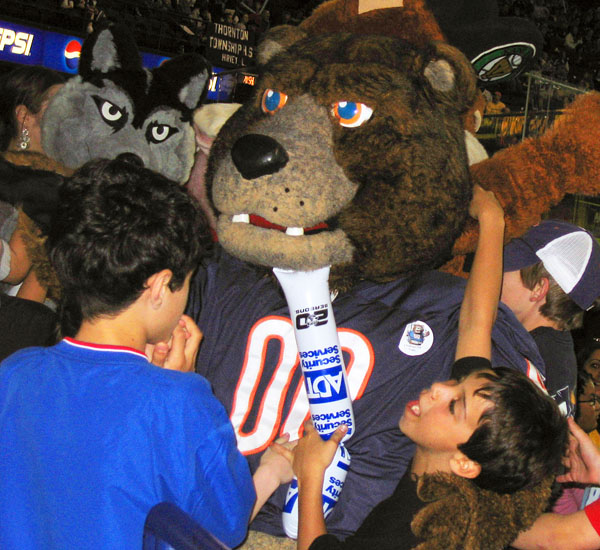
Sunday, January 14, 2007
Bear Down!
Wow, my heart is still pounding. The Bears must have caused at least a couple of coronaries today.
Okay, I know the rest of the country is rooting for New Orleans right now. But I live in Chicago. And the point of sports is to bond with the people in your own community. The Bears unite us. I hear strangers on the El asking each other, "You think they got a chance?" Today a group of people in Bears gear getting off the our train (probably coming back from the game) called out to Ken and me: "Go Bears!" We pumped our fists in the air and echoed it.
I can't betray my fellow Chicagoans. Just as New Orleans loves its team, Chicago loves the Bears. It is right and proper that Chicagoans should root for the home team.
So I hope New Orleans wins the Superbowl -- some other year.
To show my support for the Bears, I spent part of the day on a little art project.
It's one of the those Magic Eye images. So I apologize to those who can't see Magic Eye images. But we were shopping in a book store yesterday, and stopped to look at a couple of books of them, which inspired me to download a program for creating my own
(StereoCreator. Scroll down at that link) And then last night, Ken had a dream that we created a stereogram in which the 3D image moved. I'm sure it's been done before, but I haven't seen it, so I had to attempt it. For that I needed an animated .gif creator, so I downloaded unFREEZ.
Unfortunately, animated gifs with 28 cells are 28 times as large as normal gifs. So I cut down the number of frames and the color density to fit within Blogger's 3MB limit, and now the depth doesn't look exactly right. But still, as a first attempt...
Click on the image to enlarge and animate.

Wondering what it's supposed to be?
Click here.
I might post a few more (non-animated) stereograms if I have more homework to procrastinate on later.
UPDATE:
In the comments, Stereo DDD links to a couple of animated stereograms that outclass mine like Cary Grant outclasses Pauly Shore.
3-D staircase
3-D descent
3-D pink
The "descent" stereogram in particular is really a stunning work of art. Check out this guy's whole gallery.
Okay, I know the rest of the country is rooting for New Orleans right now. But I live in Chicago. And the point of sports is to bond with the people in your own community. The Bears unite us. I hear strangers on the El asking each other, "You think they got a chance?" Today a group of people in Bears gear getting off the our train (probably coming back from the game) called out to Ken and me: "Go Bears!" We pumped our fists in the air and echoed it.
I can't betray my fellow Chicagoans. Just as New Orleans loves its team, Chicago loves the Bears. It is right and proper that Chicagoans should root for the home team.
So I hope New Orleans wins the Superbowl -- some other year.
To show my support for the Bears, I spent part of the day on a little art project.
It's one of the those Magic Eye images. So I apologize to those who can't see Magic Eye images. But we were shopping in a book store yesterday, and stopped to look at a couple of books of them, which inspired me to download a program for creating my own
(StereoCreator. Scroll down at that link) And then last night, Ken had a dream that we created a stereogram in which the 3D image moved. I'm sure it's been done before, but I haven't seen it, so I had to attempt it. For that I needed an animated .gif creator, so I downloaded unFREEZ.
Unfortunately, animated gifs with 28 cells are 28 times as large as normal gifs. So I cut down the number of frames and the color density to fit within Blogger's 3MB limit, and now the depth doesn't look exactly right. But still, as a first attempt...
Click on the image to enlarge and animate.

Wondering what it's supposed to be?
Click here.

I might post a few more (non-animated) stereograms if I have more homework to procrastinate on later.
UPDATE:
In the comments, Stereo DDD links to a couple of animated stereograms that outclass mine like Cary Grant outclasses Pauly Shore.
3-D staircase
3-D descent
3-D pink
The "descent" stereogram in particular is really a stunning work of art. Check out this guy's whole gallery.
Tuesday, January 09, 2007
Physics Classes
I'm finally taking my last two classes this quarter. After that, I will probably never take another, at least not for credit. I can barely imagine never having to do homework again; I've been a student for so long, my whole life. I observed a while ago that I didn't feel ready to be done, didn't feel like I knew as much as I expected to, with only two classes left. A certain older, wiser graduate student with the initial "K" reminded me that I was supposed to be learning something from the research, too.
Surprisingly enough, I seem to have become a little less cynical since I wrote that last post. Just because you can't learn everything in grad school doesn't mean you learn nothing. And I have gotten a lot from independent study and bull-sessions with my co-workers (especially the one I married. I think we figured out what it meant to quantize the electromagnetic field while driving across France on our honeymoon. This was not as quite romantic as it sounds -- we nearly always get frustrated with each other when we talk about physics. But then, we nearly always understand things better afterward.)
Anyway, my last two classes are relativity, which I have been waiting to take, and the second quarter of quantum field theory. I think people might be kind of interested in what classes like that are like. The topics sound so... Deep. Don't they? Is it a profound experience, learning this stuff? Am I gaining access to the secrets of the universe?
Well... No. Physics classes aren't really like that. I mean, take Newton's laws, right? Everyone learned at least a little about Newton's laws at some point, and learned about gravity. Now, if you take a step back, Newton's ideas really are profound. They're universal. With them we can comprehend the motion of the planets, or how far a flea can jump. The same pattern underlies both. They allow us to build devices so powerful they might as well be magic, and, in the limited sense, even to predict the future.
But when you were sitting in your high school physics class, did it feel like a mystical experience?
Everybody who finds out what I do for a living tells me they hated physics in high school, and guess what? So did I. There's so much notation to learn, so many simplistic and unlikely problems to solve. I felt as mindless as a programable calculator, memorizing equations and plugging in numbers and getting out other numbers. It was dry and difficult and mechanical. Worst of all, the more basic questions that I was actually interested in, such as "Why are these equations true? Where do they come from?" were actively discouraged. Newton didn't know why his equations were true. He was just guessing. He figured he saw a pattern underlying a lot of the dynamics of the natural world, and he tried to describe it. It turned out to be a good description. That is all.
Nowadays we have even more sophisticated descriptions, and we can show that if those equations are true, then Newton's follow. So in that sense, we can explain his equations. But then, we can't explain the newer ones. Why do things obey Schroedinger's equation? We don't know. It's just how they seem to behave. Don't ask. Shut up and calculate.
This pragmatic approach continues to the very highest levels of physics education. You can think about "why?" on your own time. In class, we will address questions we can actually answer. Such as "what is the probability that an electron on a collision course with another electron will fly off at a 45 degree angle?"
Just so you know, when you hear physicists pontificating about different interpretations, "many worlds" theories and so on, those are just their own opinions. You don't learn interpretations in class. They aren't speaking for scientists in general.
I'm guilty of it myself. When I write or talk about science, I try to make it sound more interesting by injecting my own private sense of wonder, my own interpretations and opinions. Like I did up there with Newton's laws. But the day-to-day practice and study of science, in the lab and in class, is much more boring.
Surprisingly enough, I seem to have become a little less cynical since I wrote that last post. Just because you can't learn everything in grad school doesn't mean you learn nothing. And I have gotten a lot from independent study and bull-sessions with my co-workers (especially the one I married. I think we figured out what it meant to quantize the electromagnetic field while driving across France on our honeymoon. This was not as quite romantic as it sounds -- we nearly always get frustrated with each other when we talk about physics. But then, we nearly always understand things better afterward.)
Anyway, my last two classes are relativity, which I have been waiting to take, and the second quarter of quantum field theory. I think people might be kind of interested in what classes like that are like. The topics sound so... Deep. Don't they? Is it a profound experience, learning this stuff? Am I gaining access to the secrets of the universe?
Well... No. Physics classes aren't really like that. I mean, take Newton's laws, right? Everyone learned at least a little about Newton's laws at some point, and learned about gravity. Now, if you take a step back, Newton's ideas really are profound. They're universal. With them we can comprehend the motion of the planets, or how far a flea can jump. The same pattern underlies both. They allow us to build devices so powerful they might as well be magic, and, in the limited sense, even to predict the future.
But when you were sitting in your high school physics class, did it feel like a mystical experience?
Everybody who finds out what I do for a living tells me they hated physics in high school, and guess what? So did I. There's so much notation to learn, so many simplistic and unlikely problems to solve. I felt as mindless as a programable calculator, memorizing equations and plugging in numbers and getting out other numbers. It was dry and difficult and mechanical. Worst of all, the more basic questions that I was actually interested in, such as "Why are these equations true? Where do they come from?" were actively discouraged. Newton didn't know why his equations were true. He was just guessing. He figured he saw a pattern underlying a lot of the dynamics of the natural world, and he tried to describe it. It turned out to be a good description. That is all.
Nowadays we have even more sophisticated descriptions, and we can show that if those equations are true, then Newton's follow. So in that sense, we can explain his equations. But then, we can't explain the newer ones. Why do things obey Schroedinger's equation? We don't know. It's just how they seem to behave. Don't ask. Shut up and calculate.
This pragmatic approach continues to the very highest levels of physics education. You can think about "why?" on your own time. In class, we will address questions we can actually answer. Such as "what is the probability that an electron on a collision course with another electron will fly off at a 45 degree angle?"
Just so you know, when you hear physicists pontificating about different interpretations, "many worlds" theories and so on, those are just their own opinions. You don't learn interpretations in class. They aren't speaking for scientists in general.
I'm guilty of it myself. When I write or talk about science, I try to make it sound more interesting by injecting my own private sense of wonder, my own interpretations and opinions. Like I did up there with Newton's laws. But the day-to-day practice and study of science, in the lab and in class, is much more boring.
Tuesday, January 02, 2007
Colorado Trip
I'm late posting because I've been in Colorado, visiting parents and siblings.
As you may have heard, they've had a little snow there, recently.

You can click on the picture for a bigger image. That's not my parents' car, just a random one parked in my old neighborhood, which we visited on a little nostalgia trip. Actually, both my parents have SUVs, of which I've been disapproving, but I have to say they came in handy this year. The city doesn't plow the residential streets (instead they rely on the 300+ days of sunshine Colorado gets to melt the snow for them within a few days.) So the four wheel drives are the only reason anyone was able to make it out of the cul-de-sac they live on for a little while. The neighbors all shared a couple of snowblowers to clear each other's driveways and get rid of the larger drifts, and then drove in each other's tracks to flatten down the snow on the street.

That's what it looked like by Saturday, which was almost a week after the big storm and the cleanup. Of course, during that week, another eight inches or so fell...
As the van picture indicates, our old neighborhood got a bit more, even. Here's the house we lived in during the eighties, from a couple of different angles.
Driving back there took us a little closer to the mountains, so my parents took me into the foothills a little ways for lunch at a restaurant that they remember from when we lived in that old house. And I can't resist including a few pictures of that, because they show the biggest icicles I've ever seen
To get a sense of scale, compare to the doorway.
As for gifts...
From my husband I got a really fancy portable DVD player and earphones (which I used on the plane and in the airport, both ways) and a shoulder massager, and a Bears T-shirt which I am currently wearing, and a movie, "The Ref," which was hilarious and has nothing to do with sports and was perfect to watch on Christmas Eve, and a video game, "Nancy Drew: Danger by Design." Because I said there should be more video games where you have to solve mysteries.
From my parents, Ken and I got an electric toothbrush (which I asked for, and love) and a down comforter, and I got a new winter coat (black with cool random metal bits, and very warm), a couple of pairs of jeans and tops during a mother daughter mall trip, and holes in my ears. Yes, my mom paid for me to get my ears pierced. I must be one of the only women in the world to pick out her first earrings to match her wedding ring. Also, they're paying for the plane ticket for the visit, which is a huge gift in itself.
From my brother, the Xbox 360 remote, because the Xbox 360 is now the source of all our entertainment. From my sister, a poster sized Lord of the Rings Calendar and a Harry Potter bookmark, because she knows I'm a sucker for LotR and Harry Potter. And from my Grandpa, as usual, a pad of one dollar bills. You tear them off one at a time and the look of consternation on the store clerks' faces is worth way more than a dollar.
All in all I made out like a bandit, and I hope you did too. Happy New Year.
As you may have heard, they've had a little snow there, recently.

You can click on the picture for a bigger image. That's not my parents' car, just a random one parked in my old neighborhood, which we visited on a little nostalgia trip. Actually, both my parents have SUVs, of which I've been disapproving, but I have to say they came in handy this year. The city doesn't plow the residential streets (instead they rely on the 300+ days of sunshine Colorado gets to melt the snow for them within a few days.) So the four wheel drives are the only reason anyone was able to make it out of the cul-de-sac they live on for a little while. The neighbors all shared a couple of snowblowers to clear each other's driveways and get rid of the larger drifts, and then drove in each other's tracks to flatten down the snow on the street.

That's what it looked like by Saturday, which was almost a week after the big storm and the cleanup. Of course, during that week, another eight inches or so fell...
As the van picture indicates, our old neighborhood got a bit more, even. Here's the house we lived in during the eighties, from a couple of different angles.


Driving back there took us a little closer to the mountains, so my parents took me into the foothills a little ways for lunch at a restaurant that they remember from when we lived in that old house. And I can't resist including a few pictures of that, because they show the biggest icicles I've ever seen


To get a sense of scale, compare to the doorway.
As for gifts...
From my husband I got a really fancy portable DVD player and earphones (which I used on the plane and in the airport, both ways) and a shoulder massager, and a Bears T-shirt which I am currently wearing, and a movie, "The Ref," which was hilarious and has nothing to do with sports and was perfect to watch on Christmas Eve, and a video game, "Nancy Drew: Danger by Design." Because I said there should be more video games where you have to solve mysteries.
From my parents, Ken and I got an electric toothbrush (which I asked for, and love) and a down comforter, and I got a new winter coat (black with cool random metal bits, and very warm), a couple of pairs of jeans and tops during a mother daughter mall trip, and holes in my ears. Yes, my mom paid for me to get my ears pierced. I must be one of the only women in the world to pick out her first earrings to match her wedding ring. Also, they're paying for the plane ticket for the visit, which is a huge gift in itself.
From my brother, the Xbox 360 remote, because the Xbox 360 is now the source of all our entertainment. From my sister, a poster sized Lord of the Rings Calendar and a Harry Potter bookmark, because she knows I'm a sucker for LotR and Harry Potter. And from my Grandpa, as usual, a pad of one dollar bills. You tear them off one at a time and the look of consternation on the store clerks' faces is worth way more than a dollar.
All in all I made out like a bandit, and I hope you did too. Happy New Year.
Wednesday, December 20, 2006
Good MOT, Good MOT!
Okay, so remember the other day when I said we had the brightest trap ever, but couldn't get it to work when we changed the set-up? And how if we didn't change the set-up, we couldn't do the experiment? So we really needed to get it working with the new set-up? Well, we did!
I promised pictures of the super-bright trap, and I took them, just didn't get around to uploading them. But now you can see the super-bright trap, and the new-set-up trap.
But first, for reference, is a picture of what the trap used to always look like (on a good day)

Second is a picture I took of the same monitor, with the same camera (though the camera had been moved slightly, but not significantly closer) on the day after we saw the trap with the naked eye. Believe it or not, the trap was actually even bigger than this at one point, though not much bigger.

The final picture is the trap we got today. It was also slightly bigger than this at one point, but this was a better photo. As you can see, even the weaker new trap is brighter than the kind of trap we used to get.

It always feels like a lot of lot of work to get back to the same place, when we're trying to get the trap going again. This time it took weeks. But the truth is, this represents a major step forward. Because we changed the configuration of the laser beams, and this trap, unlike the old one, can be launched upwards.
The theory behind a trap requires six laser beams: one pointing up, one pointing down, one pointing left, one pointing right, one pointing forward, and one pointing backward. (Actually, our trap is rotated a little so that some beams are diagonal, but lets just ignore that and talk about up and down, forward and back, and left and right.) Up until now, the left pushing beam was simply a reflection of the right pushing beam, and the doward pushing beam was a reflection of the upward pushing beam, and so on. But if you can change the frequencies a little, so that the upward pushing beam is a little higher in frequency than the doward pushing beam, you can arrange for the upward beam to push a little harder than the downward beam... And the atoms are launched upward. It's called an "atomic fountain." This is a necessary part of Ken's experiment. But you can't do it if the downward beam is simply a reflection of the upward beam -- then they're automatically the same frequency.
However, the downward beam is a reflection no more, but a completely independent beam whose frequency can be independently changed. Another hurdle cleared. The impossible experiment is still on.
And we can go on Christmas break without this frustration hanging over our heads.
It feels good.
I promised pictures of the super-bright trap, and I took them, just didn't get around to uploading them. But now you can see the super-bright trap, and the new-set-up trap.
But first, for reference, is a picture of what the trap used to always look like (on a good day)

Second is a picture I took of the same monitor, with the same camera (though the camera had been moved slightly, but not significantly closer) on the day after we saw the trap with the naked eye. Believe it or not, the trap was actually even bigger than this at one point, though not much bigger.

The final picture is the trap we got today. It was also slightly bigger than this at one point, but this was a better photo. As you can see, even the weaker new trap is brighter than the kind of trap we used to get.

It always feels like a lot of lot of work to get back to the same place, when we're trying to get the trap going again. This time it took weeks. But the truth is, this represents a major step forward. Because we changed the configuration of the laser beams, and this trap, unlike the old one, can be launched upwards.
The theory behind a trap requires six laser beams: one pointing up, one pointing down, one pointing left, one pointing right, one pointing forward, and one pointing backward. (Actually, our trap is rotated a little so that some beams are diagonal, but lets just ignore that and talk about up and down, forward and back, and left and right.) Up until now, the left pushing beam was simply a reflection of the right pushing beam, and the doward pushing beam was a reflection of the upward pushing beam, and so on. But if you can change the frequencies a little, so that the upward pushing beam is a little higher in frequency than the doward pushing beam, you can arrange for the upward beam to push a little harder than the downward beam... And the atoms are launched upward. It's called an "atomic fountain." This is a necessary part of Ken's experiment. But you can't do it if the downward beam is simply a reflection of the upward beam -- then they're automatically the same frequency.
However, the downward beam is a reflection no more, but a completely independent beam whose frequency can be independently changed. Another hurdle cleared. The impossible experiment is still on.
And we can go on Christmas break without this frustration hanging over our heads.
It feels good.
December Poem
A Child's Christmas in Wales
(It's more a short story than a poem, and I can't possibly quote all of it. I'll link to this copy instead.
I'm just going to quote the end, but please believe me that knowing how it ends does not spoil this particular story.)
... And then, at tea the recovered Uncles would be jolly; and the ice cake loomed in the center of the table like a marble grave. Auntie Hannah laced her tea with rum, because it was only once a year.
Bring out the tall tales now that we told by the fire as the gaslight bubbled like a diver. Ghosts whooed like owls in the long nights when I dared not look over my shoulder; animals lurked in the cubbyhole under the stairs and the gas meter ticked. And I remember that we went singing carols once, when there wasn't the shaving of a moon to light the flying streets. At the end of a long road was a drive that led to a large house, and we stumbled up the darkness of the drive that night, each one of us afraid, each one holding a stone in his hand in case, and all of us too brave to say a word. The wind through the trees made noises as of old and unpleasant and maybe webfooted men wheezing in caves. We reached the black bulk of the house.
"What shall we give them? Hark the Herald?"
"No," Jack said, "Good King Wencelas. I'll count three." One, two three, and we began to sing, our voices high and seemingly distant in the snow-felted darkness round the house that was occupied by nobody we knew. We stood close together, near the dark door. Good King Wencelas looked out On the Feast of Stephen ... And then a small, dry voice, like the voice of someone who has not spoken for a long time, joined our singing: a small, dry, eggshell voice from the other side of the door: a small dry voice through the keyhole. And when we stopped running we were outside our house; the front room was lovely; balloons floated under the hot-water-bottle-gulping gas; everything was good again and shone over the town.
"Perhaps it was a ghost," Jim said.
"Perhaps it was trolls," Dan said, who was always reading.
"Let's go in and see if there's any jelly left," Jack said. And we did that.
Always on Christmas night there was music. An uncle played the fiddle, a cousin sang "Cherry Ripe," and another uncle sang "Drake's Drum." It was very warm in the little house. Auntie Hannah, who had got on to the parsnip wine, sang a song about Bleeding Hearts and Death, and then another in which she said her heart was like a Bird's Nest; and then everybody laughed again; and then I went to bed. Looking through my bedroom window, out into the moonlight and the unending smoke-colored snow, I could see the lights in the windows of all the other houses on our hill and hear the music rising from them up the long, steady falling night. I turned the gas down, I got into bed. I said some words to the close and holy darkness, and then I slept.
(It's more a short story than a poem, and I can't possibly quote all of it. I'll link to this copy instead.
I'm just going to quote the end, but please believe me that knowing how it ends does not spoil this particular story.)
... And then, at tea the recovered Uncles would be jolly; and the ice cake loomed in the center of the table like a marble grave. Auntie Hannah laced her tea with rum, because it was only once a year.
Bring out the tall tales now that we told by the fire as the gaslight bubbled like a diver. Ghosts whooed like owls in the long nights when I dared not look over my shoulder; animals lurked in the cubbyhole under the stairs and the gas meter ticked. And I remember that we went singing carols once, when there wasn't the shaving of a moon to light the flying streets. At the end of a long road was a drive that led to a large house, and we stumbled up the darkness of the drive that night, each one of us afraid, each one holding a stone in his hand in case, and all of us too brave to say a word. The wind through the trees made noises as of old and unpleasant and maybe webfooted men wheezing in caves. We reached the black bulk of the house.
"What shall we give them? Hark the Herald?"
"No," Jack said, "Good King Wencelas. I'll count three." One, two three, and we began to sing, our voices high and seemingly distant in the snow-felted darkness round the house that was occupied by nobody we knew. We stood close together, near the dark door. Good King Wencelas looked out On the Feast of Stephen ... And then a small, dry voice, like the voice of someone who has not spoken for a long time, joined our singing: a small, dry, eggshell voice from the other side of the door: a small dry voice through the keyhole. And when we stopped running we were outside our house; the front room was lovely; balloons floated under the hot-water-bottle-gulping gas; everything was good again and shone over the town.
"Perhaps it was a ghost," Jim said.
"Perhaps it was trolls," Dan said, who was always reading.
"Let's go in and see if there's any jelly left," Jack said. And we did that.
Always on Christmas night there was music. An uncle played the fiddle, a cousin sang "Cherry Ripe," and another uncle sang "Drake's Drum." It was very warm in the little house. Auntie Hannah, who had got on to the parsnip wine, sang a song about Bleeding Hearts and Death, and then another in which she said her heart was like a Bird's Nest; and then everybody laughed again; and then I went to bed. Looking through my bedroom window, out into the moonlight and the unending smoke-colored snow, I could see the lights in the windows of all the other houses on our hill and hear the music rising from them up the long, steady falling night. I turned the gas down, I got into bed. I said some words to the close and holy darkness, and then I slept.
Tuesday, December 12, 2006
Good News and Bad News
The good news is, yesterday we got the biggest, brightest trap we've ever seen. It took up half the camera's view. Its brightness saturated both cameras and drowned out all other light in the chamber in the pictures. It looked like the sun. It looked like it was going to eat the lab. Our advisor asked us why it was so much bigger, and Ken said "Because we rock?"
Here's the thing -- it was so bright, you could even see it with your naked eye. The reason that is surprising is because it glows in infrared.
"Wait, how can you see infrared with the naked eye?" you ask. Well, the eye's response doesn't cut off sharply at a certain wavelength. It just gets less and less sensitive as you go to longer and longer wavelength. Our light is far enough past the peak sensetivity of the red-receptors in your eye to qualify for the term "infrared," but the eye still has some sensetivity to it. In other words, if it's really bright, you can still see it.
The trap was that bright.
Somehow seeing something like that with your naked eye is much more impressive than merely seeing it on a screen or through a viewer. You know it's not a special effect. It's like -- wow, there's a ghostly glowing red dot just hovering in the center of our vacuum chamber. Okay, I believe in quantum mechanics now.
Nothing else could possibly explain that.
The bad news is, we got this incredible trap by going back to the old set up. See, the way we usually get a trap involves having laser beams that go through the trap (it's partly transparent), hit a mirror, and then go through it again from the other direction. What we need to do now, for reasons I won't get into, is have one beam going through it from one direction, and a separate (but identical) beam going through it from the other direction.
When we reflect one beam back on itself, the trap works, and works spectacularly. When we take off the reflectors and send a supposedly identical beam in from that direction, it doesn't work at all. How can that be?
So that's where we are now, the frustrating mystery we are still trying to solve. But seeing the largest trap ever, and seeing it with our naked eye, makes up for the frustration a little.
For reference this post has a picture of what the trap normally looks like on our TV screen. Yesterday, it took up, literally, about a third of that screen. So, huge. I'll bring a camera in today... And here is a picture of what a trap looks like when you look at it with your naked eye. The difference is, theirs is a sodium trap, and sodium glows with visible yellow light, which makes it much easier to see than our infrared glow. But other than appearing redder and dimmer, that's just what ours looked like.
Here's the thing -- it was so bright, you could even see it with your naked eye. The reason that is surprising is because it glows in infrared.
"Wait, how can you see infrared with the naked eye?" you ask. Well, the eye's response doesn't cut off sharply at a certain wavelength. It just gets less and less sensitive as you go to longer and longer wavelength. Our light is far enough past the peak sensetivity of the red-receptors in your eye to qualify for the term "infrared," but the eye still has some sensetivity to it. In other words, if it's really bright, you can still see it.
The trap was that bright.
Somehow seeing something like that with your naked eye is much more impressive than merely seeing it on a screen or through a viewer. You know it's not a special effect. It's like -- wow, there's a ghostly glowing red dot just hovering in the center of our vacuum chamber. Okay, I believe in quantum mechanics now.
Nothing else could possibly explain that.
The bad news is, we got this incredible trap by going back to the old set up. See, the way we usually get a trap involves having laser beams that go through the trap (it's partly transparent), hit a mirror, and then go through it again from the other direction. What we need to do now, for reasons I won't get into, is have one beam going through it from one direction, and a separate (but identical) beam going through it from the other direction.
When we reflect one beam back on itself, the trap works, and works spectacularly. When we take off the reflectors and send a supposedly identical beam in from that direction, it doesn't work at all. How can that be?
So that's where we are now, the frustrating mystery we are still trying to solve. But seeing the largest trap ever, and seeing it with our naked eye, makes up for the frustration a little.
For reference this post has a picture of what the trap normally looks like on our TV screen. Yesterday, it took up, literally, about a third of that screen. So, huge. I'll bring a camera in today... And here is a picture of what a trap looks like when you look at it with your naked eye. The difference is, theirs is a sodium trap, and sodium glows with visible yellow light, which makes it much easier to see than our infrared glow. But other than appearing redder and dimmer, that's just what ours looked like.
Saturday, December 09, 2006
Things that are Nerdy
Okay, I know the "breaking news: water on Mars" thing was kinda ridiculous. I mean, since it really was news, you probably saw something about from real journalists, and didn't need my link. What can I say? I was excited. In my opinion, nothing could possibly affect the course of history as much as life on other planets, whether human (someday) or alien -- even bacteria. And Stephen Hawking agrees with me. So there.
Meanwhile, Nasa's putting out press releases about plans for a moonbase.
There's a lot of "why" in the discussion that links to, that I really don't comprehend. Why go to the moon? Why hold the Superbowl? Why fight wars? Why try to build quantum computers? Why make Bond movies? When you think of all of the ridiculous things the human race spends billions of dollars on, doesn't a moonbase sound supremely rational in comparison? I know, people say we could better spend NASA's budget on things like aid for African countries dealing with famine and disease. But number one, we wouldn't spend the money on aid for Africa; we'd more likely spend it on weapons research. Or should we give it back to the taxpayers so they can spend it on tooth whitening systems and Christmas presents for their pets? You know it's going to get spent on something ridiculous regardless, right? And number two, even if it were going to go toward aid for Africa, it could only help a small part of single generation... Which is certainly worth doing, but isn't it also worth doing something that could potentially change the destiny of all of the human generations to come?
Um, just in case I offended anyone there: I've bought tooth whitening systems and presents for my pets too. I'm not saying there's anything horrible about that. Just the national teeth-whitening project we're all engaged in is perhaps slightly more ridiculous than a national space exploration project.
That's all the space news I've got, but there are a couple of more links I've been saving up, so I'll sqeeze them into this post as a part of an overall "nerdiness" theme.
Scientists trying to predict the future
Comic books: Joss Whedon is writing one apparently to be titled "Buffy: Season Eight".
For those who watched the Sci-Fi channel's reality show "Who Wants to be a Superhero?" the comic book based on the winner's character has been delayed again.
I'm planning to read both of those comic books, but right now the only one I read is The Walking Dead. That link goes to a review of the first issue that I agree with, so I don't have to write my own review. Except he says he doesn't like zombie movies, and, ever since I started hanging out with Ken, I do.
I do read lots of comic strips. And since I am a protophysicist, I'm gonna link to Zippy the Pinhead talking about string theory every now, and then.
I also think the Brewster Rockit Space Guy story line beginning here is funny, but the website is annoying. Just lie when they ask you for personal information.
Man, I am such a nerd.
Meanwhile, Nasa's putting out press releases about plans for a moonbase.
There's a lot of "why" in the discussion that links to, that I really don't comprehend. Why go to the moon? Why hold the Superbowl? Why fight wars? Why try to build quantum computers? Why make Bond movies? When you think of all of the ridiculous things the human race spends billions of dollars on, doesn't a moonbase sound supremely rational in comparison? I know, people say we could better spend NASA's budget on things like aid for African countries dealing with famine and disease. But number one, we wouldn't spend the money on aid for Africa; we'd more likely spend it on weapons research. Or should we give it back to the taxpayers so they can spend it on tooth whitening systems and Christmas presents for their pets? You know it's going to get spent on something ridiculous regardless, right? And number two, even if it were going to go toward aid for Africa, it could only help a small part of single generation... Which is certainly worth doing, but isn't it also worth doing something that could potentially change the destiny of all of the human generations to come?
Um, just in case I offended anyone there: I've bought tooth whitening systems and presents for my pets too. I'm not saying there's anything horrible about that. Just the national teeth-whitening project we're all engaged in is perhaps slightly more ridiculous than a national space exploration project.
That's all the space news I've got, but there are a couple of more links I've been saving up, so I'll sqeeze them into this post as a part of an overall "nerdiness" theme.
Scientists trying to predict the future
Comic books: Joss Whedon is writing one apparently to be titled "Buffy: Season Eight".
For those who watched the Sci-Fi channel's reality show "Who Wants to be a Superhero?" the comic book based on the winner's character has been delayed again.
I'm planning to read both of those comic books, but right now the only one I read is The Walking Dead. That link goes to a review of the first issue that I agree with, so I don't have to write my own review. Except he says he doesn't like zombie movies, and, ever since I started hanging out with Ken, I do.
I do read lots of comic strips. And since I am a protophysicist, I'm gonna link to Zippy the Pinhead talking about string theory every now, and then.
I also think the Brewster Rockit Space Guy story line beginning here is funny, but the website is annoying. Just lie when they ask you for personal information.
Man, I am such a nerd.
Thursday, December 07, 2006
Canals on Mars?
A riverbed on Mars where there was none before.
It might mean life, or it might just make life a lot easier for future Mars colonists...
It might mean life, or it might just make life a lot easier for future Mars colonists...
Tuesday, December 05, 2006
A New Project
So, you all know by now that research is frustrating, right? The project that was supposed to be my thesis... Well, I was spinning my wheels on that for a long time. Couldn't get any traction. When we finally, finally understood the theoretical description of our problem, we discovered that 1: the experimental device we were trying to build wasn't going to work (although not for the reasons I had thought it wouldn't) and 2: the theory behind wasn't new. Other people had already done these calculations.
Ugh, that's very vague. I never know how much I can say about my actual research. I mean, in science, you're supposed to publish in peer reviewed journals, not blogs. But I think it's okay to tell you that I was working on a new kind of optical gyroscope.
Ordinary optical gyroscopes, usually called ring laser gyroscopes, are pretty simple, in principle. Basically, when you rotate a certain type of laser, the frequency of the light coming out of it changes. If you want to know how fast you're rotating, measure the frequency of your laser. This is useful for navigation. Keep track of how fast you're turning and for how long, and you always know what direction you're facing. You can know really accurately, enough to navigate by dead reckoning alone. So all of these airplanes and ships and satellites carry little lasers on board now; optical gyroscopes are pretty standard, apparently.
Anyway, we were supposed to be building a more sensitive optical gyroscope, capable of detecting even very tiny rotations. But it turns out that the effect we thought would simply enhance the sensitivity has a lot of other consequences as well -- like making the frequency measurement much harder to do accurately. And the conditions under which this effect happens turn out to be narrow and hard to realize in practice, and realizing them handicaps the sensitivity in other ways. Which explains why we never managed to demonstrate the increased sensitivity experimentally.
So. End of story, right? So much for my thesis. I've been at loose ends now for a couple of months, wondering if I was ever going to graduate, if I had to start all over, worn out and kind of burned out by the whole saga of the gyroscope. (And meanwhile working on the trap, which is a two person job, with Ken. The trap is always, always frustrating. About two hundred pieces of equipment have to be working all at once in order to trap atoms at all, and optimizing them all takes half a day for two people, even when things are working well, which is not very often. And then when you change anything, it can take days or weeks or months to get the trap back, as you try to track down the problem among all those parts... We've recently changed some things. Ken found a better way of doing what he's trying to do with the trap, in some papers. But it's So. Much. Work.)
To sum up: Arghh! Damnit! Arrrrghh!
But the effect that was supposed to make the gyroscope more sensitive, the effect that other people have already discovered and written about? In trying to understand it, a question occured to us (well, to my advisor) to which we can't seem to find any answer in the literature. Nor is the answer obvious from theory. At first this seemed like bad news -- we still don't totally understand! But now my advisor has given me the assignment of attempting to answer the question experimentally. The fact that no one else seems to know the answer means that the result of such an experiment would potentially be publishable... And more importantly, could go into a thesis.
And that means that all my work so far isn't wasted. The stuff that I learned about this effect, even the stuff I learned about gyroscopes (because depending on the answer to our question, maybe some of those problems I mentioned can be gotten around someday), can still go into my thesis. These things are supposed to be about 200 pages long, but most of that is usually background material. I was worried that all the background I'd been learning was going to turn out to be totally irrelevant, that'd I'd have to start from scratch. So I am incredibly relieved to be given a new problem that is actually related to the work I've already done.
Now actually doing the experiment is going to be hard, don't get me wrong. I don't know where I'm going to find the time, considering that the trap is going to continue to be a two person job, and there are only three of us in the lab. And I've still got classes to take... And I'm already forseeing a million problems with trying to set this new experiment up, and the problems that you forsee aren't ever the bad ones, either.
But those frustrations are for later. Right now, I'm just relieved to have a new project that won't require me to start from scratch.
Ugh, that's very vague. I never know how much I can say about my actual research. I mean, in science, you're supposed to publish in peer reviewed journals, not blogs. But I think it's okay to tell you that I was working on a new kind of optical gyroscope.
Ordinary optical gyroscopes, usually called ring laser gyroscopes, are pretty simple, in principle. Basically, when you rotate a certain type of laser, the frequency of the light coming out of it changes. If you want to know how fast you're rotating, measure the frequency of your laser. This is useful for navigation. Keep track of how fast you're turning and for how long, and you always know what direction you're facing. You can know really accurately, enough to navigate by dead reckoning alone. So all of these airplanes and ships and satellites carry little lasers on board now; optical gyroscopes are pretty standard, apparently.
Anyway, we were supposed to be building a more sensitive optical gyroscope, capable of detecting even very tiny rotations. But it turns out that the effect we thought would simply enhance the sensitivity has a lot of other consequences as well -- like making the frequency measurement much harder to do accurately. And the conditions under which this effect happens turn out to be narrow and hard to realize in practice, and realizing them handicaps the sensitivity in other ways. Which explains why we never managed to demonstrate the increased sensitivity experimentally.
So. End of story, right? So much for my thesis. I've been at loose ends now for a couple of months, wondering if I was ever going to graduate, if I had to start all over, worn out and kind of burned out by the whole saga of the gyroscope. (And meanwhile working on the trap, which is a two person job, with Ken. The trap is always, always frustrating. About two hundred pieces of equipment have to be working all at once in order to trap atoms at all, and optimizing them all takes half a day for two people, even when things are working well, which is not very often. And then when you change anything, it can take days or weeks or months to get the trap back, as you try to track down the problem among all those parts... We've recently changed some things. Ken found a better way of doing what he's trying to do with the trap, in some papers. But it's So. Much. Work.)
To sum up: Arghh! Damnit! Arrrrghh!
But the effect that was supposed to make the gyroscope more sensitive, the effect that other people have already discovered and written about? In trying to understand it, a question occured to us (well, to my advisor) to which we can't seem to find any answer in the literature. Nor is the answer obvious from theory. At first this seemed like bad news -- we still don't totally understand! But now my advisor has given me the assignment of attempting to answer the question experimentally. The fact that no one else seems to know the answer means that the result of such an experiment would potentially be publishable... And more importantly, could go into a thesis.
And that means that all my work so far isn't wasted. The stuff that I learned about this effect, even the stuff I learned about gyroscopes (because depending on the answer to our question, maybe some of those problems I mentioned can be gotten around someday), can still go into my thesis. These things are supposed to be about 200 pages long, but most of that is usually background material. I was worried that all the background I'd been learning was going to turn out to be totally irrelevant, that'd I'd have to start from scratch. So I am incredibly relieved to be given a new problem that is actually related to the work I've already done.
Now actually doing the experiment is going to be hard, don't get me wrong. I don't know where I'm going to find the time, considering that the trap is going to continue to be a two person job, and there are only three of us in the lab. And I've still got classes to take... And I'm already forseeing a million problems with trying to set this new experiment up, and the problems that you forsee aren't ever the bad ones, either.
But those frustrations are for later. Right now, I'm just relieved to have a new project that won't require me to start from scratch.
Subscribe to:
Posts (Atom)