Today, I spent trying to turn eight teeny tiny screws by hundredths of a degree at a time (without going too far) in order to line up teeny-tiny reflections, which disappear when you try to see where they are. Oh, and they can only be seen at all through a special viewer. In the dark. And that's not counting a couple of dozen other screws that had to be adjusted before I could even start... And this is also what I did Friday. And Thursday. Except those days, I didn't give myself a 400V shock on the piezo. (I'm fine.) I don't know why this is so hard for me. It shouldn't be. It wasn't, before. Somebody shoot me.
Fortunately, the weekend was spent doing other things. Watched the Cubs get embarrassed twice by the Brewers (just after I posted that last thing about them, with the stuff about Derek Lee being everybody's hero, he broke his wrist on an unlikely collision at first base, and was sidelined for the first half of the season. Because he's a Cub.) Listened to sports radio all day as they covered the Bears draft. I don't even like football that much, but I can tell you all about Danieal ("Dan-yell") Manning's career at Division II Abilene Christian. And we went over to a friend's place (actually, our post-doc's) to watch the Bulls win a playoff game.
Yes, I have watched a lot more sports since I got married, but just in case you think the influence is all one way -- Ken did go to a local farmer's market with me on Saturday.
So, busy weekend, mind-numbing, spirit-destroying workdays = little blog material.
But here's a link I want to put out there as a follow-up to my last post:
More worker riots in Dubai. Most of the deported rioters were construction workers from India. The blurb is short, and mostly interesting because of its context. The blog luxist mostly covers crazy and crazy-expensive products like "beer spas," pet jewelry, and celebrity real-estate. This story belongs because the building they were working on targets "the sophisticated, young and upwardly mobile professional of the middle to high income class" and "offers a very select number of sought after villas and one extravagant penthouse apartment that takes up the complete top floor of the building and is complemented by a private outdoor swimming pool and rooftop entertainment area." It's just a not-quite-ironic contrast.
A commenter links a Washington Post story about the life of workers in Dubai in general -- about what was described in the Tribune's article, but here the "villains" aren't American corporations but only American-style corporations.
But I'm not up for the full length post this deserves, with asides on immigrant rights rallies, and outsourcing.
Maybe later.
Monday, May 01, 2006
Tuesday, April 25, 2006
When Journalism Feels like Science Fiction
The Chicago Tribune ran a series back in October that reminds me of a lot of science fiction I've read. Donald Westlake's Anarchaos, for instance. The plot centers around a man who goes to an anarchist world to find out what happened to his brother, and is himself ambushed by "corporation" thugs and sold into slavery (which is, ironically, inevitable on an anarchist world). Then there's the classic Merchants of Space, which is about an advertising executive who is likewise ambushed, has his identity papers stolen, and finds himself working a brutal agricultural job in order pay off ever increasing "debts" to a corporation he once promoted -- I think it starts with his kidnappers charging him for transportation.
I'm pretty sure I could think of a lot more if I tried hard enough. World building, suspence, and social commentary all in one neat package. And there's one other bonus: you get your readers on your main character's side right away. It's automatic; you can't help but identify with the victim in these stories.
Which is why the Tribune's series is so weird to read. 1) It's not science fiction. This is the world we see on the news. 2) The victims are young men from the incredibly foreign (to Americans) country of Nepal; the bad guys are American military contractors -- and you can't help but identify with the victims. It makes me a little dizzy to switch perspectives like that.
Here's the basic outline:
(from part one
Unlike the science fiction stories I mentioned above, though, this one doesn't end with any kind of poetic justice. The unprotected convoy which is taking the Nepalese workers from Jordan to Iraq gets stopped by insurgents. The mother gets to see the ending on TV.
(from part two)
I'm not quoting the graphic parts, or the the last words of the men, captured on tape. But it was all on shown on TV. Apparently there were some riots in Nepal afterward. I feel guilty about not knowing about this sooner. Maybe you people who read this already did. But in case anybody didn't, I feel like I should maybe try to publicize it. Not that I think I'm really helping any, but it's such a powerful story you know, classic plot, I'm really not going to be able to come up with anything better to write about. So I might as well put a few more links about this on the internet, for whatever it's worth... Maybe try to get the Tribune some more readers, so they can keep paying reporters to do this stuff. Maybe they can put a little more pressure on the military...
Because the whole point, of course, is that the guy in this story wasn't alone.
So basically: it's there may be more Americans holding hostages in Iraq than being held hostage, Nepalese kids, not enemy combatants.
But that might be changing. The last story that I quoted above was from Sunday's paper, and the headline was Iraq war contractors ordered to end abuses. Ordered by the "top U.S. commander in Iraq" -- so the US doesn't come off as a complete villain. (Although the Tribune says officials had been informed before, and that this order might not go far enough. Still, at least the officials admit something is wrong.)
Here is the home page for the whole series:Pipeline to Peril.
Be warned: you will have to register in order to read it. There's ways around that, but I sort of hope people to register this time. As a sort of reward for the paper, for good reporting, so they can keep doing it. Also, if you follow these links, you should know a lot of the descriptions are bloodier than the parts I've quoted. And with the photos, there's a couple that are really sickening. The others are mostly of daily life in the place these guys come from, which I think are really valuable, but this isn't a pretty story. The problem with the pictures, I guess, is that they make it feel so real.
I'm pretty sure I could think of a lot more if I tried hard enough. World building, suspence, and social commentary all in one neat package. And there's one other bonus: you get your readers on your main character's side right away. It's automatic; you can't help but identify with the victim in these stories.
Which is why the Tribune's series is so weird to read. 1) It's not science fiction. This is the world we see on the news. 2) The victims are young men from the incredibly foreign (to Americans) country of Nepal; the bad guys are American military contractors -- and you can't help but identify with the victims. It makes me a little dizzy to switch perspectives like that.
Here's the basic outline:
It had been only seven weeks since she sent her 18-year-old son off to earn a paycheck that would bring their family a better life. But that paycheck was supposed to come from the safety of a five-star hotel in Jordan, not the combat zone of Iraq.
Whether Bishnu Hari and most of the other 11 Nepalis even knew before leaving home that they were headed to Iraq remains a mystery.
At least three did, but they were deceived about key details. Most of the rest, including Bishnu Hari, appear to have been lured with fraudulent paperwork promising jobs at the luxury hotel in Amman.
They learned Iraq was their real destination only after their families went deeply into debt to pay huge sums demanded by the brokers who sent these sons and brothers to the Middle East.
...
For a fee, often 10 times more than Nepal's per capita income of $270 a year, those agencies send men to labor in the Persian Gulf region, Malaysia and beyond. While onerous, the fee is a gamble that any job in the Middle East might yield a salary of $200 a month, an unimaginable sum in Nepal.
...
Just one month's salary would be enough to cover rent for Bishnu Hari's family for more than half the year. Enough for him to send his little brother to college.
...
In late June, Bishnu Hari spoke by phone with his mother. It was time to pay the fee for the job, he told her, so please arrange to get the money.
She borrowed more than $2,100, about $400 of which came from the local development bank, a sort of savings and loan. The rest came from lenders in the village who charged 36 percent interest a month, she said.
(from part one
Unlike the science fiction stories I mentioned above, though, this one doesn't end with any kind of poetic justice. The unprotected convoy which is taking the Nepalese workers from Jordan to Iraq gets stopped by insurgents. The mother gets to see the ending on TV.
The carnage was captured in a grainy video. Judging by the blurred image of a young man in bluejeans and long-sleeved shirt, it appears Bishnu Hari was the fifth man shot.
(from part two)
I'm not quoting the graphic parts, or the the last words of the men, captured on tape. But it was all on shown on TV. Apparently there were some riots in Nepal afterward. I feel guilty about not knowing about this sooner. Maybe you people who read this already did. But in case anybody didn't, I feel like I should maybe try to publicize it. Not that I think I'm really helping any, but it's such a powerful story you know, classic plot, I'm really not going to be able to come up with anything better to write about. So I might as well put a few more links about this on the internet, for whatever it's worth... Maybe try to get the Tribune some more readers, so they can keep paying reporters to do this stuff. Maybe they can put a little more pressure on the military...
Because the whole point, of course, is that the guy in this story wasn't alone.
The top U.S. commander in Iraq has ordered sweeping changes for privatized military support operations after confirming violations of human-trafficking laws and other abuses by contractors involving possibly thousands of foreign workers on American bases, according to records obtained by the Tribune.
...
The Tribune also found evidence that subcontractors and brokers routinely seized workers' passports, deceived them about their safety or contract terms and, in at least one case, allegedly tried to force terrified men into Iraq under the threat of cutting off their food and water.
So basically: it's there may be more Americans holding hostages in Iraq than being held hostage, Nepalese kids, not enemy combatants.
But that might be changing. The last story that I quoted above was from Sunday's paper, and the headline was Iraq war contractors ordered to end abuses. Ordered by the "top U.S. commander in Iraq" -- so the US doesn't come off as a complete villain. (Although the Tribune says officials had been informed before, and that this order might not go far enough. Still, at least the officials admit something is wrong.)
Here is the home page for the whole series:Pipeline to Peril.
Be warned: you will have to register in order to read it. There's ways around that, but I sort of hope people to register this time. As a sort of reward for the paper, for good reporting, so they can keep doing it. Also, if you follow these links, you should know a lot of the descriptions are bloodier than the parts I've quoted. And with the photos, there's a couple that are really sickening. The others are mostly of daily life in the place these guys come from, which I think are really valuable, but this isn't a pretty story. The problem with the pictures, I guess, is that they make it feel so real.
Monday, April 17, 2006
Everybody Loves the Chicago Cubs
Well, the Cubs are off to a hot 7 and 4 start, but don't worry, according to the Onion, Dusty Baker is sure they can pull out a losing record before the playoffs.
And if you like that, you should take a look at the Cubs very own satirical newspaper, The Heckler. Passed out for free outside Wrigley Field before games, it has stories like Cubs on Prior injury: Bleacher renovation on schedule, and Tribune circulation jumps 100,000 after Lee signs new deal:
Fine print reveals $65 million contract to be paid in Tribune subscriptions.
Speaking of Derek Lee, he is now the most highly paid baseball player in the city of Chicago, having passed the most expensive guy on the World Series Champion White Sox, Paul Konerko. This is fine by Cubs fans. The White Sox are no longer as desperate as we are. And Derek Lee is everybody's hero.
"When Derrek works out, the machine gets stronger."
"Lee doesn't take steroids, he's a donor."
"Derrek Lee is the reason Waldo is hiding!"
"Derrek Lee once shot down a german fighter plane by pointing his finger and yelling bang!"
"Derrek Lee can divide by zero."
And... "Superman carries a DLee lunchbox!"
From the fans at the Cubs message board.
They sound so exited, and hopeful, don't they? They can't help it. They know they're doomed, but they can't help but hope..."Wait 'til next century. No millennium can hold the Cubs." ... "Chicago Cubs fans are ninety percent scar tissue."
The Cubs don't have to win games to win these loyal fans. They play at Wrigley Field, the most beautiful ballpark in baseball. No, seriously. Look at this shot. Makes you want to move to Chicago just to go to a game, doesn't it? And calling their games are the endlessly entertaining team of Pat Hughes and Ron Santo. Listen to some clips. They don't always make sense, but that's part of the charm. Baseball itself is like that -- have you ever tried to explain it to someone who didn't know the rules? Life is like that.
We bought tickets but had to turn around a sell them, because of scheduling conflicts. But we will be buying more. And taking a friend or two from India with us, to see all that is best about America. It's going to be a great season.
And if you like that, you should take a look at the Cubs very own satirical newspaper, The Heckler. Passed out for free outside Wrigley Field before games, it has stories like Cubs on Prior injury: Bleacher renovation on schedule, and Tribune circulation jumps 100,000 after Lee signs new deal:
Fine print reveals $65 million contract to be paid in Tribune subscriptions.
Speaking of Derek Lee, he is now the most highly paid baseball player in the city of Chicago, having passed the most expensive guy on the World Series Champion White Sox, Paul Konerko. This is fine by Cubs fans. The White Sox are no longer as desperate as we are. And Derek Lee is everybody's hero.
"When Derrek works out, the machine gets stronger."
"Lee doesn't take steroids, he's a donor."
"Derrek Lee is the reason Waldo is hiding!"
"Derrek Lee once shot down a german fighter plane by pointing his finger and yelling bang!"
"Derrek Lee can divide by zero."
And... "Superman carries a DLee lunchbox!"
From the fans at the Cubs message board.
They sound so exited, and hopeful, don't they? They can't help it. They know they're doomed, but they can't help but hope..."Wait 'til next century. No millennium can hold the Cubs." ... "Chicago Cubs fans are ninety percent scar tissue."
The Cubs don't have to win games to win these loyal fans. They play at Wrigley Field, the most beautiful ballpark in baseball. No, seriously. Look at this shot. Makes you want to move to Chicago just to go to a game, doesn't it? And calling their games are the endlessly entertaining team of Pat Hughes and Ron Santo. Listen to some clips. They don't always make sense, but that's part of the charm. Baseball itself is like that -- have you ever tried to explain it to someone who didn't know the rules? Life is like that.
We bought tickets but had to turn around a sell them, because of scheduling conflicts. But we will be buying more. And taking a friend or two from India with us, to see all that is best about America. It's going to be a great season.
Monday, April 10, 2006
Visit Japan Without Leaving your Computer
So I wanted a haircut, yesterday. Apparently I've only had one since moving to my current location, from a place across the street, and I wasn't totally satisfied. So I did a google maps "salon near" and "hair near" search, and found about a dozen places, and planned my running route to go by them all, so I could see if they were 1) where Google said they were 2) open on a Sunday 3) likely to take walk-ins 4) likely to be cheap and 5) targetted at women, or at least unisex.
Not a single one fulfilling all those criteria. In fact, few that fulfilled more than one. I came back defeated. (I ended up taking a train down to where I used to live, and that was a whole other boring yet frustrating story.)
So anyway, I feel slightly let down by Google maps. But Ken reminded me what it's really for.
We explored the salons of a random city we chose to zoom in on over the Japanese map. Don't know the name. But we can zoom almost as close there as over our own city. See what the streets the salons are on look like. See the golf courses (if that's what they are) outside of town, and the beach. Click on the names of salons, and get taken to their webcams (the only English words on this page are "Japanese Barbershop Drama"). See them styling practice heads. Lots of slightly surreal English, including my favorite, Beauty Salon Mommy. We think we managed to sign up for a Yahoo Japan account, but I can't find my way back there now. Probably we'll get e-mail from them.
So Ken once again provides blogable links, and Google Maps is redeemed. We had a very nice trip.
Not a single one fulfilling all those criteria. In fact, few that fulfilled more than one. I came back defeated. (I ended up taking a train down to where I used to live, and that was a whole other boring yet frustrating story.)
So anyway, I feel slightly let down by Google maps. But Ken reminded me what it's really for.
We explored the salons of a random city we chose to zoom in on over the Japanese map. Don't know the name. But we can zoom almost as close there as over our own city. See what the streets the salons are on look like. See the golf courses (if that's what they are) outside of town, and the beach. Click on the names of salons, and get taken to their webcams (the only English words on this page are "Japanese Barbershop Drama"). See them styling practice heads. Lots of slightly surreal English, including my favorite, Beauty Salon Mommy. We think we managed to sign up for a Yahoo Japan account, but I can't find my way back there now. Probably we'll get e-mail from them.
So Ken once again provides blogable links, and Google Maps is redeemed. We had a very nice trip.
Friday, April 07, 2006
Poetry Post
Two for one, March and April. Both by Rudyard Kipling:
IN THE NEOLITHIC AGE
In the Neolithic Age savage warfare did I wage
For food and fame and woolly horses' pelt;
I was singer to my clan in that dim, red Dawn of Man,
And I sang of all we fought and feared and felt.
Yea, I sang as now I sing, when the Prehistoric spring
Made the piled Biscayan ice-pack split and shove;
And the troll and gnome and dwerg, and the Gods of Cliff and Berg
Were about me and beneath me and above.
But a rival, of Solutré, told the tribe my style was ~outré~ --
'Neath a tomahawk of diorite he fell.
And I left my views on Art, barbed and tanged, below the heart
Of a mammothistic etcher at Grenelle.
Then I stripped them, scalp from skull, and my hunting dogs fed full,
And their teeth I threaded neatly on a thong;
And I wiped my mouth and said, "It is well that they are dead,
For I know my work is right and theirs was wrong."
But my Totem saw the shame; from his ridgepole shrine he came,
And he told me in a vision of the night: --
"There are nine and sixty ways of constructing tribal lays,
And every single one of them is right!"
. . . . .
Then the silence closed upon me till They put new clothing on me
Of whiter, weaker flesh and bone more frail;
And I stepped beneath Time's finger, once again a tribal singer
[And a minor poet certified by Tr--ll].
Still they skirmish to and fro, men my messmates on the snow,
When we headed off the aurochs turn for turn;
When the rich Allobrogenses never kept amanuenses,
And our only plots were piled in lakes at Berne.
Still a cultured Christian age sees us scuffle, squeak, and rage,
Still we pinch and slap and jabber, scratch and dirk;
Still we let our business slide -- as we dropped the half-dressed hide --
To show a fellow-savage how to work.
Still the world is wondrous large, -- seven seas from marge to marge, --
And it holds a vast of various kinds of man;
And the wildest dreams of Kew are the facts of Khatmandhu,
And the crimes of Clapham chaste in Martaban.
Here's my wisdom for your use, as I learned it when the moose
And the reindeer roared where Paris roars to-night: --
There are nine and sixty ways of constructing tribal lays,
And -- every -- single -- one -- of -- them -- is -- right!
(Sounds sorta anti-war for a guy who loved glory so much, huh? I wonder what the soldiers who are in Afghanistan right now would make of Ford O' Kabul River...)
THE EXPLANATION
Love and Death once ceased their strife
At the Tavern of Man's Life.
Called for wine, and threw -- alas! --
Each his quiver on the grass.
When the bout was o'er they found
Mingled arrows strewed the ground.
Hastily they gathered then
Each the loves and lives of men.
Ah, the fateful dawn deceived!
Mingled arrows each one sheaved;
Death's dread armoury was stored
With the shafts he most abhorred;
Love's light quiver groaned beneath
Venom-headed darts of Death.
Thus it was they wrought our woe
At the Tavern long ago.
Tell me, do our masters know,
Loosing blindly as they fly,
Old men love while young men die?
IN THE NEOLITHIC AGE
In the Neolithic Age savage warfare did I wage
For food and fame and woolly horses' pelt;
I was singer to my clan in that dim, red Dawn of Man,
And I sang of all we fought and feared and felt.
Yea, I sang as now I sing, when the Prehistoric spring
Made the piled Biscayan ice-pack split and shove;
And the troll and gnome and dwerg, and the Gods of Cliff and Berg
Were about me and beneath me and above.
But a rival, of Solutré, told the tribe my style was ~outré~ --
'Neath a tomahawk of diorite he fell.
And I left my views on Art, barbed and tanged, below the heart
Of a mammothistic etcher at Grenelle.
Then I stripped them, scalp from skull, and my hunting dogs fed full,
And their teeth I threaded neatly on a thong;
And I wiped my mouth and said, "It is well that they are dead,
For I know my work is right and theirs was wrong."
But my Totem saw the shame; from his ridgepole shrine he came,
And he told me in a vision of the night: --
"There are nine and sixty ways of constructing tribal lays,
And every single one of them is right!"
. . . . .
Then the silence closed upon me till They put new clothing on me
Of whiter, weaker flesh and bone more frail;
And I stepped beneath Time's finger, once again a tribal singer
[And a minor poet certified by Tr--ll].
Still they skirmish to and fro, men my messmates on the snow,
When we headed off the aurochs turn for turn;
When the rich Allobrogenses never kept amanuenses,
And our only plots were piled in lakes at Berne.
Still a cultured Christian age sees us scuffle, squeak, and rage,
Still we pinch and slap and jabber, scratch and dirk;
Still we let our business slide -- as we dropped the half-dressed hide --
To show a fellow-savage how to work.
Still the world is wondrous large, -- seven seas from marge to marge, --
And it holds a vast of various kinds of man;
And the wildest dreams of Kew are the facts of Khatmandhu,
And the crimes of Clapham chaste in Martaban.
Here's my wisdom for your use, as I learned it when the moose
And the reindeer roared where Paris roars to-night: --
There are nine and sixty ways of constructing tribal lays,
And -- every -- single -- one -- of -- them -- is -- right!
(Sounds sorta anti-war for a guy who loved glory so much, huh? I wonder what the soldiers who are in Afghanistan right now would make of Ford O' Kabul River...)
THE EXPLANATION
Love and Death once ceased their strife
At the Tavern of Man's Life.
Called for wine, and threw -- alas! --
Each his quiver on the grass.
When the bout was o'er they found
Mingled arrows strewed the ground.
Hastily they gathered then
Each the loves and lives of men.
Ah, the fateful dawn deceived!
Mingled arrows each one sheaved;
Death's dread armoury was stored
With the shafts he most abhorred;
Love's light quiver groaned beneath
Venom-headed darts of Death.
Thus it was they wrought our woe
At the Tavern long ago.
Tell me, do our masters know,
Loosing blindly as they fly,
Old men love while young men die?
Wednesday, April 05, 2006
Real Post to Follow
Back Monday from a wedding in Philadelphia. Real blog post as soon as I get done with taxes... In the mean time, via Chicagoist... How to have fun on the El.
Tuesday, March 28, 2006
Earth in the 21st Century
At first I was going to title this post "pictures from another world" or something like that. But it struck me that the pictures I was going to link to weren't from another world, really. What's more, they aren't from another time. They're this week's news.
I came across these when I clicked on a misfiled photo and found myself watching the slideshow labelled "Muslims Offended by Danish Cartoons" on Yahoo's news site.
There's a lot of ugly images in that slide show. Lots of pictures of burning flags of various nations, free speech protesters in London with the cartoons on their signs, protestors in Jakarta with banners saying Condoleezza Rice wasn't welcome, a dead Palestinian girl, victims of shootings by "suspected Islamic militants" in Thailand, funerals in Pakistan and India... Grenade wounds. Angry crowds. Blast sites. Tear gas. A picture from Guantanamo Bay.
But there are four that really struck me. They don't really have anything to do with the stories mentioned in their captions. They're just everyday scenes. And they're not from another world, and they're definitely not from another time.
A skyline
A man reading
Kids being lectured
A woman in the city
And then from the Afghanistan slideshow:
A kid with a kite
A cup of tea
The beginning of spring
(Here's another stunning picture of that and one of
women celebrating)
Of course, not all the pictures look like this. Some are ugly, like I said. And some just look like the kind of candid snapshots we all have in our albums. But some of them are magic, a kind of magic our culture doesn't know (though we have our own kinds, of course). Can you blame anyone for wanting to preserve this way of life, or for seeing us as a threat to it?
I came across these when I clicked on a misfiled photo and found myself watching the slideshow labelled "Muslims Offended by Danish Cartoons" on Yahoo's news site.
There's a lot of ugly images in that slide show. Lots of pictures of burning flags of various nations, free speech protesters in London with the cartoons on their signs, protestors in Jakarta with banners saying Condoleezza Rice wasn't welcome, a dead Palestinian girl, victims of shootings by "suspected Islamic militants" in Thailand, funerals in Pakistan and India... Grenade wounds. Angry crowds. Blast sites. Tear gas. A picture from Guantanamo Bay.
But there are four that really struck me. They don't really have anything to do with the stories mentioned in their captions. They're just everyday scenes. And they're not from another world, and they're definitely not from another time.
A skyline

A man reading
Kids being lectured
A woman in the city
And then from the Afghanistan slideshow:
A kid with a kite
A cup of tea
The beginning of spring
(Here's another stunning picture of that and one of
women celebrating)
Of course, not all the pictures look like this. Some are ugly, like I said. And some just look like the kind of candid snapshots we all have in our albums. But some of them are magic, a kind of magic our culture doesn't know (though we have our own kinds, of course). Can you blame anyone for wanting to preserve this way of life, or for seeing us as a threat to it?
Sunday, March 19, 2006
Life in the Lab
I'm really enjoying Chad Orzel's "true lab stories." I linked to his first post in the series, which involved a two-liter soda bottle filled with liquid nitrogen, sealed, and dropped in the bathroom sink. The key words were "earth shattering KABOOM."
He's followed up with a link to a similar story involving a whole tank of liquid nitrogen. This time the key words are "all of the remaining walls of the lab were blown 4-8 inches off their foundations."
Most recently, he's posted a story of his own involving a lab flood. Our lab has had a couple of those, but no really bad ones since I got there. If you don't work in a lab, you probably think the most horrifying words in this story are "the fire department had already been called by the people in the lab downstairs, who came in to find a little waterfall running over the circuit breaker boxes on one wall of their lab"
But our lab has almost exactly the same technology that he describes in this post (only not two but *three* Ti:sapphire laser, each pumped by argon lasers... Or actually, four of each, if you count the ones that don't work. I won't get into the other lasers.) These are fussy, touchy, bad tempered machines that get sick frequently, and have to be painstakingly nursed back to health with days of tweaking. So I know that the most horrifying words are "The external cavity module was literally full of water-- when my supervisor picked it up and turned it on its side, it took a good ten seconds for all the water to drain out. We had to dismantle the whole thing, and clean every single surface."
And the idea of having to remove and clean every single optic (an "optic" is a mirror, a lens, a prism pair, or anything else that the laser beam hits on its way from the laser to the atoms you're aiming it at. There are dozens of things in each beam path, hundreds on a table) makes me shudder. It may give me nightmares.
I doubt that people who aren't optical experimentalists will fully appreciate these stories, but just in case anyone reads the blog in order to get a flavor of what life as a scientist is like... Well, even these stories make it sound more glamorous than it really is. But they're more accurate than any science fiction I've ever seen. A lot of science is trying to fix things that got broken in stupid accidents. When anything works, you don't change it, even if it could theoretically work better. It's almost impossible not to be superstitious, when so many things seem to happen for no better reason than that the universe it out to get you.
I have stories like this from our own lab, of course, but I think I'll wait until I've safely graduated to tell them in public.
He's followed up with a link to a similar story involving a whole tank of liquid nitrogen. This time the key words are "all of the remaining walls of the lab were blown 4-8 inches off their foundations."
Most recently, he's posted a story of his own involving a lab flood. Our lab has had a couple of those, but no really bad ones since I got there. If you don't work in a lab, you probably think the most horrifying words in this story are "the fire department had already been called by the people in the lab downstairs, who came in to find a little waterfall running over the circuit breaker boxes on one wall of their lab"
But our lab has almost exactly the same technology that he describes in this post (only not two but *three* Ti:sapphire laser, each pumped by argon lasers... Or actually, four of each, if you count the ones that don't work. I won't get into the other lasers.) These are fussy, touchy, bad tempered machines that get sick frequently, and have to be painstakingly nursed back to health with days of tweaking. So I know that the most horrifying words are "The external cavity module was literally full of water-- when my supervisor picked it up and turned it on its side, it took a good ten seconds for all the water to drain out. We had to dismantle the whole thing, and clean every single surface."
And the idea of having to remove and clean every single optic (an "optic" is a mirror, a lens, a prism pair, or anything else that the laser beam hits on its way from the laser to the atoms you're aiming it at. There are dozens of things in each beam path, hundreds on a table) makes me shudder. It may give me nightmares.
I doubt that people who aren't optical experimentalists will fully appreciate these stories, but just in case anyone reads the blog in order to get a flavor of what life as a scientist is like... Well, even these stories make it sound more glamorous than it really is. But they're more accurate than any science fiction I've ever seen. A lot of science is trying to fix things that got broken in stupid accidents. When anything works, you don't change it, even if it could theoretically work better. It's almost impossible not to be superstitious, when so many things seem to happen for no better reason than that the universe it out to get you.
I have stories like this from our own lab, of course, but I think I'll wait until I've safely graduated to tell them in public.
Thursday, March 16, 2006
What's the Matter with Kansas Revisited
Fred Clark's posted something I agree with on the reasons why Republicans keep winning elections, in spite of the fact that the nation keeps getting less peaceful and less prosperous under their rule.
Of course, I nearly always agree with Fred Clark, but in this case, he's saying what I wanted to say after I read that book.
It's amazing how many liberals really don't understand. They think these pro-life voters are really anti-sex, or anti-woman, or anti-progress, or that it's a class thing (Tom Frank's argument) or a religious stricture, not having abortions, like keeping kosher if you're Jewish or not cutting your hair if you're Sikh.
But listen, Fred Clark's right. It's not any of those things. Pro-life people really do believe that abortion is murder. It's not a slogan. When they say that, they mean it as a simple statement of fact. How can they support any candidate who sanctions legal murder, whatever their positions on other issues?
Lance Mannion understands too. This is the real debate. Pro-choicers who argue about "not imposing your religion on others" or about women's rights to privacy are fighting straw men, though they don't know it. Knock those religious and misogynistic arguments down if you want. Those aren't the arguments that convince people to vote Republican. The argument that convinces people to vote Republican against their own economic self interest is this one: "Abortion is murder."
Of course, I nearly always agree with Fred Clark, but in this case, he's saying what I wanted to say after I read that book.
It's amazing how many liberals really don't understand. They think these pro-life voters are really anti-sex, or anti-woman, or anti-progress, or that it's a class thing (Tom Frank's argument) or a religious stricture, not having abortions, like keeping kosher if you're Jewish or not cutting your hair if you're Sikh.
But listen, Fred Clark's right. It's not any of those things. Pro-life people really do believe that abortion is murder. It's not a slogan. When they say that, they mean it as a simple statement of fact. How can they support any candidate who sanctions legal murder, whatever their positions on other issues?
Lance Mannion understands too. This is the real debate. Pro-choicers who argue about "not imposing your religion on others" or about women's rights to privacy are fighting straw men, though they don't know it. Knock those religious and misogynistic arguments down if you want. Those aren't the arguments that convince people to vote Republican. The argument that convinces people to vote Republican against their own economic self interest is this one: "Abortion is murder."
Wednesday, March 15, 2006
What's the Point of Having a Blog...
If you're not going to brag?

Those are the pieces I made in the machine shop class. Two sets of bookends, four candle-stick holders, a plumb bob, and a paperweight/pencil holder. The silvery ones are aluminum, and the goldish ones are brass. We used a grinder, a horizontal band saw, a vertical band saw, a milling machine, and an oxyacetalene torch, to solder the tubes on the candlestick holders to their bases. It was not, technically, welding. But I did have to light the torch myself.
One of my bookends has an extra set of holes on the bottom. That's because, in trying to make the holes threaded so that I could put a screw in them, I accidentally broke a tap off in one of them. Also, one of the ring-shaped handles on the candlesticks is loose, because they too are held on by little screws, but I went too deep with the center drill and made my hole a little too big for the tap, so that there are only one or two threads in the hole, and the screw doesn't tighten well.
Still, I did better than I thought I would, considering my general level of clumsiness, and the inability to erase mistakes.
The guy who taught the class, Jim, is retiring this quarter after forty-something years of doing this. He has infinite patience and is good at explaing things without making you feel stupid, even if it's the fourth or fifth time you've asked. I feel lucky to have gotten to take the class with him.
All in all an experience I am grateful to have had. Even if I'm also grateful not to have to get up so early on Tuesday mornings anymore...
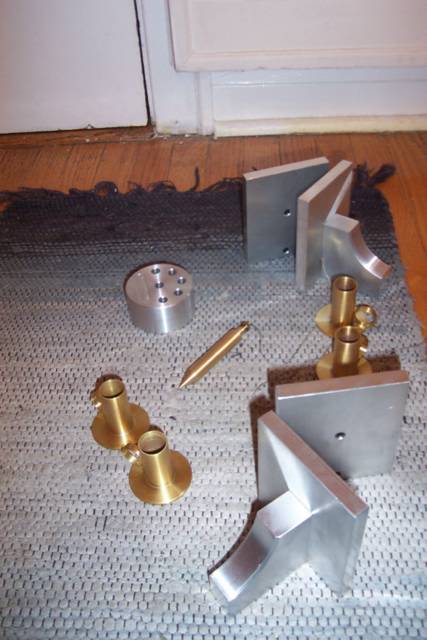
Those are the pieces I made in the machine shop class. Two sets of bookends, four candle-stick holders, a plumb bob, and a paperweight/pencil holder. The silvery ones are aluminum, and the goldish ones are brass. We used a grinder, a horizontal band saw, a vertical band saw, a milling machine, and an oxyacetalene torch, to solder the tubes on the candlestick holders to their bases. It was not, technically, welding. But I did have to light the torch myself.
One of my bookends has an extra set of holes on the bottom. That's because, in trying to make the holes threaded so that I could put a screw in them, I accidentally broke a tap off in one of them. Also, one of the ring-shaped handles on the candlesticks is loose, because they too are held on by little screws, but I went too deep with the center drill and made my hole a little too big for the tap, so that there are only one or two threads in the hole, and the screw doesn't tighten well.
Still, I did better than I thought I would, considering my general level of clumsiness, and the inability to erase mistakes.
The guy who taught the class, Jim, is retiring this quarter after forty-something years of doing this. He has infinite patience and is good at explaing things without making you feel stupid, even if it's the fourth or fifth time you've asked. I feel lucky to have gotten to take the class with him.
All in all an experience I am grateful to have had. Even if I'm also grateful not to have to get up so early on Tuesday mornings anymore...
Monday, March 13, 2006
Neat Toy
Google maps pedometer. Useful for planning running or walking routes. Saturday, which was the nicest day in human history, I apparently went 5.6 miles, passing through three different municipalities as I did so. And one of them, I went all the way across, northern city limits to southern city limits. Yes, I was so impressed with myself that I had to post it on my blog. Pathetic, I know.
Still, that makes six different cities that I've run to or through from where I live, counting the one I start in. Chicago suburbs are so small.
Still, that makes six different cities that I've run to or through from where I live, counting the one I start in. Chicago suburbs are so small.
Monday, March 06, 2006
Long Days
Have I missed the weekend again? It just doens't feel like a weekend, is the problem. We worked yesterday.
Not an unsucessful day at work, actually, but to do anything these days takes longer and longer. First we have to turn on the cooling systems, and turn on, warm up, and tune the lasers. The tuning by itself can take all day, if we're unlucky.
Then align all the beams. This involves turning little screws on the back of the mirror mounts to change the angle. We have little targets set up to help us aim them correctly, irises which open when you're done with them to let the beams pass through. You have to start from the first mirror and go down the line, because if you're off by a small angle at the beginning, you'll miss mirrors entirely, toward the end. Also you have to make sure the beam is passing through all the different lenses and frequency shifters correctly. With so many beams and such long paths this always takes a couple of hours, and is tedious and repetative. If we have to change the beam paths for any reason, that can take an extra hour, or all day.
Parts of the beam are split off and sent through rubidium vapor cells, where, if they are at the right frequency, they are absorbed. We have electronics to adjust the lasers if the beam stops being absorbed (meaning that the laser frequency has drifted). But the electronics are complicated and don't always work. So getting that going can take a while too.
Meanwhile Ken has turned on the heaters that vaporize the rubium for the trap. Once everything is ready, assuming the vacuum pressure is okay, he opens the valve the releases the stream of rubidium vapor into the main vacuum chamber, and looks for a trap. He gets it every day now, reliably. But usually it starts out weak, and more alignment has to be done, and frequencies adjusted, before it will get big and bright.
Now we set up and mount any equipment we will be using for today's trial. Oscilloscopes, high voltage power supplies, light detectors, function generators, etc. Our post-doc does most of the electronic configuration. He's very good. We run lots of cables. More alignment, to make sure the light is getting onto the detectors.
Now, finally, we are ready to begin. We turn off the lights. (These detectors are sensetive. Room light could damage them.) I babysit my laser, changing the frequency when called upon, and making sure it doesn't change when it shouldn't. Ken babysits one of his lasers, and pours liquid nitrogen into the part of the vacuum system from time to time (this helps keep the pressure down.)
Lately his job also includes casting a shadow on the detector, which is picking up light sources we can't control. If he moves, it stops working.
Our post-doc watches the function generators and oscilloscopes and calls out instructions for us, parameters to change. Make this beam stronger. Make this beam weaker. Change the frequency. Scan the frequencies. Block this. Block that. Make the pulse longer. Make the delay shorter. He is looking for certain effects on the light the detector picks up. If he sees them, he saves a trace and calls us over to look.
Not every day is like this. Sometimes we are assigned other projects to work on. But this is the priority, and it always comes back to running this experiment in the trap.
Yesterday we saw an effect we were looking for -- two of our beams prevented one another from being absorbed by the rubidium in the trap. (This is supposed to be useful one day in making the basis elements of a quantum computer. If you don't exactly see how, join the club.)
Today... We get to do it all over again, probably.
Not an unsucessful day at work, actually, but to do anything these days takes longer and longer. First we have to turn on the cooling systems, and turn on, warm up, and tune the lasers. The tuning by itself can take all day, if we're unlucky.
Then align all the beams. This involves turning little screws on the back of the mirror mounts to change the angle. We have little targets set up to help us aim them correctly, irises which open when you're done with them to let the beams pass through. You have to start from the first mirror and go down the line, because if you're off by a small angle at the beginning, you'll miss mirrors entirely, toward the end. Also you have to make sure the beam is passing through all the different lenses and frequency shifters correctly. With so many beams and such long paths this always takes a couple of hours, and is tedious and repetative. If we have to change the beam paths for any reason, that can take an extra hour, or all day.
Parts of the beam are split off and sent through rubidium vapor cells, where, if they are at the right frequency, they are absorbed. We have electronics to adjust the lasers if the beam stops being absorbed (meaning that the laser frequency has drifted). But the electronics are complicated and don't always work. So getting that going can take a while too.
Meanwhile Ken has turned on the heaters that vaporize the rubium for the trap. Once everything is ready, assuming the vacuum pressure is okay, he opens the valve the releases the stream of rubidium vapor into the main vacuum chamber, and looks for a trap. He gets it every day now, reliably. But usually it starts out weak, and more alignment has to be done, and frequencies adjusted, before it will get big and bright.
Now we set up and mount any equipment we will be using for today's trial. Oscilloscopes, high voltage power supplies, light detectors, function generators, etc. Our post-doc does most of the electronic configuration. He's very good. We run lots of cables. More alignment, to make sure the light is getting onto the detectors.
Now, finally, we are ready to begin. We turn off the lights. (These detectors are sensetive. Room light could damage them.) I babysit my laser, changing the frequency when called upon, and making sure it doesn't change when it shouldn't. Ken babysits one of his lasers, and pours liquid nitrogen into the part of the vacuum system from time to time (this helps keep the pressure down.)
Lately his job also includes casting a shadow on the detector, which is picking up light sources we can't control. If he moves, it stops working.
Our post-doc watches the function generators and oscilloscopes and calls out instructions for us, parameters to change. Make this beam stronger. Make this beam weaker. Change the frequency. Scan the frequencies. Block this. Block that. Make the pulse longer. Make the delay shorter. He is looking for certain effects on the light the detector picks up. If he sees them, he saves a trace and calls us over to look.
Not every day is like this. Sometimes we are assigned other projects to work on. But this is the priority, and it always comes back to running this experiment in the trap.
Yesterday we saw an effect we were looking for -- two of our beams prevented one another from being absorbed by the rubidium in the trap. (This is supposed to be useful one day in making the basis elements of a quantum computer. If you don't exactly see how, join the club.)
Today... We get to do it all over again, probably.
Friday, March 03, 2006
The Power of Procrastination
I usually skip the speakers invited to talk by my department. I went a couple of times at first, but didn't find it rewarding. What these speakers are usually trying to do, is impress you. This means they use a lot of jargon and complicated graphs, and try to cram every result they've ever gotten into a one hour presentation. So you, as an audience member, have little to no chance of understanding what they're talking about at all. First, because they don't leave themselves time to explain the basics of their field. Second, because if you understood, you probably wouldn't be as impressed.
But last night I made an exception. Our whole lab attended a talk by Jorge Cham, the creator of Piled Higher and Deeper. You know, that comic strip I keep linking to.
He was great. It was like stand-up comedy with Powerpoint. Why don't more stand-up comedians use Powerpoint?
It was also thereputic. The thing about these comics is, we've all had these experiences. We've all been humiliated. We've all been ignored. We've all panicked. We've all been depressed. We've all been desperate. We've all felt like imposters. We've all considered quitting. According to a study Cham cited, 10% of us have considered suicide, and 1 in 200 actually attempted it. But we never see each other. We all think we're alone. The strip is nice because it tells us we're not. This guy we've never met knows exactly what we're going through. And he has thousands of readers. And he told us to look around the room and see how many people from our own university were laughing at these painful jokes, about being ignored by your advisor. About getting nowhere on your project. About having your ego crushed. About feeling overwhelmed.
At it was really nice to see all these people, to laugh with them. (Our post-doc was laughing so hard he could hardly breathe. That was nice to see.)
The title of the talk was "The Power of Procrastination." The message was -- yes, there are more important things you should be doing right now instead of attending this talk. Or watching TV. Or hanging out with your friends. Or being outside. But there will always be more important things you should be doing. You can't ever be finished with them. So you have no real choice but to put them off, if you ever want to do anything else. Try not to feel so guilty about it.
There were also some words of warning, now that he's graduated -- writing your dissertation will nearly kill you. You will not be happy with your work. And no one will ever read it. But the tenure process makes getting your degree look easy. This is why your professor has no sympathy for you. The academic job market sucks (but you don't have to stay in academia.) Get used to being rejected.
Man, for some reason when I say it, instead of him, this stuff sounds a lot less hilarious...
Interestingly, this morning, I followed a link from Word Munger to a page postulating that the reason there aren't more women in university science departments, is that jobs in university science departments are terrible. Their only attraction is as booby prizes in a sort of pissing contest, and women don't do pissing contests. Those jobs do seem more attractive if you are from China or India, where the standard of living is lower, but immigrant work forces are usually composed mainly of men. (In case you're wondering, Americans are traditionally the minority among physics grad students at major universities.) This sounds pretty cynical, but last night when Cham said the Big Question of grad student life was "Why?!" he got one of his biggest laughs. It's funny 'cause it's true.
Sounds like a depressing talk, but really, it put us in a good mood. It's just so reassuring to be told that it's not us, it's the system. We may feel like failures, but so does everyone else. And there's nothing wrong with a little procrastination. It was exactly what we needed to hear.
Thank you, Jorge Cham.
But last night I made an exception. Our whole lab attended a talk by Jorge Cham, the creator of Piled Higher and Deeper. You know, that comic strip I keep linking to.
He was great. It was like stand-up comedy with Powerpoint. Why don't more stand-up comedians use Powerpoint?
It was also thereputic. The thing about these comics is, we've all had these experiences. We've all been humiliated. We've all been ignored. We've all panicked. We've all been depressed. We've all been desperate. We've all felt like imposters. We've all considered quitting. According to a study Cham cited, 10% of us have considered suicide, and 1 in 200 actually attempted it. But we never see each other. We all think we're alone. The strip is nice because it tells us we're not. This guy we've never met knows exactly what we're going through. And he has thousands of readers. And he told us to look around the room and see how many people from our own university were laughing at these painful jokes, about being ignored by your advisor. About getting nowhere on your project. About having your ego crushed. About feeling overwhelmed.
At it was really nice to see all these people, to laugh with them. (Our post-doc was laughing so hard he could hardly breathe. That was nice to see.)
The title of the talk was "The Power of Procrastination." The message was -- yes, there are more important things you should be doing right now instead of attending this talk. Or watching TV. Or hanging out with your friends. Or being outside. But there will always be more important things you should be doing. You can't ever be finished with them. So you have no real choice but to put them off, if you ever want to do anything else. Try not to feel so guilty about it.
There were also some words of warning, now that he's graduated -- writing your dissertation will nearly kill you. You will not be happy with your work. And no one will ever read it. But the tenure process makes getting your degree look easy. This is why your professor has no sympathy for you. The academic job market sucks (but you don't have to stay in academia.) Get used to being rejected.
Man, for some reason when I say it, instead of him, this stuff sounds a lot less hilarious...
Interestingly, this morning, I followed a link from Word Munger to a page postulating that the reason there aren't more women in university science departments, is that jobs in university science departments are terrible. Their only attraction is as booby prizes in a sort of pissing contest, and women don't do pissing contests. Those jobs do seem more attractive if you are from China or India, where the standard of living is lower, but immigrant work forces are usually composed mainly of men. (In case you're wondering, Americans are traditionally the minority among physics grad students at major universities.) This sounds pretty cynical, but last night when Cham said the Big Question of grad student life was "Why?!" he got one of his biggest laughs. It's funny 'cause it's true.
Sounds like a depressing talk, but really, it put us in a good mood. It's just so reassuring to be told that it's not us, it's the system. We may feel like failures, but so does everyone else. And there's nothing wrong with a little procrastination. It was exactly what we needed to hear.
Thank you, Jorge Cham.
Subscribe to:
Posts (Atom)